


This article was automatically translated from the original Turkish version.
+1 More
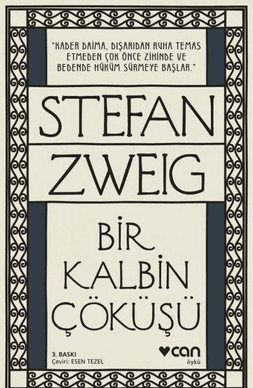
The Collapse of a Heart (Book)
Author(s) | Stefan Zweig | ||||||||
|---|---|---|---|---|---|---|---|---|---|
Translator(s) | Esen Tezel | ||||||||
Publisher(s) | Can Yayınları | ||||||||
Number of Pages | 56 | ||||||||
The Downfall of a Heart (Ger. Untergang eines Herzens) is one of the short stories written by Austrian author Stefan Zweig. First published in 1927, the work explores with psychological depth the emotional collapse and inner disintegration of an individual. Zweig’s distinctive narrative style, marked by his character analyses and psychological insights, is clearly evident in this piece. Through a simple plot structure, The Downfall of a Heart reveals the fragile aspects of human nature.
The narrative centers on the character of Mrs. C. (or Mrs. Blanka, as named in other editions). This mother has devoted her entire life to her son, making every decision in the past with his well-being as the sole guiding principle. Her son’s presence is the only element that gives meaning to her life. However, years later, when her son establishes his own life, distances himself, and even becomes indifferent toward her, her psychological equilibrium is shattered. The disappointment she experiences in response to his unexpected behavior triggers an irreversible inner collapse. The narrative is structured to observe this collapse deepen progressively until its final conclusion.
At the heart of the narrative lies the bond between mother and child. The mother character has fully identified herself with motherhood, dedicating her entire life to this role. Over time, this attachment has transformed into a dependency, pushing her individual identity into the background.
The ideals the woman holds about her son clash with reality, resulting in profound disillusionment. This conflict leads to the collapse of her personal world of meaning.
Throughout the story, the character’s inability to cope with loneliness and the emotional void caused by the withdrawal of her object of love are emphasized. This condition leads to the disruption of her psychological balance and a profound inner collapse.
Zweig’s narrative is constructed from a third-person perspective with deep psychological insight. Throughout the story, internal monologues and stream-of-consciousness techniques are employed to reveal the character’s inner world in intricate detail. The language is simple yet powerfully expressive, conveying a wide range of intense emotions. While the timeline follows a specific sequence of events, flashbacks provide information about the character’s past experiences and decisions.
Mrs. C. / Mrs. Blanka
The central character of the work. A self-sacrificing mother who has devoted her entire life to her son. She defines her identity entirely through the role of motherhood and has never lived outside this definition. When she fails to receive the attention and loyalty she expects from her son, she suffers a deep emotional collapse.
The Son
This unnamed character occupies the center of the mother’s life. He grows up, becomes independent, and fails to meet his mother’s emotional expectations. His behavior is the primary catalyst for her psychological collapse. Throughout the narrative, the son is perceived almost exclusively through the mother’s perspective.
Zweig, Stefan. Bir Kalbin Çöküşü. Trans. Esen Tezel. Can Yayınları, 2018.

The Collapse of a Heart (Book)
Author(s) | Stefan Zweig | ||||||||
|---|---|---|---|---|---|---|---|---|---|
Translator(s) | Esen Tezel | ||||||||
Publisher(s) | Can Yayınları | ||||||||
Number of Pages | 56 | ||||||||
No Discussion Added Yet
Start discussion for "The Collapse of a Heart (Book)" article
Subject
Theme
Mother-Son Relationship and Attachment
Idealism and Disillusionment
Loneliness and Inner Destruction
Style
Characters