


This article was automatically translated from the original Turkish version.

When you open your eyes in any neighborhood of Istanbul in the morning, you do not actually begin the day alone. The sound of your neighbor’s curtains being drawn across the opposite building, the clink of a teaspoon against a teacup from the aunt below, or the morning alarm from the apartment next door all become part of your own morning. The city is so tightly packed, the houses so closely pressed together, that walls are less like concrete barriers and more like thin, sound-permeable gauze. Indeed, the concept of privacy loses its dictionary meaning in this city, yielding instead to an involuntary shared sense of communal life.
Balconies are the most tangible expression of this closeness. When you step out onto your balcony to get some air, you find yourself suddenly inside your neighbor’s living room directly opposite. The distance between your balcony and theirs is sometimes so minimal that you do not need to shout to ask for something; a whisper of “Do you have salt?” feels as if your neighbor will extend their hand across the gap. The silent struggle to avoid eye contact while sipping tea on the balcony in the evening is one of the most refined skills of Istanbul’s residents. Gazes are constantly diverted to the sky, the far end of the street, or the phone screen; because looking at someone just a few meters away feels like intruding into their life without permission.
This extreme proximity gradually narrows our mental space. Even when you take a large step, you live as if you are stepping into someone else’s territory. You cannot move freely even within your own home; you hesitate to walk loudly late at night or to turn up the television volume by just a fraction. Instead of moving freely in your own living space, you take every step throughout the day with the awareness of dozens of people around you. The streets are no different; while walking along narrow sidewalks shadowed by buildings, avoiding shoulder-to-shoulder collisions becomes a reflex.
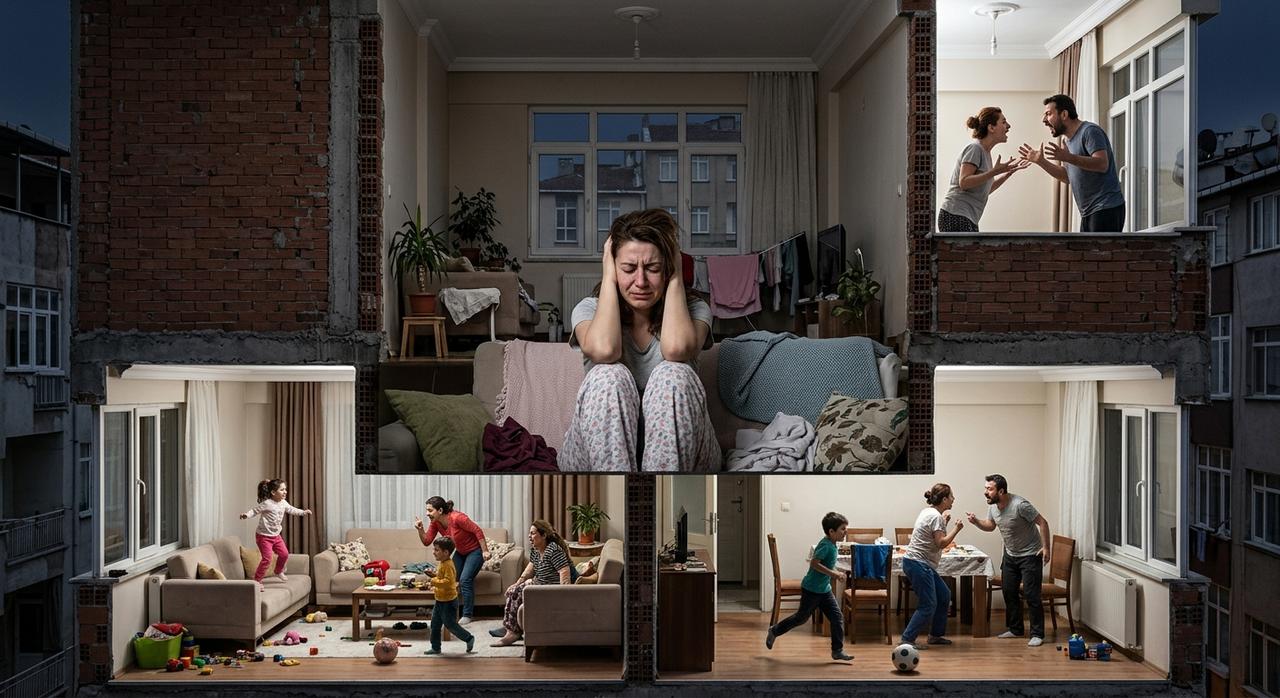
Komşu Seslerinden Rahatsızlık Duyan Bir Ev Sahibinin Durumu (Yapay Zeka ile Oluşturulmuştur.)
This sense of confinement directly reflects on the psychology of Istanbul’s residents and the city’s culture of living. On one hand, people grow agitated and irritable from this excessive closeness; on the other, they strangely cling to one another. You worry about the neighbor across the window whose light has not been on for a week, and you memorize the routines of someone you have never spoken to. The city gives you no breathing room on one side, yet never allows you to be truly alone. Just as buildings lean against each other, people unconsciously learn to survive by holding on to one another within this confinement.
This interwoven existence transforms into small rituals that appear at every hour of the day. For example, when you open your window in the morning to let in fresh air, what enters is rarely a clean breeze but rather the scent of sautéed onions rising from the kitchen opposite or the fragrance of detergent from the laundry of the neighbor below. Even ventilating your home in Istanbul becomes a collective act; while refreshing the air of your own apartment, you inhale the shared atmosphere of the neighborhood.
The extreme permeability of personal boundaries within homes has rewritten the behavioral code of city dwellers. Notice this: Istanbul residents wear a kind of invisible armor even inside their own homes. When evening lights turn on, the shadows behind curtains become theatrical stages, yet everyone pretends not to look. You know by heart when the person across the window goes to sleep, who argues and who laughs; yet when you meet them on the street, you offer only a slight nod and continue walking as if you know nothing. This is an unwritten social contract of politeness born from living in dense, confined spaces: “I see you, I hear you, but I act as if I do not.”
This restriction of personal space does not end with physical walls; it slowly erodes the sense of inner spaciousness. Our eyes need to see the horizon, yet in Istanbul, no matter which way you turn, your gaze strikes another building’s facade, another windowed wall. Even the sky becomes a narrow strip between rooftops. Failing to see the horizon gradually makes people, without realizing it, more impatient, more alert, and more inward. Living between buildings so close that you could touch them if you stretched out your hand forces city dwellers into a constant reflex of self-protection.
At the same time, these old and new buildings leaning against each other seem to share the city’s burdens. When the steam from a soup cooking in one home hits the window of another, the word loneliness finds no true meaning here. Everyone is as cramped, as restricted, yet simultaneously all of us are together within the same narrow circle. Istanbul’s dense fabric steals a little of our freedom while forcing us to rely on each other’s presence, sustaining the city’s endless vitality.
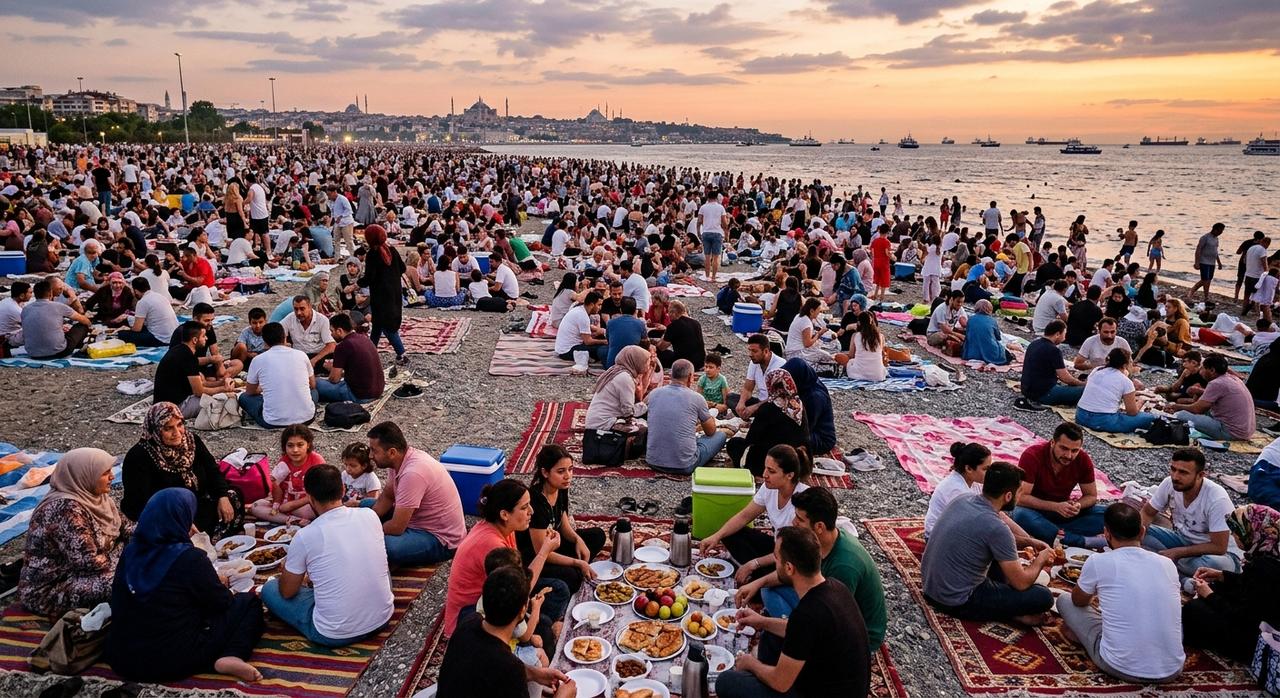
Sahil Alanında Kısıtlanmış Olan Sosyal Mesafe Düzeni (Yapay Zeka ile Oluşturulmuştur.)
Even when you pass behind closed doors, the intense closeness you feel on the street follows you. Even in what you consider the most private corners of your home—the bathroom or bedroom—the city accompanies you. Due to echoes rising through ventilation gaps, every detail from the sound of toothbrushing to the flush of a toilet becomes part of a shared melody. You think you are alone in your home, yet in reality you move in sync with the rhythms of dozens of other lives.
This condition has completely transformed how Istanbul’s residents relate to space. Unable to find wide open areas outside, people must calculate every square centimeter of their own homes. Because of facing balconies, sheer curtains remain closed all day and night. Allowing sunlight, natural light, and openness into the home becomes a luxury. Even when arranging chairs and tables, people act with the anxiety of “Will I be visible from across?” or “Will I make eye contact with my neighbor as they pass by?”
Precisely for this reason, the only refuge left for city dwellers is parks, waterfronts, or any green space they can find. They seek in the city’s open areas the freedom of movement and breath they cannot find at home or on the street. But when they arrive there, they encounter the same scene; because everyone in the city is trying to escape this same feeling of confinement. Picnic blankets laid side by side on the shore are merely an outdoor version of the tightly packed living found inside homes.
Ultimately, these shrinking living spaces have become a method ingrained in the identity of Istanbul’s residents. Observing and being so close to others’ lives makes people both more tolerant and more protective. The narrower our space becomes, the more essential it is to adapt to the rhythm of this city and to carve out tiny islands of personal freedom within those minuscule square meters. This is the quietest yet strongest skill of being an Istanbulite.
This is why living in Istanbul is an art of mental adaptation. Over time, people attempt to transcend the physical constraints by expanding their inner worlds. While the noisy, tightly packed world outside spills over from building facades, you construct within a small corner of your home an abstract space of openness. Putting on headphones to drown out the noise of neighbors or placing a single potted flower by the window to alter your perspective is a quiet act of resistance against confinement.
I must emphasize, based on urban sociology courses and my own in-depth research on this subject, that behind this confinement lies a rent-driven municipal governance model that disregards the city’s identity and the quality of human life. For years, zoning permits have been granted with the logic of “let’s squeeze out one more apartment,” reducing plot sizes to the minimum. Municipalities turning a blind eye to additional floors, issuing permits without considering street widths, and treating neighbor-to-neighbor distances as mere paper details have shaped the city’s fate. When urban planning abandoned a human-centered approach in favor of a rent-based, square-meter calculation model, this terrifying density became inevitable.
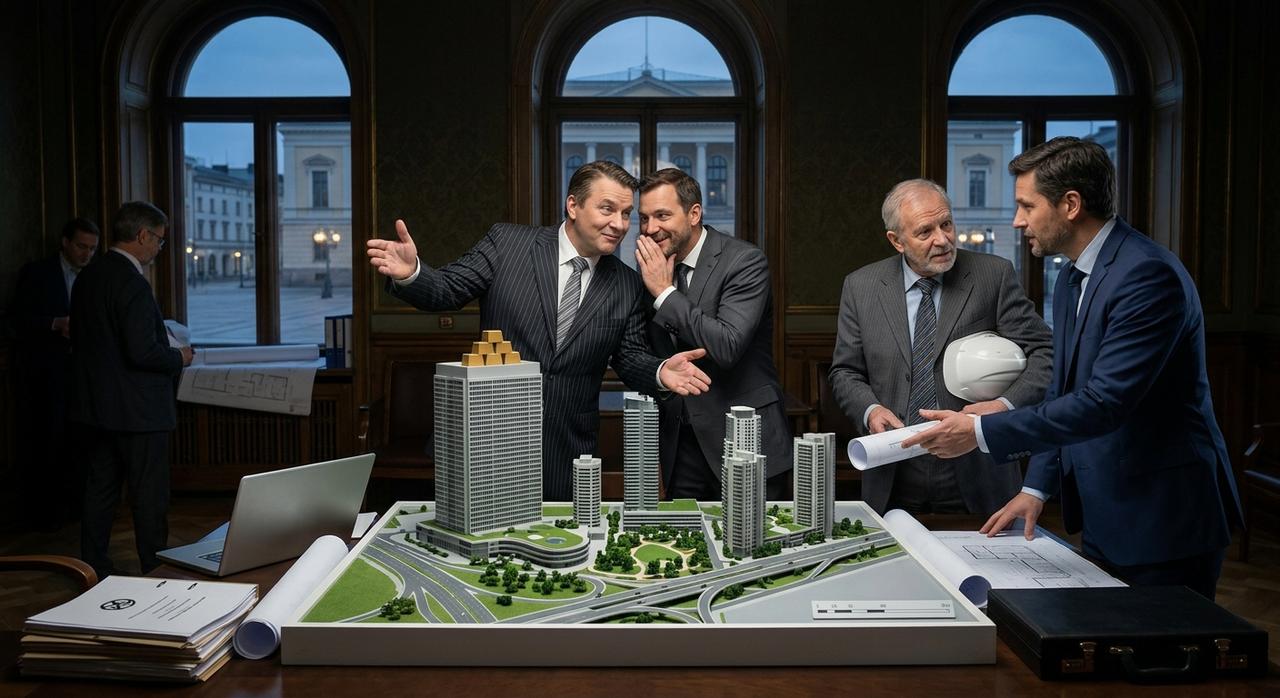
Rant Odaklı Belediyecilik Anlayışının Arka Planı (Yapay Zeka ile Oluşturulmuştur.)
Another painful aspect is the role of architects and urban planners who signed off on this scenario. Projects drawn without considering how people would breathe inside the buildings or what their windows would look out upon have turned the city into an uninhabitable labyrinth. These structures, devoid of aesthetics, daylight, ventilation, and above all privacy, have risen like piles of concrete. Instead of embracing an architecture respectful of nature and humanity, a design philosophy that capitulated to developers’ demands for “maximum apartments” has trapped us in these soulless housing units where we are forced to see what our neighbors eat.
In conclusion, the spatial claustrophobia we experience today is a deliberate consequence of unchecked development, flawed urban planning decisions, and visionless architecture. As long as municipalities and decision-makers see the city only as lines on a map of land parcels, we will remain imprisoned in living spaces where we fear opening our windows and dread making eye contact on our balconies.
Istanbul reminds us once again: In a city that is not properly planned and does not grant people space to move, no matter how many luxurious buildings you erect, at the end of the day all you are left with is a dense, confined crowd forced to live in extreme proximity.