


This article was automatically translated from the original Turkish version.
+2 More
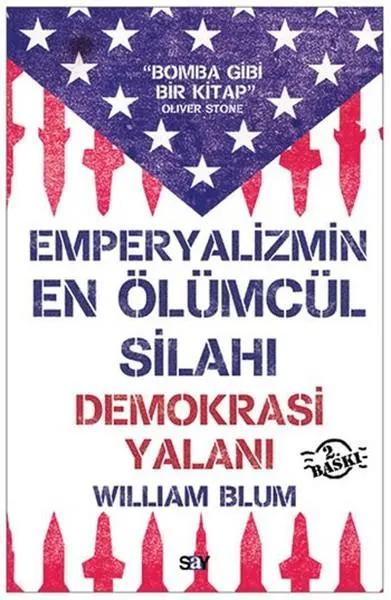
The Most Deadly Weapon of Imperialism: The Lie of Democracy (Book)
Author(s) | William Blum | ||||||||
|---|---|---|---|---|---|---|---|---|---|
Publication Year | 2004 | ||||||||
Publisher(s) | Say Yayınları | ||||||||
Translator(s) | Ekin Duru | ||||||||
Number of Pages | 408 | ||||||||
The Deadliest Weapon of Imperialism: The Lie of Democracy is a socio-political work by William Blum, published by Say Yayınları. It provides an in-depth analysis of the cultural, psychological, and social impacts of imperialism. The book examines not only the military and economic power of imperialism but also its cultural and ideological hegemony. A central theme is how the concept of democracy has been manipulated by imperialist powers to pacify societies.
William Blum is an American writer, sociologist, and researcher. He is best known for his writings on imperialism, post-colonialism, and international relations. Through his analysis of imperialist policies, Blum thoroughly investigates the psychological, cultural, and social destruction these policies inflict on individuals and communities. The Deadliest Weapon of Imperialism: The Lie of Democracy is one of Blum’s most well-known works and offers a critical analysis of the relationship between imperialism and democracy. Blum’s writings provide a critical perspective on how imperialist powers construct cultural hegemony and transform societies.
The book explores how imperialism in the modern world has transformed into a tool of cultural and psychological occupation. The author discusses how the concept of democracy has been used by imperialist powers as a mechanism to alter the internal structures of societies. Through detailed examination of the social, cultural, and ideological dimensions of imperialism, the book presents examples of how neo-imperialist forms operate in today’s world. Concepts such as cultural hegemony, identity loss, and social alienation are central to the analysis.
The author examines the cultural hegemony of imperialism and its psychological effects on societies. It investigates how concepts such as democracy and freedom have been manipulated by imperialist powers and how this manipulation has reshaped societal structures. The methods through which cultural dominance is established and their long-term effects on collective identities are also discussed.
The book investigates how imperialism leads to identity erosion in colonized societies. The efforts of imperialist powers to establish cultural hegemony cause populations to become alienated from their own origins and lose their sense of belonging. This theme delves deeply into the methods used by colonial powers to sever local populations from their native cultures and impose foreign values.
Democracy is defined not merely as a political tool used by imperialist powers but as a “lie functioning as a mechanism of social control.” Democratic values have been shaped by imperialist states to facilitate governance and manipulation of populations. The author questions imperialist interventions carried out under the banner of democracy and the coercive measures justified in the name of freedom.
In addressing modern imperialism, the book discusses the transition from classical colonialism to neo-imperialism. It analyzes how globalization, economic globalisation, and social media have strengthened the reach of imperialism. Social media and global media institutions are presented as key instruments in the dissemination of imperialist ideology.
1000Kitap. "Emperyalizmin En Ölümcül Silahı: Demokrasi Yalanı." Accessed April 28, 2025. https://1000kitap.com/kitap/emperyalizmin-en-olumcul-silahi-demokrasi-yalani--94030.
Blum, William. Emperyalizmin En Ölümcül Silahı: Demokrasi Yalanı. Çev. Ekin Duru. İstanbul: Say Yayınları, 2004.
SDE. "Emperyalizmin En Ölümcül Silahı: Demokrasi Yalanı." SDE. Accessed April 28, 2025. https://www.sde.org.tr/emperyalizmin-en-olumcul-silahi-demokrasi-yalani-konu-632.

The Most Deadly Weapon of Imperialism: The Lie of Democracy (Book)
Author(s) | William Blum | ||||||||
|---|---|---|---|---|---|---|---|---|---|
Publication Year | 2004 | ||||||||
Publisher(s) | Say Yayınları | ||||||||
Translator(s) | Ekin Duru | ||||||||
Number of Pages | 408 | ||||||||
No Discussion Added Yet
Start discussion for "The Deadliest Weapon of Imperialism: The Lie of Democracy (Book)" article
Subject and Content
Thematic Structure
Cultural Impacts of Imperialism
Identity and Belonging
Democracy and Imperialism
Modern Imperialism