

This article was automatically translated from the original Turkish version.
Original Name(s) | The Beguiling of Merlin | ||||||||
|---|---|---|---|---|---|---|---|---|---|
Dimension(s) | 186.7 × 110.5 cm | ||||||||
Collection | National Museums Liverpool | ||||||||
Model | Maria Zambaco for the figure of Nimue | ||||||||
Location | Room 10 Lady Lever Art Gallery | ||||||||
Depicted Figures | Merlin, Nimue (Vivien) | ||||||||
Technique | Oil on canvas | ||||||||
Artist | Sir Edward Coley Burne-Jones | ||||||||
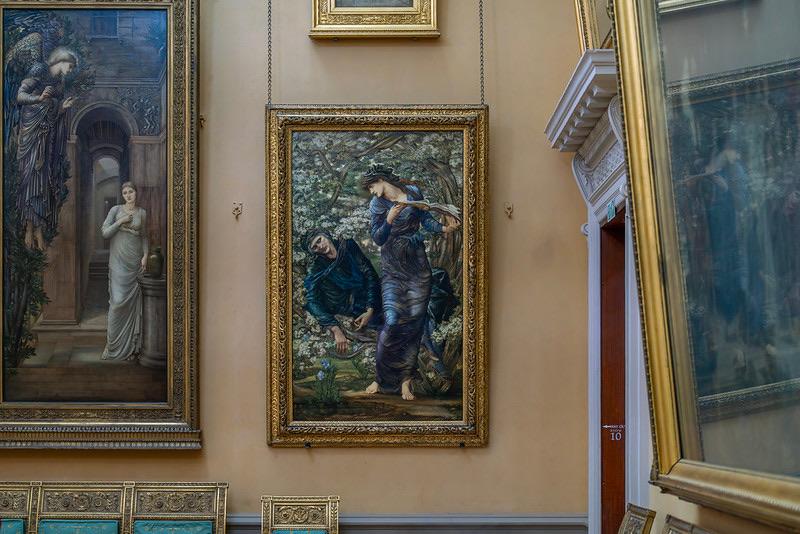
The Beguiling of Merlin, a monumental oil painting, is regarded as one of the exemplars of the Arthurian narrative tradition in 19th-century British painting. Completed by Sir Edward Coley Burne-Jones between 1870 and 1874, the work depicts the relationship between Merlin and Nimue (Vivien) from Arthurian legend and is currently held in the collection of the Lady Lever Art Gallery, part of Liverpool National Museums.
Edward Burne-Jones, The Beguiling of Merlin (Smarthistory)
The painting is based on the story of Merlin and Nimue (Vivien), a tale also treated in Alfred Tennyson’s Idylls of the King. According to legend, the magician Merlin, driven by his love for Nimue, teaches her his arcane knowledge; Nimue then uses this knowledge to enchant Merlin and render him powerless. In Burne-Jones’s composition, Merlin is depicted as entranced in a deep slumber or magical bondage, while Nimue emerges as the dominant figure of the scene.

Merlin's Beguiling (Walker Art Gallery / Art UK)
The creation of the work was long and intermittent. Burne-Jones began initial studies around 1870 but was forced to abandon the project due to the pigments failing to adhere properly to the canvas. At the urging of his patron Frederick Leyland, the artist resumed work in 1873. Although the painting bears the date 1874, it underwent further modifications before being exhibited in 1877. During this period, numerous preparatory drawings and drapery studies were produced, highlighting the artist’s heightened attention to figure and fabric.
In the composition, the figures and the dense vegetation of the setting form a tightly integrated whole. Nimue’s long, undulating hair and serpentine posture create an iconography that evokes both allure and menace. The hawthorn trees in the background allude to the enchanted forest in Arthurian legend where Merlin is imprisoned. The contrast between Nimue’s almost Medusa-like stance and Merlin’s limp, passive body intensifies the psychological tension of the scene. These features demonstrate how Burne-Jones elevated the Pre-Raphaelite aesthetic to a symbolic and poetic plane.
The figure of Nimue in the painting is widely believed to have been inspired by Maria Zambaco, with whom Burne-Jones had an emotionally intense relationship during the 1860s and 1870s. In this context, the painting is not merely a depiction of a mythological scene but also an indirect reflection of Burne-Jones’s personal emotional tensions. The power embodied by Nimue and the passivity of Merlin are read through this biographical lens.
The Beguiling of Merlin was first exhibited at the inaugural show of the Grosvenor Gallery in 1877 and attracted considerable attention from contemporary critics. William Michael Rossetti described Nimue as “dark but alluring,” while Henry James praised the technical mastery of the work. The painting was also displayed at the 1878 Paris Exposition Universelle, contributing to Burne-Jones’s international recognition. Critics particularly emphasized the symbolic power and the harmony between figure and background.
The painting was initially acquired by Frederick Leyland and later purchased by William Hesketh Lever, who donated it to the Lady Lever Art Gallery. Today it is preserved and displayed within the collection of Liverpool National Museums.
Art UK. "The Beguiling of Merlin." Accessed January 26, 2026. https://artuk.org/discover/artworks/the-beguiling-of-merlin-102461.
Liverpool National Museums. "The Beguiling of Merlin." Lady Lever Art Gallery. Accessed January 26, 2026. https://www.liverpoolmuseums.org.uk/artifact/beguiling-of-merlin.
The Edward Burne-Jones Catalogue Raisonné. "The Beguiling of Merlin (Nzcz)." Accessed January 26, 2026. https://www.eb-j.org/browse-artwork-detail/Nzcz.
Zucker, Steven and Beth Harris. "Edward Burne-Jones, The Beguiling of Merlin." Smart History. Accessed January 26, 2026. https://smarthistory.org/edward-burne-jones-beguiling-merlin/.
Original Name(s) | The Beguiling of Merlin | ||||||||
|---|---|---|---|---|---|---|---|---|---|
Dimension(s) | 186.7 × 110.5 cm | ||||||||
Collection | National Museums Liverpool | ||||||||
Model | Maria Zambaco for the figure of Nimue | ||||||||
Location | Room 10 Lady Lever Art Gallery | ||||||||
Depicted Figures | Merlin, Nimue (Vivien) | ||||||||
Technique | Oil on canvas | ||||||||
Artist | Sir Edward Coley Burne-Jones | ||||||||
No Discussion Added Yet
Start discussion for "The Deception of Merlin (Painting)" article
Subject and Mythological Sources
Production Process
Iconography and Style
Biographical Context
Critical Reception and Exhibitions
Provenance and Current Status