


This article was automatically translated from the original Turkish version.
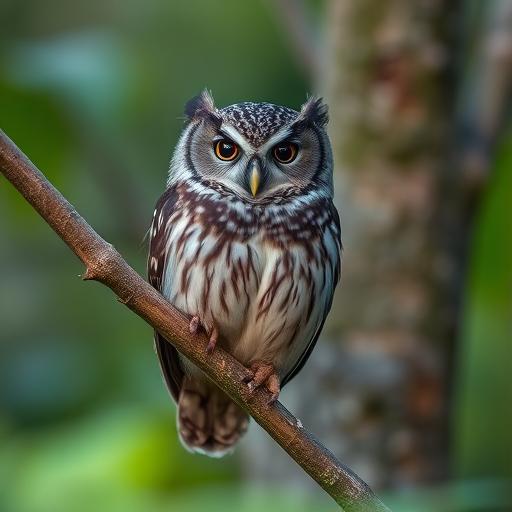
The Forest Owlet is a small owl species belonging to the family Strigidae. It was first described by Allan Octavian Hume in 1873. Due to its long period of being unobserved, it was presumed extinct until it was rediscovered in Maharashtra in 1997 by Pamela Rasmussen.
This species inhabits dry deciduous forests in central India, particularly in the states of Maharashtra, Madhya Pradesh, Chhattisgarh, and Gujarat. Its presence has been confirmed in areas such as the Toranmal and Taloda forests, the Melghat Tiger Reserve, and the Purna Wildlife Sanctuary.

Visual representation of the Forest Owlet (Heteroglaux blewitti). (Generated by artificial intelligence.)
Unlike other owl species, the Forest Owlet is active during the day and at twilight. Its diet includes lizards, amphibians, small birds, rodents, and large invertebrates.
According to the IUCN Red List, the Forest Owlet is classified as Endangered (EN). The total number of mature individuals is estimated to be between 250 and 999. Major threats include deforestation, illegal logging, expansion of agricultural land, and dam construction.

Visual representation of the Forest Owlet (Heteroglaux blewitti). (Generated by artificial intelligence.)
The Forest Owlet is a significant species in terms of India’s biological diversity. Its limited distribution and small population size make its conservation even more critical. Enhanced conservation efforts and habitat protection are vital for the survival of this rare species.
BirdLife International. "Forest Owlet Athene Blewitti Species." BirdLife DataZone. Accessed May 10, 2025. https://datazone.birdlife.org/species/factsheet/forest-owlet-athene-blewitti
Birds of India. "Heteroglaux blewitti Hume, 1873 - Forest Owlet." Accessed May 10, 2025. https://www.birdsofindia.org/heteroglaux-blewitti
EDGE of Existence. "Forest Owlet | Heteroglaux blewitti." Accessed May 10, 2025. https://www.edgeofexistence.org/species/forest-owlet/
The Peregrine Fund. "Forest Owlet." Accessed May 10, 2025. https://peregrinefund.org/explore-raptors-species/owls/forest-owlet

No Discussion Added Yet
Start discussion for "The Forest Owlet (Heteroglaux blewitti)" article
Habitat and Distribution
Behavior and Diet
Conservation Status and Threats
Conclusion