


This article was automatically translated from the original Turkish version.
+2 More
The Great Divergence is an economic history concept that describes the socio-economic differentiation between the European economy and the rest of the world, notably China and India, which emerged with global imperialism and became pronounced during the Industrial Revolution. The term gained widespread academic recognition through Kenneth Pomeranz’s 2000 book The Great Divergence: China, Europe, and the Making of the Modern World Economy, in which it was first used in its modern sense. The central question of the debate is why this economic and technological breakthrough occurred in Europe rather than in major power centers such as China, India, or the Ottoman Empire.
While the concept generally refers to intercontinental divergence, the term “The Little Divergence” is used to describe disparities within continents. In this context, the rise of Northwestern Europe (England and the Netherlands) above Mediterranean Europe (Italy and Spain) is termed “The Little Divergence in Europe,” while Japan’s surpassing of China and India is called “The Little Divergence in Asia.”
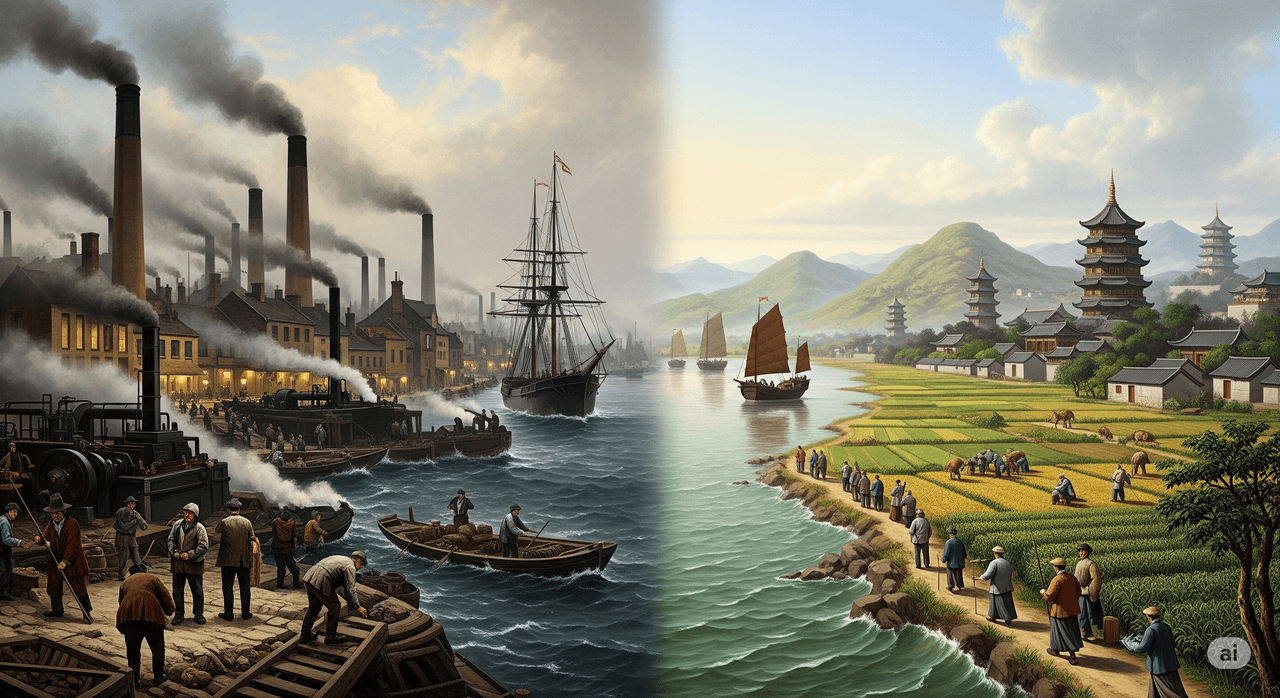
The West Industrialized, the East Remained Traditional (Generated by Artificial Intelligence)
Debates on the Great Divergence focus on whether significant differences in prosperity existed between Europe and the advanced regions of Asia before the Industrial Revolution, and when and through which factors these disparities emerged. Pomeranz and a group of historians known as the California School argue that until the 1800s, advanced regions of China such as the Yangtze Delta were economically no less developed than the wealthiest regions of Europe like England and the Netherlands, and in some respects even more advanced. According to this view, the divergence emerged largely in the 19th century as a consequence of contingent and accidental factors.
In contrast, more recent studies based on historical national accounting data indicate that the roots of divergence date back to the late Middle Ages and were already clearly evident in the early modern period. According to this perspective, per capita income differences between Europe and Asia existed long before 1800. For instance, historical GDP data reveal that Italy in the 14th century and the Netherlands in the 16th century had higher per capita incomes than China. During this period, although Japan followed a growth trajectory similar to that of Northwestern Europe, it began from a lower base and grew more slowly, so the gap continued to widen.
Hypotheses explaining the Great Divergence are generally classified under two main categories: natural factors and cultural-institutional factors. Analyses examine how these factors, either individually or in interaction, led to divergent developmental paths.
These approaches emphasize the decisive role of geography, biology, climate, and resource endowments in long-term economic development.
Thinkers such as Jared Diamond argue that the geographical structure and biological diversity of continents shaped historical development. The east-west orientation of Eurasia facilitated the spread of agriculture, animal husbandry, technology, and diseases, whereas the north-south orientation of the Americas hindered such diffusion. Additionally, Europe’s fragmented geography is said to have fostered continuous political competition that incentivized innovation, while China’s unified geography led to centralized and non-competitive empires.
Pomeranz identifies the proximity of coal deposits to industrial regions and the resources obtained from colonies—particularly in the Americas—which he terms “ghost acres”—as critical factors enabling Britain’s Industrial Revolution. Coal overcame the energy bottleneck, while colonial products such as cotton and sugar alleviated ecological pressures on European land and labor resources.
The role of major epidemics such as the plague in the divergence has also been examined. The Black Death of the 14th century significantly reduced Europe’s population, particularly in Northwestern Europe, leading to a permanent increase in per capita income. Population decline raised the value of labor and provided an escape from the Malthusian trap. In contrast, population declines in China during the same period did not produce similar effects.
Stephen Broadberry argues that the predominantly pastoral nature of Northwestern European agriculture directed the region toward a capital-intensive and high-value-added production model. This mode of production later extended to industry and services, deepening the divergence. Asian agriculture, by contrast, was primarily labor-intensive.
These approaches focus on the role of human-made institutions such as property rights, political structures, legal systems, religion, ideology, and modes of thought.
Figures such as Karl Marx, Daron Acemoglu, and James Robinson identify secure private property rights, a neutral judicial system based on the rule of law, and a free market economy as fundamental causes of Europe’s rise. They argue that such “inclusive institutions” encouraged innovation and investment, whereas societies dominated by “extractive institutions” experienced stagnation. The California School challenges this view by demonstrating that private property rights and efficient markets were also widespread in early modern China.
The nature of political institutions is seen as a key cause of divergence. One view holds that in countries like England and the Netherlands, the limitation of executive power through parliaments protected merchant class property rights and supported economic development. Another view contends that the crucial factor was the emergence of a centralized and powerful state capable of integrating markets, efficiently collecting taxes, and enforcing property rights.
The Dependency School and neo-Marxist approaches argue that Europe’s enrichment stemmed less from internal dynamics than from the exploitation of the rest of the world. Slavery, plantation economies, and the transfer of surplus value from colonies provided the capital accumulation necessary for the Industrial Revolution. According to this view, Europe’s development and the underdevelopment of the rest of the world are two sides of the same process.
Max Weber’s thesis on the “Protestant Ethic” claims that Protestantism, especially Calvinism, fostered a spirit of capitalism by encouraging hard work, thrift, and a rational way of life. According to Weber, this type of “instrumental rationality” permeating all spheres of life was unique to the West. The Scientific Revolution and the Enlightenment are also emphasized for introducing new methods of knowledge production and dissemination that prepared the ground for technological breakthroughs.
John Hajnal’s “European Marriage Pattern” posits that late marriage among women in Northwestern Europe limited fertility and enabled greater investment in human capital. Japan exhibits an intermediate model, while in China and India, marriage ages were lower. Additionally, the “industrious revolution” observed in both Europe and Japan refers to people working longer hours to acquire new consumer goods, highlighting the role of labor supply flexibility in the divergence.
The position of the Ottoman Empire in debates on the Great Divergence has generally received less attention. Existing studies reach conflicting conclusions. Şevket Pamuk’s research indicates that income levels in the Ottoman Empire were behind those of Northwestern Europe as early as the 16th century. Factors cited for the Ottoman Empire’s lagging behind in the divergence include the incomplete institutionalization of private property rights, the state’s intervention in markets based primarily on provisioning principles, and its adoption of a liberal foreign trade policy in contrast to the mercantilist and protectionist policies of European states. Some Western authors explain the Ottoman system using orientalist concepts such as “plunder machine” or “despotism,” while others criticize these approaches, arguing that the Ottoman Empire was more advanced than Europe in its early periods and that divergence was the result of more complex geopolitical processes.
The Great Divergence remains one of the most fundamental debates in economics and world history. The work of the California School revitalized the debate by challenging Eurocentric assumptions and highlighting the importance of regional differences. However, recent studies based on quantitative data show that the origins of divergence date back much earlier than the 19th century.
The literature increasingly emphasizes the necessity of holistic approaches that consider the long-term interaction of diverse natural and institutional factors rather than reducing divergence to a single cause. The debates underscore the need to bridge the gap between economic theory and historical data and to develop more balanced analyses grounded in the historical realities of non-Western societies. No definitive conclusion has been reached, and research continues due to the multitude and complexity of contributing factors.
Ayyıldız, Yahya. "Büyük Ayrışma Tartışmasındaki Başlıca Hipotez ve Teoriler." *Uluslararası Yönetim İktisat ve İşletme Dergisi* 20, no. 3 (2024): 803–829. Accessed July 5, 2025. https://dergipark.org.tr/en/pub/ijmeb/issue/87316/1436714.
Berlingieri, Giuseppe, Patrick Blanchenay, and Chiara Criscuolo. *The Great Divergence(s)*. CEP Discussion Paper No. 1488. London: London School of Economics and Political Science, Centre for Economic Performance, 2017. Accessed July 5, 2025. https://cep.lse.ac.uk/_new/publications/abstract.asp?index=5476.
Broadberry, Stephen. *Accounting for the Great Divergence*. Economic History Working Papers No. 184/13. London: London School of Economics and Political Science, 2013. Accessed July 5, 2025. https://eprints.lse.ac.uk/54573/.
Parthasarathi, Prasannan. "Review of *The Great Divergence*, by Kenneth Pomeranz." *Past & Present*, no. 176 (2002): 275–293. Accessed July 5, 2025. http://www.jstor.org/stable/3600733.

No Discussion Added Yet
Start discussion for "The Great Dissolution" article
Definition and Scope
Theoretical Approaches and Key Factors
Natural Factors
Geography and Biogeography
Availability and Access to Resources
Disease and Demography
Agricultural Structure
Cultural-Institutional Factors
Property Rights and Markets
The Role of the State and Political Structures
Imperialism and Colonialism
Religion, Science, and Rationality
Family Structure and Labor Supply
The Great Divergence and the Ottoman Empire
Evaluation