

 Recently Added:
This article was automatically translated from the original Turkish version.
The Hague Group’s Bogotá Declaration is a multilateral joint statement issued following a ministerial-level meeting held in Bogotá, the capital of Colombia, on 15–16 July 2025. The declaration outlines international measures to be taken against Israel’s military activities in the Gaza Strip. It was drafted by states convened under the umbrella of The Hague Group. The purpose of the summit was to ensure the application of international law in response to Israel’s actions in occupied Palestinian territories, to take concrete steps against ongoing human rights violations and allegations of genocide in Gaza, and to emphasize states’ obligations on this issue.
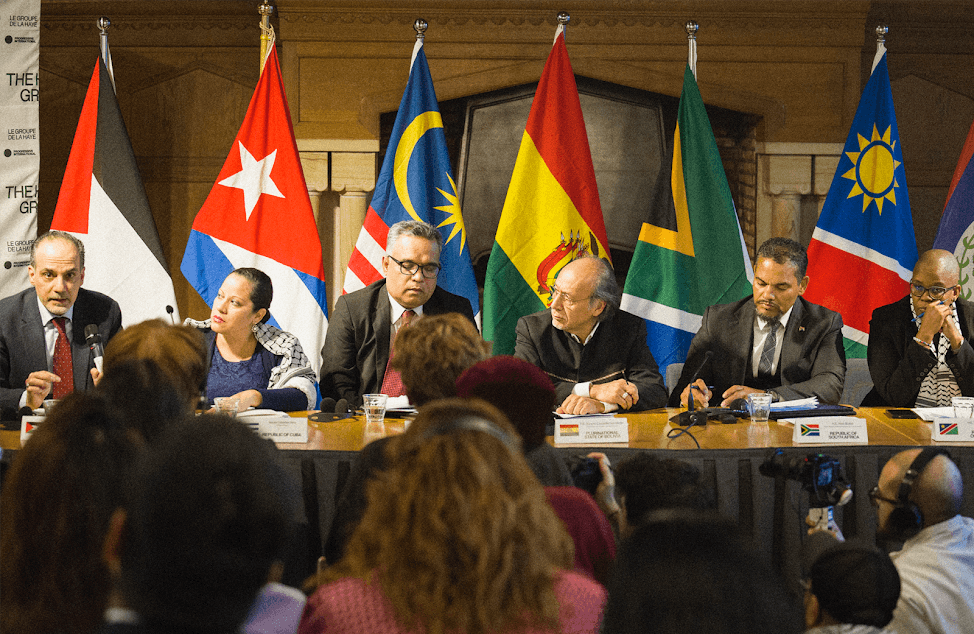
The Hague Group’s Bogotá meeting, 15–16 July 2025 – (Al Jazeera)
The Hague Group is a platform established on 31 January 2025 by Bolivia, Colombia, Cuba, Honduras, Malaysia, Namibia, Senegal and South Africa, aiming to foster collective state action in response to violations of international law. The group’s founding rationale was explicitly stated as ensuring the fulfillment of diplomatic and legal responsibilities concerning the severe human rights violations occurring in Palestinian territories.
The Bogotá Declaration sets out concrete measures for international cooperation and accountability in response to violations of international law resulting from Israel’s military operations in the Gaza Strip since 2023. Within this framework, the declaration’s primary objective was to formally record, through a unified declaration, the legal and administrative steps states intend to take to halt Israel’s activities in occupied Palestinian territories.
The declaration identifies six key steps that participating states are expected to take to end violations of international law and ensure accountability, emphasizing that the implementation of these steps must be adapted within each state’s domestic legal framework. Although the declaration does not constitute a binding action plan, it carries the character of a set of recommendations and declarations within the context of collective measures against Israel.
The Hague Group’s Bogotá meeting took place on 15–16 July 2025 in Bogotá, Colombia. Co-chaired by South Africa and Colombia, the meeting brought together representatives from 30 countries. The summit was declared an emergency session under the theme “Preventing Genocide in Gaza,” aiming to highlight states’ collective obligations in response to Israel’s actions violating international law in occupied Palestinian territories.
The call for the meeting was based on provisions from the International Court of Justice’s advisory opinion of July 2024, which reminded states of their duty to put an end to Israel’s “unlawful situation.” Participating states declared their commitment to take concrete steps through legal and diplomatic means to prevent genocide, establish justice and ensure accountability.
Delegations attending the summit included Colombian President Gustavo Petro, South African officials, Palestine’s Permanent Representative to the United Nations Riyad Mansour, and foreign ministry representatives from numerous countries. In their speeches, participants emphasized that the situation in Palestine had created a significant turning point in the international community’s awareness, underscoring the necessity of collective action.
The Bogotá Declaration, issued by The Hague Group, contains a package of six measures intended to be taken against Israel’s actions in occupied Palestinian territories. These measures are defined as tools that states may implement in accordance with their national legislation and international obligations.
1. Prevention of Arms Transfers: A non-binding commitment was made to halt all military equipment, ammunition, military fuel and dual-use goods destined for Israel. States reserved the right to prevent the transit of vessels and vehicles carrying such goods within their jurisdictions.
2. Control of Ports and Territorial Waters: Articles 2 and 3 of the declaration state that vessels suspected of transporting arms or military equipment to Israel must be barred from entering territorial waters or ports. It was specified that such measures must be implemented in accordance with international law, including the United Nations Convention on the Law of the Sea (UNCLOS).
3. Review of Public Procurements and Corporate Oversight: The declaration calls for the reassessment of public contracts and agreements with companies directly benefiting economically from occupied Palestinian territories. It emphasized that states must scrutinize their commercial ties with actors profiting from Israel’s occupation.
4. Support for Universal Jurisdiction: The declaration supports the principle of universal jurisdiction, which enables judicial authority to be exercised beyond national borders in cases of serious international crimes—including genocide, war crimes and crimes against humanity. It specifies that participating states may prosecute such crimes through their own judicial systems or international courts.
5. Obligations Regarding Vessels Flying National Flags: The declaration states that vessels flying the flags of participating states and engaged in military shipments to Israel or serving this purpose may have their flags revoked by competent authorities to ensure full accountability.
6. Call for Political and Diplomatic Action: Participating states are urged to use political pressure mechanisms in international forums against Israel’s military actions, adopt firm positions against violations of international law and issue declarations of solidarity.
The signing process for the declaration is being carried out progressively. At the Bogotá meeting attended by 30 countries, 12 states initially signed the declaration. A deadline of 20 September 2025 has been set for other countries to join. This date was chosen to coincide with the opening day of the United Nations General Assembly.
Türkiye notified the Colombian Ministry of Foreign Affairs via an official note on 25 July 2025 that it had joined the Joint Declaration issued after the 15–16 July 2025 Bogotá meeting of The Hague Group, with reservations. The declaration of participation was transmitted diplomatically by the Ministry of Foreign Affairs of the Republic of Türkiye and explicitly expressed concerns regarding references in Articles 2 and 3 of the declaration to the United Nations Convention on the Law of the Sea (UNCLOS).
The reservation applies solely to the parts of the declaration referencing UNCLOS. Türkiye clarified that it accepts the remainder of the declaration’s provisions but affirmed that the UNCLOS references in the declaration will not alter Türkiye’s existing position on international law. Foreign Minister Hakan Fidan, in a statement to NTV on 25 July, attributed Türkiye’s decision not to sign the declaration on the day of the meeting to concerns regarding UNCLOS. He explained that after consultations with international law experts, Türkiye had formally recognized the declaration with reservations.
Türkiye’s conditional acceptance of the declaration was published on the official website of the Colombian authorities and made public. In a statement issued by the Ministry of Foreign Affairs on 19 July 2025, it was noted that certain aspects of the declaration required inter-institutional coordination in light of Türkiye’s international legal obligations, necessitating a structured preparatory process for participation. The statement also emphasized that the majority of the measures proposed in the declaration are already being implemented by Türkiye.
Türkiye is not a party to the United Nations Convention on the Law of the Sea (UNCLOS), adopted on 10 December 1982. This position is based on Türkiye’s longstanding concerns regarding the potential consequences of the convention’s application in semi-enclosed seas with specific geographical conditions, such as the Aegean Sea.
Türkiye’s principal objections to UNCLOS focus on the following three articles:
In the context of the Bogotá Declaration, Türkiye entered a specific reservation regarding Articles 2 and 3, which reference UNCLOS, while accepting the remainder of those articles.
Following the publication of the Bogotá Declaration, various claims emerged in public discourse suggesting that Türkiye had initially refused to sign the declaration, later justified its decision under public pressure, and then signed it. In response, official statements were issued by Türkiye’s Disinformation Combat Center (DMM), under the Presidency of Communication, and by the Ministry of Foreign Affairs.
The DMM stated that such claims circulating on social media constitute a clear disinformation campaign designed to mislead public opinion. It clarified that Türkiye’s position on the Bogotá Declaration required a technical and legal consultation process due to its references to UNCLOS, and therefore the declaration was recognized with reservations only after the necessary assessments were completed—not on the day of the meeting.
Similarly, in its official statement No. 150 issued on 19 July 2025, the Ministry of Foreign Affairs of the Republic of Türkiye emphasized that reports claiming Türkiye did not support the declaration were unfounded and disinformational. The statement noted that declarations adopted at international meetings are often signed within a specified timeframe, and that the Bogotá Declaration remains open for signature until 20 September 2025, with several countries yet to sign.
The Ministry’s statement further indicated that Türkiye is already implementing the majority of the measures proposed in the declaration and stressed that Türkiye’s policy on Gaza must not be misinterpreted due to incomplete information. It also affirmed that the Palestinian issue holds special importance in Türkiye’s foreign policy and that Türkiye has demonstrated a firm stance against Israel’s military actions in Gaza based on international law and human rights principles.
The Bogotá Declaration was initially signed by a limited number of states within The Hague Group. A total of 30 countries were represented at the meeting, and the initial signatories included Bolivia, Colombia, Cuba, Indonesia, Iraq, Libya, Malaysia, Namibia, Nicaragua, Oman, Saint Vincent and the Grenadines, and South Africa.
At the closing of the meeting, officials stated that the declaration represents one of the most comprehensive multilateral initiatives proposed by states in response to the Gaza conflict to date, and emphasized that it would not be limited to the initial 12 signatories.
Some international law experts and UN officials who attended the meeting noted that the declaration constitutes a collective legal response to human rights violations. UN Special Rapporteur on the Situation of Human Rights in the Palestinian Territories, Francesca Albanese, stated in her address that the Palestinian issue has generated global awareness, which is now reflected in state actions.
The Bogotá Declaration is a statement that encourages participating states to implement various measures within their sovereign jurisdictions in accordance with their obligations. It does not constitute a binding action plan; each state retains the authority to evaluate and apply the six measures in accordance with its domestic legal framework and international obligations.
No common monitoring mechanism or reporting system has been established for the implementation of the declaration. Instead, states are entirely free to determine how they will act on matters falling within their sovereign domains, such as ports, territorial waters and public procurement. Each state is free to implement the provisions of the declaration as it deems appropriate within its jurisdiction. In this regard, the declaration’s significance lies not in its legal binding force but in its political and ethical appeal.
Al Jazeera. "Hague Group Announces Steps to Hold Israel Accountable in Bogota Summit." July 16, 2025. Accessed July 31, 2025. https://www.aljazeera.com/news/2025/7/16/hague-group-announces-steps-to-hold-israel-accountable-in-bogota-summit.
Anadolu Ajansı. "DMM'den Türkiye'nin Lahey Grubunun Bogota Bildirisine Tepkiler Üzerine Katıldığı İddialarına İlişkin Açıklama." July 31, 2025. Accessed July 31, 2025. https://www.aa.com.tr/tr/gundem/dmmden-turkiyenin-lahey-grubunun-bogota-bildirisine-tepkiler-uzerine-katildigi-iddialarina-iliskin-aciklama/3645855.
Anadolu Ajansı. "Hague Group to Host Emergency Ministerial Meeting in Colombia on Gaza Genocide." July 31, 2025. Accessed July 31, 2025. https://www.aa.com.tr/en/americas/hague-group-to-host-emergency-ministerial-meeting-in-colombia-on-gaza-genocide/3593654.
Anadolu Ajansı. "Türkiye Joins Hague Group's Joint Statement on Palestine." July 31, 2025. Accessed July 31, 2025. https://www.aa.com.tr/en/middle-east/turkiye-joins-hague-group-s-joint-statement-on-palestine/3645453.
Anadolu Ajansı. "Türkiye, Lahey Grubunun İsrail'e Karşı Alınacak Önlemlere İlişkin Bogota Bildirisine Katıldı." July 31, 2025. Accessed July 31, 2025. https://www.aa.com.tr/tr/gundem/turkiye-lahey-grubunun-israile-karsi-alinacak-onlemlere-iliskin-bogota-bildirisine-katildi/3645394.
Daily Sabah. "Türkiye Signs Hague Group Declaration on Palestine." Accessed July 31, 2025. https://www.dailysabah.com/politics/diplomacy/turkiye-signs-hague-group-declaration-on-palestine.
Ministry of Foreign Affairs of the Republic of Türkiye. "Our Position Regarding the Joint Statement Adopted as a Result of the Hague Group's Meeting in Bogotá." Accessed July 31, 2025. https://www.mfa.gov.tr/no_-150_-lahey-grubu-nun-bogota-daki-toplantisi-sonucunda-kabul-edilen-ortak-bildiri-ye-yonelik-tutumumuz-hk.tr.mfa.
TRT Haber. "Türkiye'nin Lahey Grubunun Bogota Bildirisine Tepkiler Üzerine Katıldığı İddialarına İlişkin Açıklama." July 31, 2025. Accessed July 31, 2025. https://www.trthaber.com/haber/gundem/turkiyenin-lahey-grubunun-bogota-bildirisine-tepkiler-uzerine-katildigi-iddialarina-iliskin-aciklama-915369.html.

On 15–16 July 2025, during a meeting held in Bogotá, the Group of Lahey adopted a six-point statement condemning Israel’s violations in Palestine. The statement listed measures including the prevention of arms transfers, the monitoring of ports and territorial waters, and the support of universal jurisdiction. Türkiye signed the statement on 25 July 2025, with annotations referencing the United Nations Convention on the Law of the Sea. Official authorities dismissed claims that the signature was made in response to public pressure as disinformation.
No Discussion Added Yet
Start discussion for "The Hague Group's Bogotá Declaration (2025)" article
July 31, 2025
Purpose of the Declaration
July 31, 2025
Organization of the Meeting
July 31, 2025
Joint Declaration and Measured Actions
July 31, 2025
Türkiye’s Participation Process and Legal Observations
July 31, 2025
Türkiye’s Position on UNCLOS
July 31, 2025
Claims Against Türkiye and Official Responses
July 31, 2025
Participating Countries and Global Reactions
July 31, 2025
Perspective on Implementation of the Declaration