
This article was automatically translated from the original Turkish version.

If you ever asked, “What does artificial intelligence have to do with medicine, philosophy, or history?” — this article is written just for you!
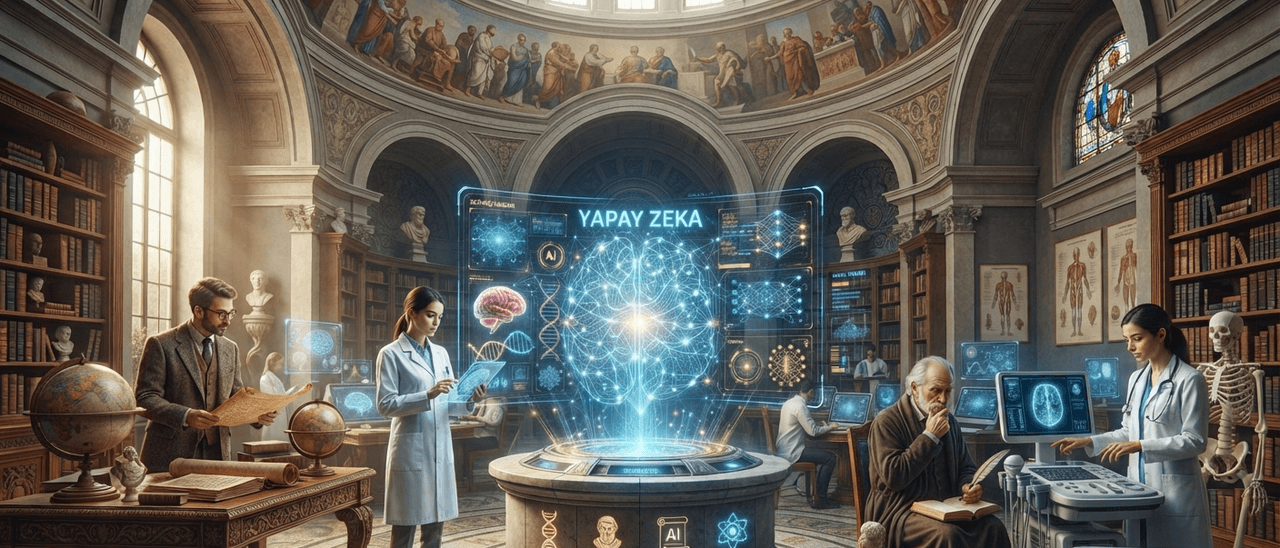
Bilim, Tıp, Felsefe ve Tarihin Birleştiği Nokta: Yapay Zeka (Yapay Zeka ile Oluşturulmuştur.)
In today’s rapidly spinning world, to avoid being swept away by the tide, we must no longer remain mere consumers — we must step into the kitchen of the process itself. The old fairy tale we were drilled into for years — “doctors work in hospitals, programmers sit at computers, philosophers linger in libraries” — has long since shattered under the weight of technological progress and its unifying wave. Unfortunately, specializing in just one narrow field, and viewing the world through that tiny window alone, is no longer enough to satisfy our needs or secure our future.
Disciplines rooted in the social sciences have become so intricately intertwined with fields seemingly opposite — such as “code, data, artificial intelligence” — that people now ask, “What possible connection could there be between these areas?”
In the past, a medical student would memorize anatomy until dawn and rush through hospital corridors; a computer engineer would work day and night under the glow of a screen, processing data and writing code. The intersection of these two worlds seemed impossible. But today we see that when the complex, living tissue of medicine fails to merge with the analytical power of computer science, incurable diseases and stalled diagnostic processes become inevitable.
Unfortunately, classical medical education still gives insufficient space to mathematical thinking and analytical formulas; on the other hand, engineers remain entirely unfamiliar with the human body’s flawless yet extraordinarily intricate mechanisms. Try explaining the function of the amygdala or the liver to an engineer, and their mind will go blank. Conversely, teaching a physician how to write code or understand algorithmic logic is no easier than forcing a camel through the eye of a needle.
It is precisely at this point that the new generation of experts, destined to carry the future on their backs, steps onto the stage. This generation blends multiple disciplines within a single mind, truly pioneering a new path. They do not say, “I know medicine” or “I write code.” Instead, they say, “I must understand both well enough to design from scratch the very tools that emerge directly from the needs of this field.”
Consider radiology: it is beyond time-consuming — it is impossible — for a human eye to examine billions of CT and MRI scans and produce reports within seconds. Artificial intelligence here is not a machine replacing the radiologist; quite the opposite — it is a tremendous tool that elevates the radiologist’s productivity to unprecedented levels. But what drives this engine is not merely code or data flow. Without the medical intuition behind the code — without the physician’s eye that knows which lesion is dangerous and which is benign — that artificial intelligence remains nothing more than flickering pixels on a screen. Or worse, it offers nothing beyond a treatment that stalls during a power outage.
Especially during the crucial period of academic choice, I can tell young friends this:
The job descriptions of the future are being rewritten from scratch. Simply saying “I am a programmer” no longer carries the weight it once did. No matter your field — medicine, law, business — if you cannot nourish your sector with artificial intelligence, you will remain on the side of those who obey the rules, not those who write them. This is why universities must open interdisciplinary programs that bridge these fields and instill this vision in young minds — it is not merely an academic fantasy, but the very essence of survival and keeping pace with our era.
Let us now turn to the most “What’s the connection?” part: the link between social sciences and artificial intelligence...
If I speak of philosophy, many still believe it to be an intellectual hobby, forgotten on dusty shelves in university corners, something to do in spare time. What a profound misconception! Do you think it is coincidence that Geoffrey Hinton, widely regarded as the father of artificial intelligence, earned his undergraduate degree in psychology and philosophy? Of course not. What is artificial intelligence, at its core, attempting to do? It seeks to imitate the human mind — how we learn, how we make decisions. So how can you possibly design a “smart” machine without understanding how the human mind works, where knowledge comes from and where it goes, or what truth even means — that is, without any grasp of epistemology?
The issue is no longer about writing code, but about reaching the “right data” and filtering it through an ethical lens. Millions of terabytes of data are dumped before you. Which of these data points are real, which are manipulated, which contradict the very nature of the human mind? You cannot teach a computer raw code to discern this. Only a human being can impart to the machine that chain of logic, that ethical boundary, that philosophical depth.
Especially in medicine, extracting the “true therapeutic knowledge” from thousands of conflicting findings across diverse sources is an issue that can only be resolved using philosophical and epistemological tools. Philosophy here is the soul and backbone of software. An artificial intelligence devoid of philosophy is nothing more than a cold pile of iron — mechanically calculating but utterly unaware of what it is doing. That is why those philosophy books are not merely for decorating libraries; they are vital for ensuring tomorrow’s intelligent machines are not just smart, but aware of what they are doing.
When we think of history as a discipline, we recall those dull, rote-learning textbooks filled with dates and names — they no longer spark any excitement in young minds. And rightly so! Who wants to memorize pages of paper until dawn, only to forget it all the next day? But when you bring history and artificial intelligence together, the scene that unfolds is indistinguishable from a science fiction film.
Imagine thousands of pages of Ottoman Turkish or Latin manuscripts, handwritten over centuries and gathering dust in archives untouched by human eyes. It would take months, even years, for a single person to read and interpret them. Yet, a properly trained artificial intelligence can digitize, categorize, and present this vast treasure to researchers in seconds. In highly specialized fields like hadith studies, which require intricate chain analyses and textual interpretations, having an expert fluent in both disciplines write their own algorithm saves immense time and delivers flawless precision — far better than spending months teaching a programmer the intricacies of hadith methodology.
Let us go further: history education is no longer confined to monotonous classroom lectures. Thanks to digital platforms, students can now engage in direct conversations with historical figures, as if they were standing before them, questioning their decisions. Animated avatars, brought to life by technology, narrate the grand stories of the past as if you were walking the streets of that era — even placing you inside the scene with a simple pair of glasses.
With gamification tools, students explore historical sites within their geographical context, learning through immersive experience. This is how the new generation processes knowledge. Our need is to fully grasp our era and adapt our knowledge to present it to people in the best possible way. Otherwise, diplomas, certificates, and all such credentials will remain nothing more than pieces of paper we carry with us.
But here we must pause for a moment — it is our duty to do so.
These AI assistants are typically built on data banks that lack critical awareness. When you ask them sensitive questions about historical or national matters, they may respond with entirely externally imposed, biased, and partisan answers. For young researchers, falling victim to these subtle algorithmic manipulations risks alienating them from their own history and roots — and this is a matter of moments.
That is precisely why the vision of “National Artificial Intelligence” is not merely a technical issue of independence — it is a struggle for the survival of our spirit, our history, and our national consciousness. Therefore, AI literacy must become one of the most fundamental lessons in schools; young people must develop a critical filter that prevents them from believing every screen they see is unquestionably true.
If we are not careful, artificial intelligence could transform into a monster that thinks for us, decides for us, and even feels for us. Today, our youth are already submitting their smallest assignments, simplest essays, and even personal decisions to AI assistants via copy-paste. That is a sign we stand at the threshold of a profound collapse. The more artificial intelligence thinks for you, the more your own analytical muscles atrophy, weaken, and become useless. Soon, you will become a pitiful digital addict — unable to construct even two coherent sentences, incapable of questioning your own history, your own philosophy, or your own medical decisions, and accepting only the data presented by AI as absolute truth.
Precisely for this reason, it is vital that we do not let ourselves be used by these systems — rather, we must use them for ourselves. Artificial intelligence is merely a colossal machine capable of processing human accumulated knowledge at a speed a billion times faster. But the one who will guide this machine, sit at the table, and say, “Wait — here we have our national sensitivity, here lies our philosophical stance, here is our moral filter,” is none other than the human mind itself.
True achievements arise only and exclusively through human hands, human knowledge, human sweat, and human intuition. Sitting before a computer screen and saying, “AI did everything, I just watched,” is not success — it is utter defeat. As young people raised on these lands, we are not obligated to accept the homogenized world offered by Western-centric algorithms. We must place our own history, our own philosophy, our own medical heritage, and our cultural richness at the center of this technology, and weave our own original artificial intelligence and our own digital future.
Let us return to the beginning: If you asked, “What does artificial intelligence have to do with medicine, philosophy, or history?” — then it is time to wake up, my friend! The connection is nothing less than life itself. This era belongs not to those who walk a single path, but to those who build bridges between those paths. Trust your own mind, your own effort, and your own conscience. See artificial intelligence not as a master, but as a powerful tool that performs its task flawlessly. The future belongs not to those who stare at screens, but to the courageous minds who know what to write on them.
Üsküdar Üniversitesi. "Prof. Geoffrey Hinton: 'Onları uyarmaya çalıştım ama kontrolü çoktan kaybettik!'" Accessed August 1, 2026.https://uskudar.edu.tr/haber/prof-hinton-onlari-uyarmaya-calistim-ama-kontrolu-coktan-kaybettik/62717
Are We Rewriting History?
Artificial Intelligence Must Not Take Control!