

This article was automatically translated from the original Turkish version.
+1 More
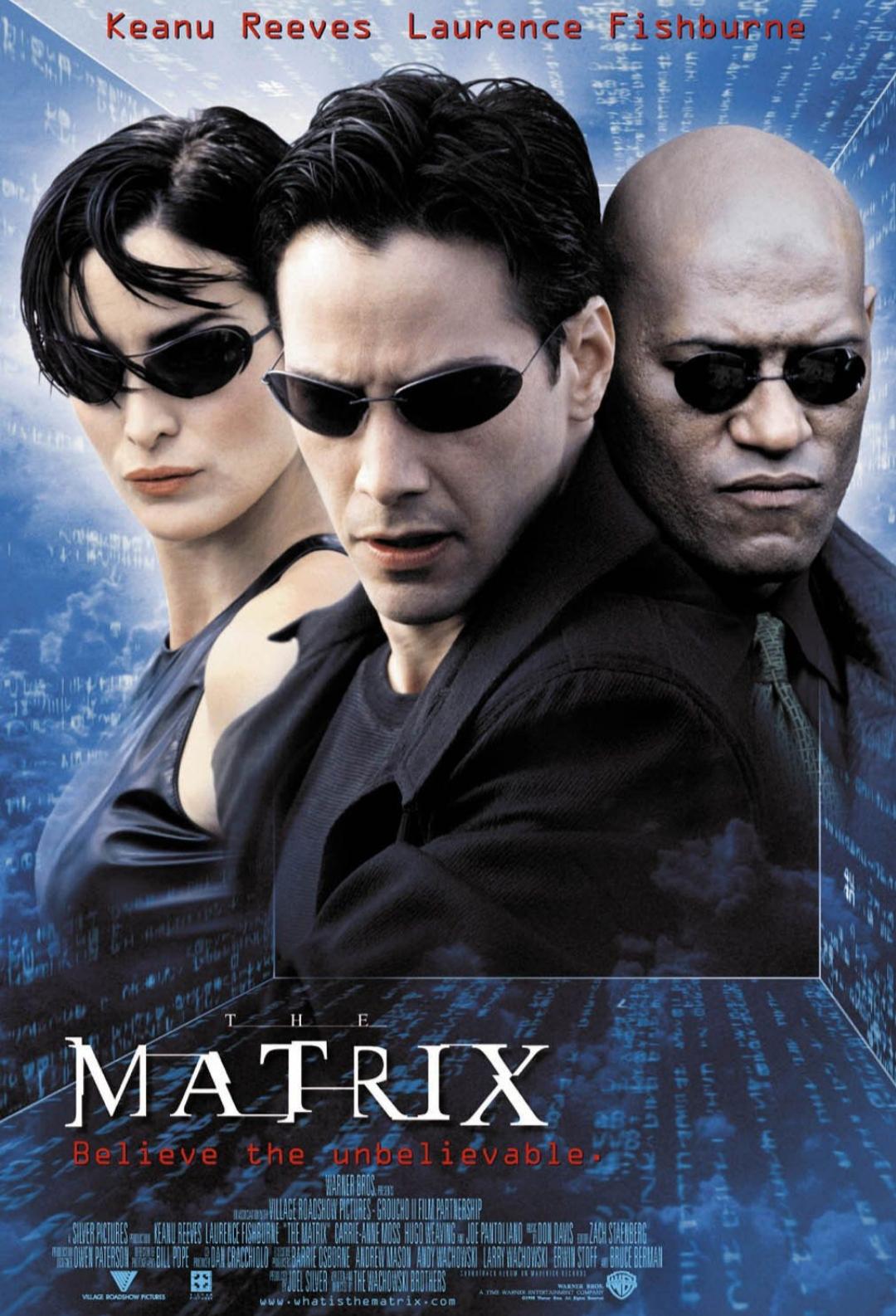
The Matrix is a 1999 science fiction feature film directed by the Wachowski siblings. The film stands out for its innovative use of advanced digital effects, particularly the introduction of the “bullet time” technique to cinema, as well as its philosophical allusions. The production, written and directed by the Wachowskis, has secured a unique place in cinematic history due to both its commercial success and its profound impact on popular culture.
The Matrix challenges viewers to question themes such as reality, simulation, free will, and fate. It reached a vast global audience, became the subject of academic study, and spawned a media universe through numerous sequels, animated shorts, and merchandise.
Official Film Trailer (Rotten Tomatoes Classic Trailers)
The Matrix centers on a simulated reality created by machines, in which human consciousnesses are trapped in a digital illusion while their physical bodies are used as an energy source. This system, called the Matrix, sustains the illusion of an ordinary everyday world. The protagonist, Thomas Anderson, is a software engineer by day and a hacker known by the alias “Neo” by night. As Neo begins to suspect the true nature of the Matrix, he makes contact with Morpheus and his crew.

Scene from the Film (IMDb)
Morpheus offers Neo a choice that reveals the boundaries of reality: taking the blue pill will return him to the illusion of his known world, while taking the red pill will expose him to the “real world” beyond the Matrix. Neo’s choice of the red pill severs the chains binding his body to his mind and forces him to confront the truth of humanity, imprisoned in pods. From that moment, Neo discovers his ability to bend the rules of the Matrix and becomes the focal point of the belief in the “chosen one.” Zion, an underground city, is introduced as the center of human resistance, while Agent programs strive to eliminate Neo and the rebels to preserve the Matrix’s order. Throughout the film, concepts of individual choice, fate, free will, and reality are explored through Neo’s transformation.

Scene from the Film (IMDb)
The Matrix is fundamentally built upon the questioning of the boundary between reality and simulation. The narrative merges the tension between individual free will and destiny with the existential search for meaning within a technologically engineered artificial world. The film weaves together diverse intellectual traditions, including Plato’s Allegory of the Cave and Baudrillard’s concept of the simulacrum, to examine humanity’s struggle for identity, consciousness, and freedom within a universal framework.
Technology and artificial intelligence are not merely background elements but serve as a metaphorical plane where the human-machine relationship is redefined. The cinematic representation of time, especially through the “bullet time” technique, visualizes the individual’s potential to intervene in reality. Thus, the film emerges as a narrative that simultaneously interrogates the limits of consciousness, the mind-body duality, social control, and the idea of salvation.
The production of The Matrix began in the mid-1990s when the Wachowski siblings’ screenplay received support from Warner Bros. Filming took place in Sydney, Australia, with studio sets and urban landscapes adapted to create the film’s visual atmosphere. During production, the film drew upon the Hong Kong martial arts choreography tradition, with Yuen Woo-Ping’s team providing the cast with extensive martial arts training.

Scene from the Film (IMDb)
The “bullet time” technique introduced by The Matrix is not merely a visual innovation but is also interpreted as a cinematic representation of the film’s central theme of time. The technique relies on placing multiple stationary cameras in a circular arrangement and digitally combining the simultaneously captured images. This allows a moment of motion to be detached from its normal flow, drastically slowed down, and viewed from multiple angles as the camera moves freely around the frozen instant. The viewer gains the ability to experience in detail an action that would normally occur too quickly to perceive.
Bullet time sequences visually manifest the characters’ ability to bend the physical laws of the Matrix. Neo’s evasion of bullets or his battles with Agents reveal that time is no longer an external constraint but a medium subject to the subject’s intervention. In Hollywood cinema, camera movement typically conforms to narrative pace; The Matrix reverses this rule: the viewpoint shifts “as fast as a bullet,” yet the bullet itself is slowed and brought entirely under control.

Scene from the Film (IMDb)
The Matrix achieved major commercial success worldwide following its 1999 release. Made with a budget of approximately $63 million, the film grossed over $465 million globally. In the United States, it topped box office charts during its opening week and maintained a top position for an extended period.
In Türkiye, the film also attracted significant attention during the summer season of 1999, reaching a large audience nationwide. Its box office success was not limited to financial gains; DVD and home video sales remained high for years, establishing the film as a cult classic within the cinema industry.
Including film institutions, festivals, critics’ associations, and popular culture organizations, the film won over 40 awards and received approximately 50 nominations.
The black leather outfits, long coats, and dark sunglasses worn in the film directly influenced the fashion sensibilities of the era; the “green digital rain” aesthetic of the code has become one of the most recognizable visual icons of digital culture. The “red pill – blue pill” dichotomy has evolved into a universal metaphor for individual choice and the pursuit of truth, used across diverse contexts.
IMDb. "Awards." IMDb. Accessed September 23, 2025. https://www.imdb.com/title/tt0133093/awards/?ref_=tt_awd
IMDb. "Matrix (1999)." IMDb. Accessed September 23, 2025. https://www.imdb.com/title/tt0133093/mediaviewer/rm2246612737/
IMDb. "Matrix." IMDb. Accessed September 23, 2025. https://www.imdb.com/title/tt0133093/
IMDb. "Photos." IMDb. Accessed September 23, 2025. https://www.imdb.com/title/tt0133093/mediaviewer/rm1364970241/?ref_=ttmi_mi_39_4
IMDb. "Photos." IMDb. Accessed September 23, 2025. https://www.imdb.com/title/tt0133093/mediaviewer/rm1465633537/?ref_=ttmi_mi_40_2
IMDb. "Photos." IMDb. Accessed September 23, 2025. https://www.imdb.com/title/tt0133093/mediaviewer/rm181212929/?ref_=ttmi_mi_28_1
IMDb. "Photos." IMDb. Accessed September 23, 2025. https://www.imdb.com/title/tt0133093/mediaviewer/rm3771537153/?ref_=ttmi_mi_14_1
IMDb. "Plot." IMDb. Accessed September 23, 2025. https://www.imdb.com/title/tt0133093/plotsummary/?ref_=tt_stry_pl
KILBOURN, RUSSELL J.A. “RE-WRITING ‘REALITY’: READING ‘THE MATRIX’”. *Revue Canadienne d’Études Cinématographiques / Canadian Journal of Film Studies* 9, no. 2 (2000): 43–54. Accessed September 23, 2025. http://www.jstor.org/stable/24402660
McWhirter, Andrew C. "The Matrix.” *International Journal of Jungian Studies* 6, no. 3 (2014): 268–274. Accessed September 23, 2025. https://doi.org/10.1080/19409052.2014.939803
Mischoulon, David, and Beresin, V. Eugene. “The Matrix”: An Allegory of the Psychoanalytic Journey. *Academic Psychiatry* 28, no. 1 (2004): 71–77. Accessed September 23, 2025. Accessed adresi
Rotten Tomatoes Classic Trailers. "The Matrix (1999) Official Trailer #1 - Sci-Fi Action Movie." YouTube. Accessed September 23, 2025. https://www.youtube.com/watch?v=vKQi3bBA1y8
Wachowski, Lana and Lilly, dir. The Matrix. United States, Australia: Warner Bros, 1999.

Plot
Themes
Cast and Characters
Production
Bullet Time
Box Office Performance
Awards and Nominations
Cultural Impact