

This article was automatically translated from the original Turkish version.

Natron Lake is a lake located within the borders of Tanzania, situated in the East African Rift Valley and notable for its highly alkaline water composition. The lake exhibits distinct physical and chemical properties due to its concentrated mineral composition and environmental conditions. In particular, the petrified appearance of organic remains observed around the lake has made this area a subject of scientific and popular interest.
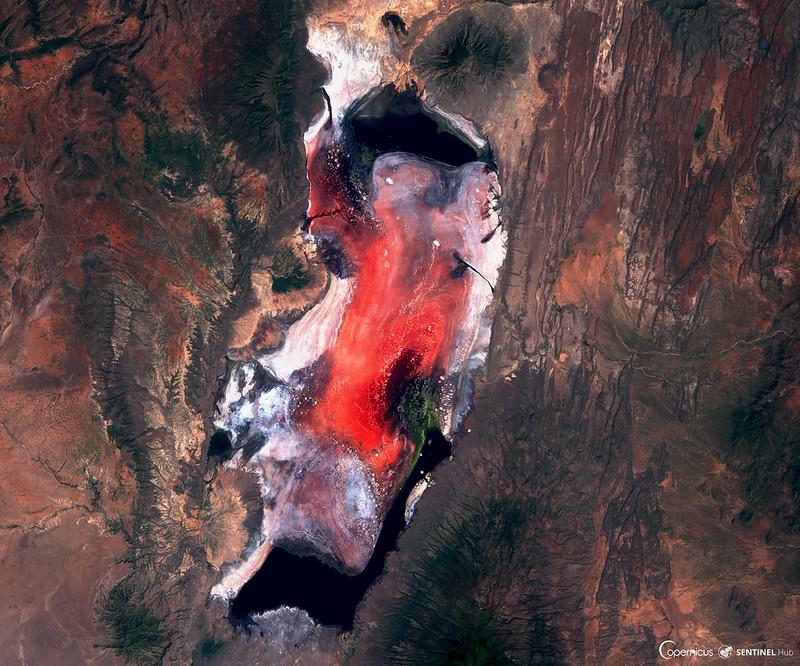
Natron Lake (Flickr)
Natron Lake is located in northern Tanzania, within a tectonic depression that forms part of the East African Rift Valley. The region has been shaped by volcanic activity and exhibits a dynamic geomorphological structure.
The area surrounding the lake is characterized by semi-arid climatic conditions. Limited rainfall and high temperatures lead to significant reductions in the water mass. This process results in seasonal shrinkage of the lake’s surface and the formation of mineral deposits along its shores.
The morphological structure of Natron Lake varies according to seasonal fluctuations. Changes in water volume accentuate the lake’s shallow nature, exposing large areas during certain periods. The salt and mineral formations observed in these exposed zones are key elements defining the lake’s physical character.
Natron Lake possesses a water composition rich in alkaline components. The lake water contains high concentrations of sodium carbonate and similar minerals. This results in a very high pH level, creating an environment that is hostile to many forms of life.
The hot climate and high evaporation rate in the region increase the concentration of minerals in the water. As evaporation reduces the water volume, dissolved minerals accumulate in the lake. This leads to the periodic formation of salt and mineral crusts on the lake surface.
Additionally, the temperature of the lake water can reach high levels depending on environmental conditions. The combination of high temperature and alkalinity creates an extreme chemical environment.
Never Swim In This Lake (YouTube)
One of the most common claims about Natron Lake is that living creatures instantly turn to stone upon approaching it. However, this does not occur as an immediate or direct petrification process. The lake’s highly alkaline water and mineral content gradually accumulate on the surfaces of dead organisms, forming a hard crust. This accumulation gives the remains a stone-like appearance.
The animal figures photographed around the lake and appearing petrified are the result of these chemical processes. In particular, increased mineral concentration due to water evaporation makes such formations more pronounced.
Therefore, the widespread notion that Natron Lake instantly turns living creatures to stone is not scientifically valid. The observed “petrification” is explained by the chemical effects of the lake’s composition on the remains of dead organisms.
Despite its harsh environmental conditions—high alkalinity and temperature—Natron Lake is not devoid of life. Certain microorganisms and algal species have adapted to its chemical composition and continue to thrive in this environment. These organisms contribute to the formation of a limited but functional food chain within the lake.
The area surrounding the lake provides an important habitat for specific bird species. Although the extreme conditions pose survival challenges for many organisms, certain species have adapted to this environment and are able to feed and reproduce here. This demonstrates that the lake supports a limited but unique ecosystem.
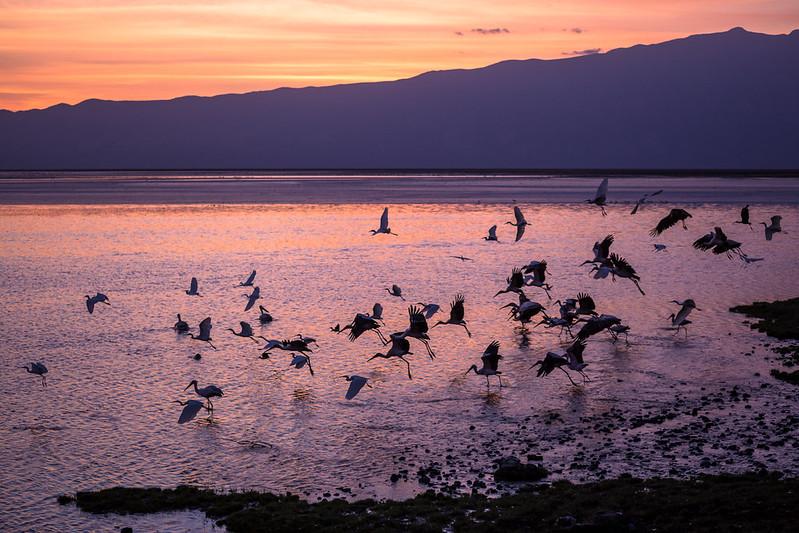
Natron Lake and Flamingos (Flickr)
Natron Lake serves as a critical breeding and living habitat for certain bird species, particularly flamingos. While the lake’s highly alkaline water creates a restrictive environment for many organisms, flamingos are among the species that have adapted to these conditions.
The area around the lake provides favorable conditions for flamingos to feed and reproduce. In particular, the microorganisms present in the lake serve as a primary food source for these birds. This contributes to Natron Lake functioning as a vital ecosystem for flamingo populations.
The environmental characteristics of Natron Lake make it one of the key areas where flamingos congregate in large numbers. In this context, the lake holds significant habitat value for the continuity of bird species at a regional level.
Claims made about Natron Lake are evaluated scientifically within the framework of its physical and chemical properties. The lake’s high alkalinity and dense mineral content form the basis for many of the phenomena observed there.
The organic remains found around the lake, which appear petrified, are explained by the accumulation of chemical components from the water on dead organisms. During this process, minerals form a crust on the surface, hardening the remains and giving them a stone-like appearance.
Statements circulating in the public domain that claim “living creatures turn to stone” are not supported by scientific evidence. Current findings indicate that the observed phenomenon is the result of gradual chemical accumulation over time, not an instantaneous transformation. Therefore, discussions regarding Natron Lake focus on natural processes and chemical interactions rather than supernatural explanations.
Akdoğan, Asya Melis. “Dünyanın En Ölümcül Göllerinden Natron.” Webtekno. Accessed March 9, 2026. https://www.webtekno.com/dunyanin-en-olumcul-gollerinden-natron-h147830.html
Berger, Alex. “Storks at Sunrise over Lake Natron.” Flickr. Accessed May 4, 2026. https://www.flickr.com/photos/virtualwayfarer/32929341120
Bilimkurgu Kulübü. “Dünyanın En Ölümcül Gölü: Natron.” Accessed March 9, 2026. https://www.bilimkurgukulubu.com/genel/inceleme/dunyanin-en-olumcul-golu-natron/
Demircan, Kozan. “Medusa’nın Gölü: Tanzanya’daki Sodalı Natron Gölü Kuşları Taşa mı Çeviriyor?” *Khosann.* Accessed March 9, 2026. https://khosann.com/medusanin-golu-tanzanyadaki-sodali-natron-golu-kuslari-tasa-mi-ceviriyor/
Gaia Dergi. “Ölen Canlıları Heykelleştiren Göl: Natron Gölü.” Accessed March 9, 2026. https://gaiadergi.com/olen-canlilari-heykellestiren-gol-natron-golu/
NTV. "Dünyanın En Ölümcül Gölü Natron: Yaklaşanı Taşa Dönüştürüyor." Accessed March 9, 2026. https://www.ntv.com.tr/galeri/dunya/dunyanin-en-olumcul-golu-natron-yaklasani-tasa-donduruyor,mbwAR2yqIU-jHugSsA1KCg/3
Nasty Nature. "Never Swim In This Lake." YouTube, 0:35. Accessed May 5, 2026. https://www.youtube.com/watch?v=oNs6R1bXBik
Sentinel Hub. “Lake Natron.” Flickr. Accessed May 4, 2026. https://flic.kr/p/2ieqCtr
Özdemir, M. Doğan. “Büyük Şaşırtmaca ve Ölümcül Son: Natron Gölü, Tanzanya.” Akuaturk. Accessed March 9, 2026. https://akuaturk.com/2013/10/buyuk-sasirtmaca-ve-olumcul-son-natron-golu-tanzanya/
Geographical Location and Physical Characteristics of Natron Lake
Chemical Composition and Water Properties
“Turned to Stone” Living Creatures: Facts and Misconceptions
The Lake’s Ecosystem and Biological Life
Flamingos and the Importance of Natron Lake
Scientific Explanations and Debates