

This article was automatically translated from the original Turkish version.

Have you ever thought of the National Technology Initiative as a psychological matter?
Probably not; and that is perfectly natural. When you hear “National Technology Initiative,” you think of an aircraft, an engine, a satellite, a factory; the thick line drawn under the export figures announced at year’s end. Almost everything it evokes is metal: measurable, photographable, inventory-listable.
The official definition initially confirms this impression. The National Technology Initiative is a policy approach aimed at achieving breakthroughs in critical technologies that will enhance Türkiye’s global competitiveness and secure its economic and technological independence. Its core is the Industry and Technology Strategy, which is built upon five components: Advanced Technology and Innovation, Digital Transformation and Industrial Initiative, Entrepreneurship, Human Capital, and Infrastructure.【1】
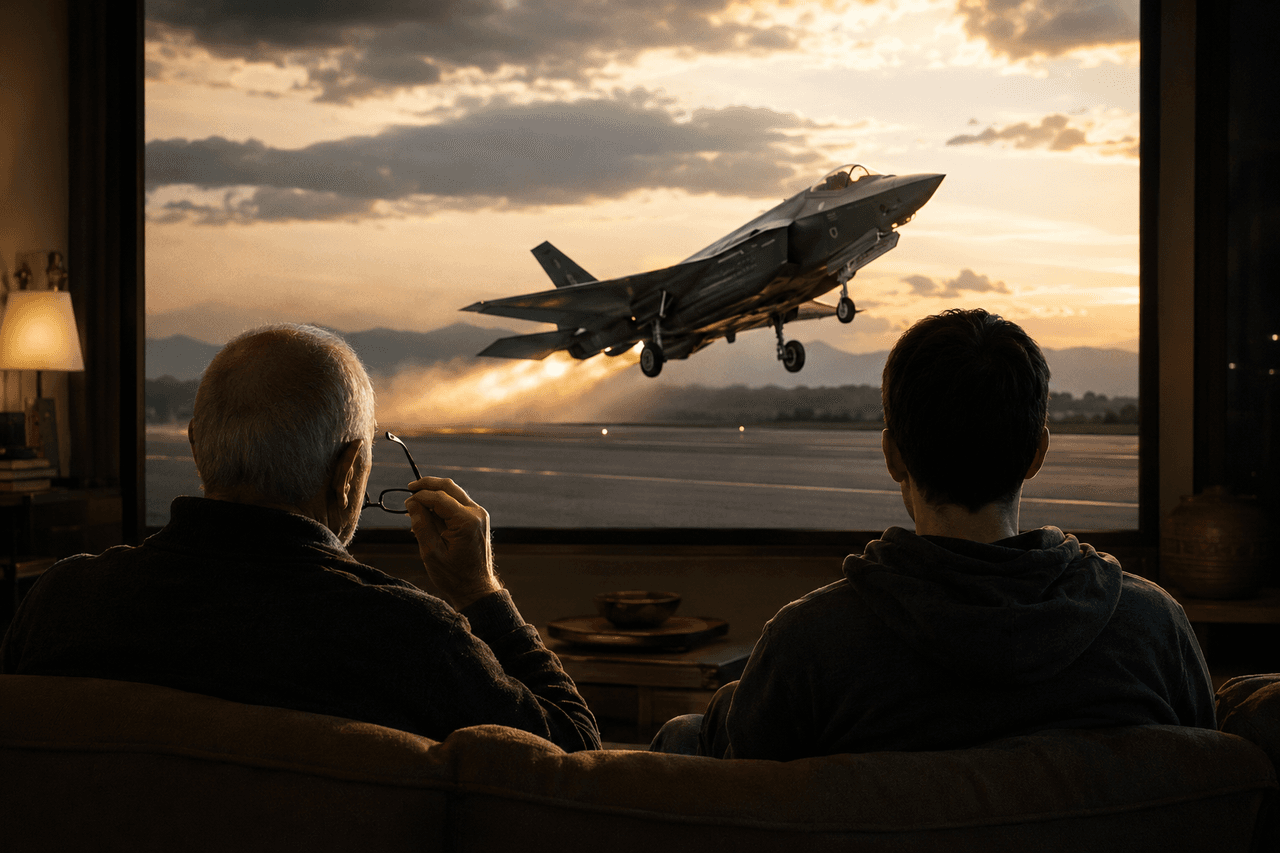
Millî Uçağın Uçuşunu Temsil Eden Görsel (Yapay Zeka ile Oluşturulmuştur.)
Now pay attention: this definition contains no aircraft, no satellite, no engine. Yet we always remember the initiative through these very things. Because they are the most visible, the noisiest part of the story a nation tells about itself.
Yet the initiative’s most difficult output does not stand in any hangar, does not appear in any photograph, is not delivered at any ceremony. No report measures how an industrial program repairs something in a person’s mind; no report asks what a flying aircraft taught an entire generation about itself. These are not engineering questions. But their answers determine whether engineering is even possible.
In psychology, there is a concept that describes when an animal stops looking for escape even when it is within reach: learned helplessness. Its definition is this: when an animal, after being exposed repeatedly to unavoidable aversive stimuli, becomes passive in the face of new threats.【2】
The concept was first observed in individuals, but it is not only an individual phenomenon. Societies, shaped by past experiences, may come to believe that change is difficult or even impossible, and like individuals, they can develop silent, passive resistance to every new possibility life presents.【3】
This article will examine Türkiye’s technological history through this lens. It will not offer a diagnosis; it will ask only one question: If a society has learned that it cannot do something, how do we know it has learned otherwise?
I will argue that the answer is not where we assume it to be. The only place where this most difficult output of the initiative can be measured is on a person’s face, and the unit of measurement is the magnitude of their astonishment. Let me illustrate what I mean with a scene; you have almost certainly seen something similar.
Two people sit in front of a screen. In the same room, at the same time, they watch the same image: a domestic fighter jet lifts off the runway, raises its nose, and writes itself into the sky.
The elderly man in front of the screen is crying. Quietly, almost as if ashamed; he takes off his glasses, wipes the lenses, puts them back on, then wipes them again...
Next to him is a young person who does not cry. They are not even surprised. A brief nod of pride, perhaps a quiet “well done,” and then life continues as before.
The same image, two different people, two different reactions...
Now consider a strange question: Which of these two reactions is the good news?
Our instinct chooses the tears. The weeping man is the one who feels his nation’s success in his heart; the calm young person is seen as ungrateful, insensitive, unaware of value. This article will argue the opposite. The real good news is not in the man wiping his glasses. It is in the young person’s lack of surprise.
To understand why, we must first look at what each of these two individuals was taught at the beginning of their lives. The story begins in an unexpected place: a laboratory in Pennsylvania in the mid-1960s.
The experiment was simple; its result would become one of psychology’s most unsettling findings.
Dogs were placed in a device from which escape was impossible and subjected repeatedly to electric shocks. They resisted. They struggled, tried, fought to escape. Nothing worked; no matter what they did, the shock came. No matter what they did not do, the shock still came. After a while, they stopped trying.
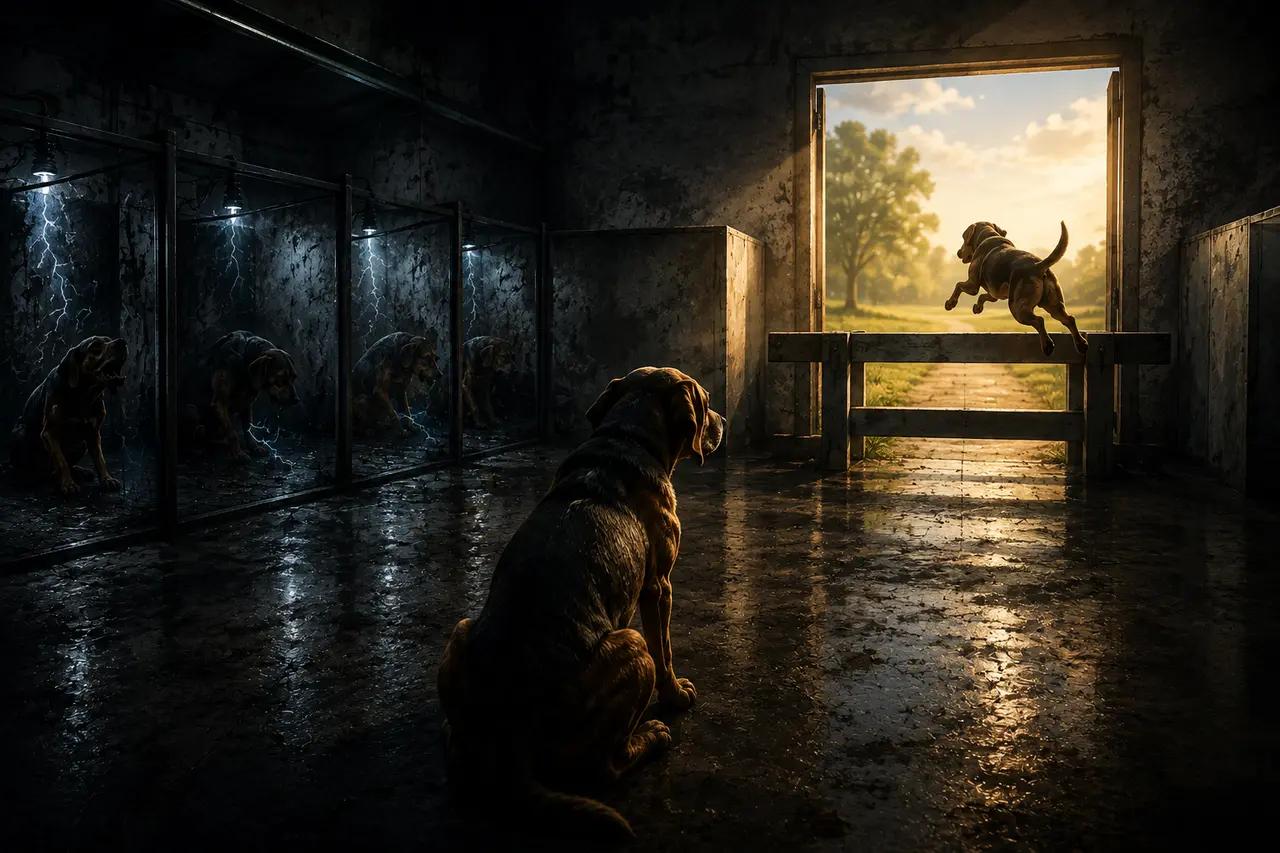
Öğrenilmiş Çaresizlik Deneyini Temsil Eden Görsel (Yapay Zeka ile Oluşturulmuştur.)
Then the researchers changed the setup. Now escape was possible. Simply moving from one compartment to another, crossing a low barrier, taking a few steps was enough. Freedom was as close as a leap.
Of the eight dogs from the group that had previously been unable to escape, only two jumped over the barrier. The rest remained passive, even though escape was now clearly possible.【4】
This scene deserves a moment of reflection. There is not only a creature suffering pain here; there is a creature that has stopped looking for escape even though it is within reach. The door was open. They did not leave. Because they had learned that escape was impossible.
Perhaps the most beautiful Turkish expression of this condition comes from Mümin Sekman: according to him, learned helplessness is simply losing the courage to try again. 【5】
Now set aside those laboratory dogs. Turn the lens to the youth of the man crying in front of the screen.
In 1964, the Johnson Letter arrived; the subsequent arms embargo weakened the bonds of trust between two NATO allies. The embargo went into effect on February 5, 1975.【6】Afterward, a habit took root that would last for decades: refusal, delay, conditional sales, half-delivered technology, waiting for spare parts...
To understand what this meant, one detail suffices. During the embargo, half of the four hundred aircraft in inventory became grounded because a single part worth ten cents could not be found. A spare part that normally cost twenty dollars rose to six hundred on the black market.【7】
Ten cents. Two hundred aircraft.
All of this, viewed from afar, looks like a supply crisis: aircraft we could not obtain, inventory waiting, modernization programs delayed; as if the problem were merely logistical, as if the only missing thing were a signature or a shipment.
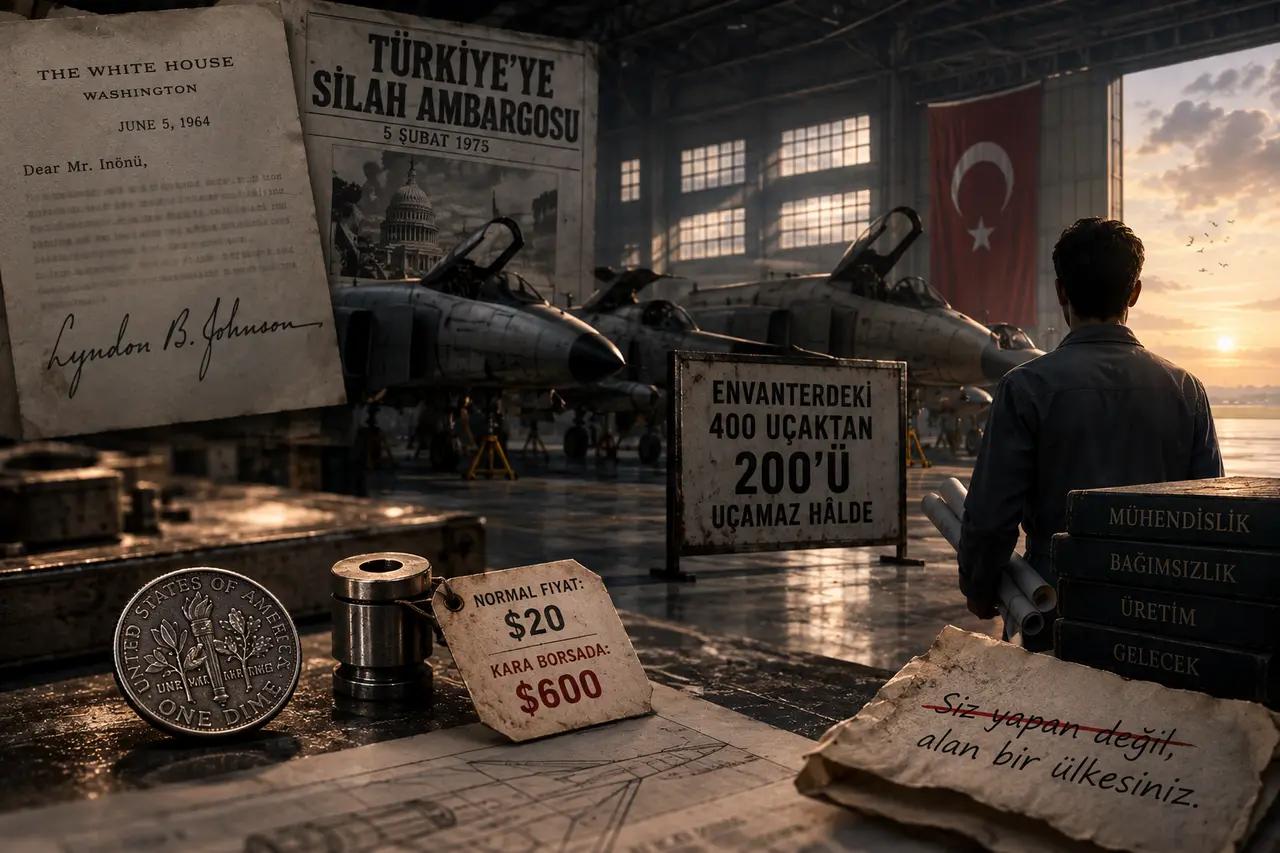
Johnson Mektubu ve Ambargoyu Temsil Eden Görsel (Yapay Zeka ile Oluşturulmuştur.)
But an embargo delivers not only goods. It delivers sentences.
Repeated often enough, this sentence ceases to be a foreign policy decision and becomes a definition of identity: you are not a country that builds, you are a country that receives.
The man crying in front of the screen was young during the years when this sentence was in force. He read the newspapers, listened to the news; he grew up believing that words like “not given,” “not approved,” and “placed on hold” were natural parts of everyday Turkish. He had talent, education, enthusiasm. What was limited was not his ability, but his experience of seeing something he had built actually fly.
Perhaps this is why the National Technology Initiative cannot be read merely as an industrial program. What needed repair was not only the assembly line.
Of course, comparing a nation to a laboratory animal is a metaphor; societies are not placed in experimental devices, their memories are not measured, their reactions are not recorded. This article does not diagnose Türkiye. It simply suggests: this concept may be a useful lens for understanding those years. Because what was not produced during that time was not only aircraft; a silent belief also accumulated—that effort makes no difference. And this belief, though never listed on any embargo, outlasted them all.
The most unexpected turn in this story comes here.
In 2016, on the fiftieth anniversary of the concept’s birth, Martin Seligman, who had introduced learned helplessness to science, confronted the accumulated findings of neuroscience. He reevaluated his own theory, the concept bearing his name, in light of these discoveries. He expressed his conclusion in a single sentence: the original theory had framed the problem backward.【8】
Passivity was not learned.
Passivity was the default state of an animal under prolonged pressure; it was not learned, but already present, waiting. What was truly learned was its opposite: control. When an animal experiences that its own effort changes the outcome, the relevant circuit in its brain activates and suppresses the default passivity.【9】
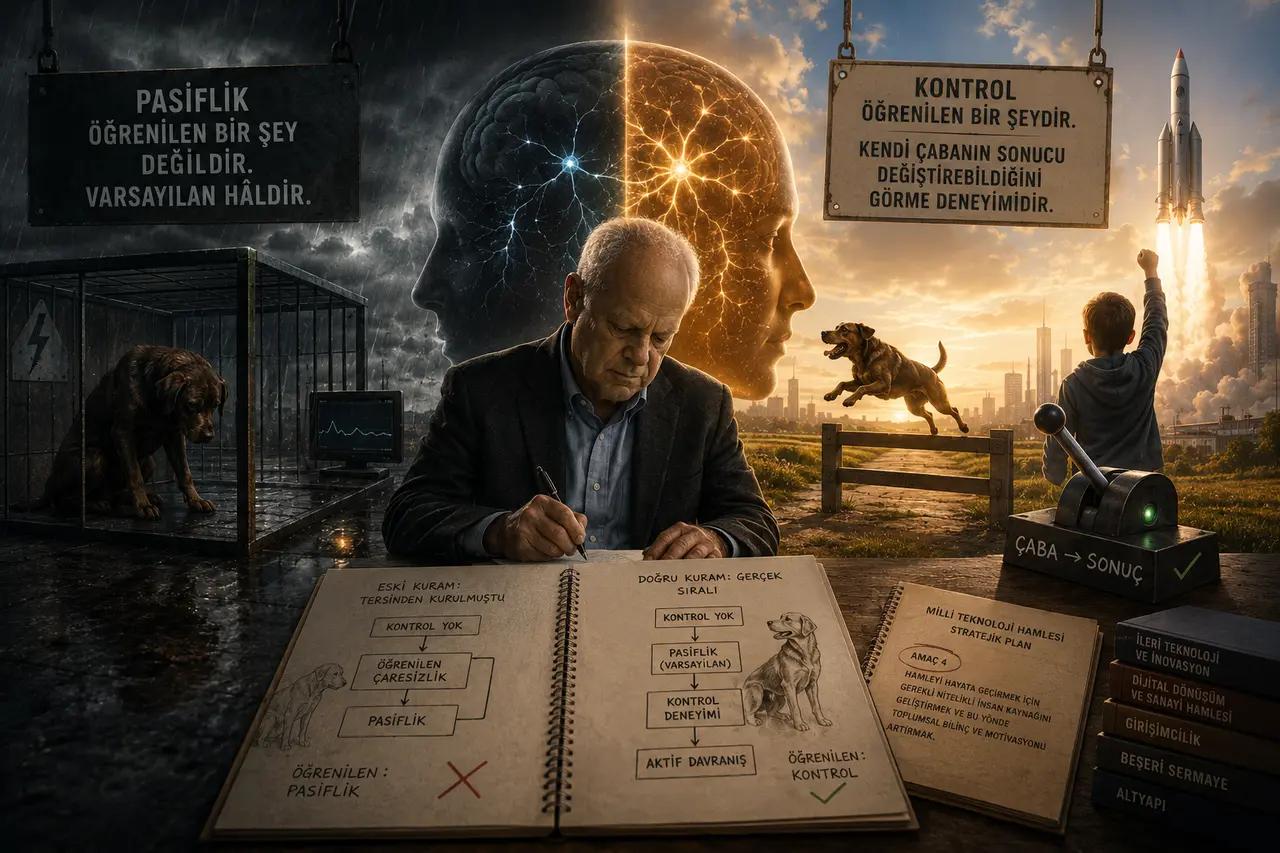
Martin Seligman Kuramını Temsil Eden Görsel (Yapay Zeka ile Oluşturulmuştur.)
Consider what this correction means for a nation’s history...
We were not taught something.
Something was withheld from us: the experience of building something and seeing it work.
From this perspective, the issue is not only a lack of technological capacity, but also a limited experience of seeing one’s own effort produce results. This seemingly pessimistic reading, in fact, warms the heart. Because the task before a nation is not to forcibly forget something it has been taught for decades.
Forgetting is beyond the reach of will; no nation can erase from its mind what history has taught it by decree. The task is far more modest and far more possible: to learn control. To see, with your own eyes, once, that you can do it.
This is not an external interpretation imposed on the initiative. In the strategic plan of the Ministry of Industry and Technology, the fourth objective of the National Technology Initiative is clearly defined: to develop the necessary qualified human resources and to increase social awareness and motivation in this direction.【10】
The human dimension of the initiative was not an afterthought. It was written from the start.
Now we can return to the two people in front of the screen, because we now have a way to distinguish between them.
Astonishment is not a harmless emotion. A person is astonished only by what they did not expect. Thus, every moment of surprise is an unconscious admission: I did not consider this possible.
That is why the old man’s tears carry such weight. They do not measure the size of the aircraft on the screen, but the size of the sentence he was taught. The more he cries, the more often he was told as a young man: “You cannot do it.”
What he wipes away as he cleans his glasses is a fifty-year assumption.
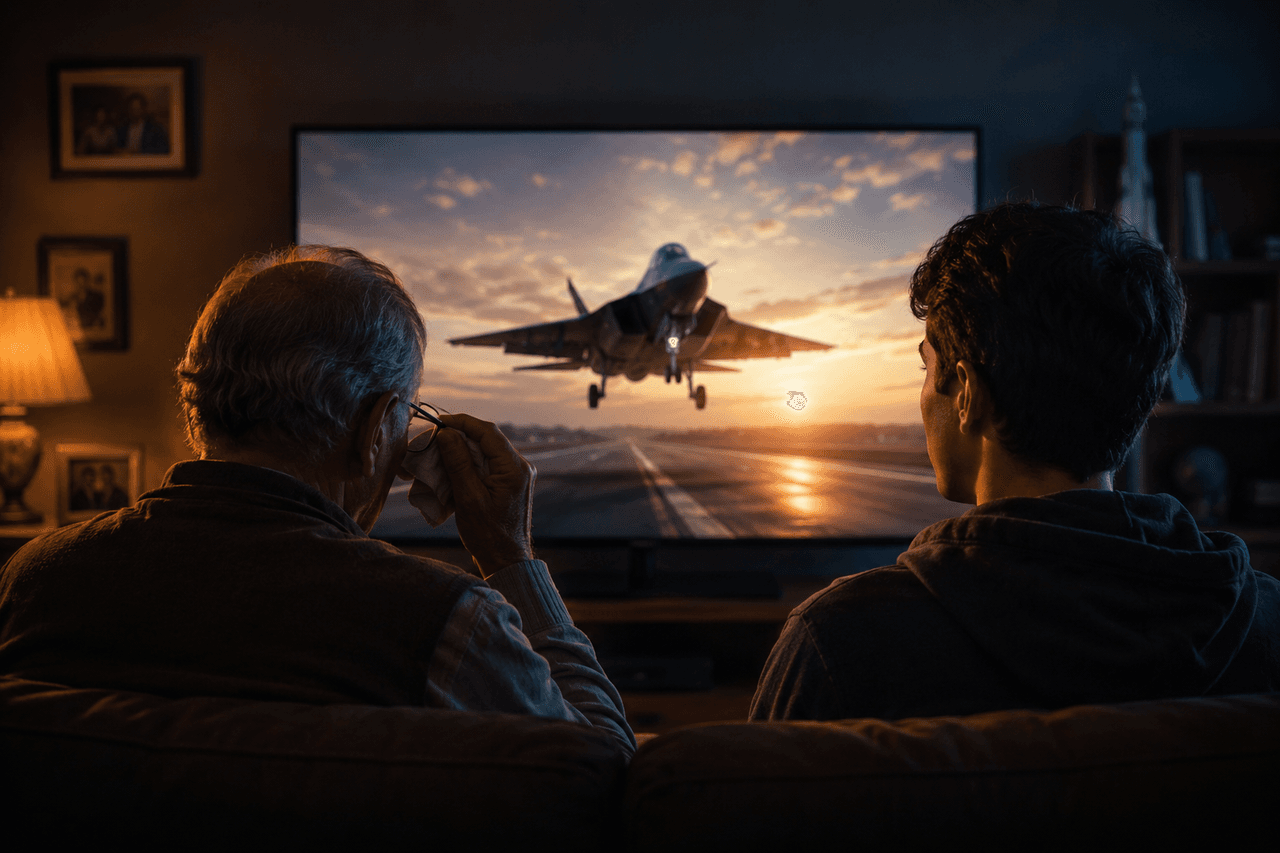
Millî Uçağın Uçuşunu Temsil Eden Görsel (Yapay Zeka ile Oluşturulmuştur.)
The calmness of the young person beside him is not indifference. It is the calmness of having accounted for it. The possibility that this aircraft could fly was already present in his mind; therefore, there is nothing to be surprised by. Two different Türkiyes sit in the same room: one that learned it could not be done, the other that never learned it at all.
But how does this second person know? He did not build an aircraft himself, draw a satellite, or design an engine.
The answer is shockingly simple: by watching.
A person does not need to have done something themselves to say, “I can do it.” It is enough to have seen someone like them do it. The success of the observed model directly raises the observer’s belief in their own competence.【11】
The young person in front of the screen is not building the KAAN. He is not building any aircraft. But he sees people from his own country, engineers who speak his language, people who might have come from his own neighborhood, doing it. What he is watching is not an aircraft; it is someone like himself succeeding.
Skill does not always pass from hand to hand. Sometimes it passes from eye to eye.
When we realize that the same channel worked in reverse for fifty years, the story begins to hurt. The old man learned exactly the same way. He watched people like himself want something and not get it; he watched them wait; he grew up in a world where rejection was normal. The mechanism was always the same; the only thing that changed was what the person was looking at.
The quietest thing the National Technology Initiative has done for this country is this: changing what people look at.
These are beautiful sentences. But beautiful sentences do not prove a claim; so we must ask: is this really happening, or are we merely wishing it to be?
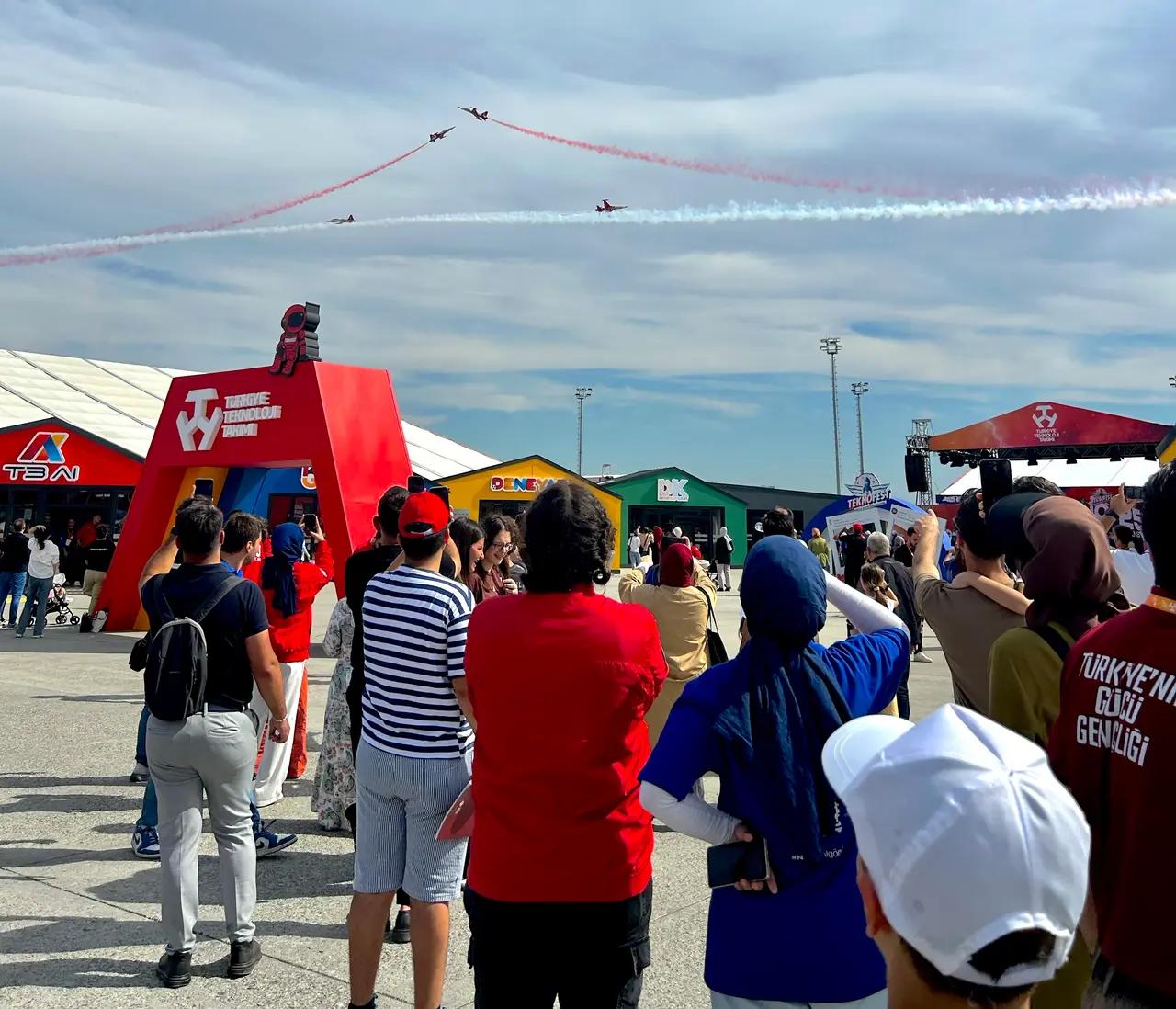
Teknofest 2025 Yılına Ait Görsel (Fotoğraf: Nida Üstün)
In a study of 781 high school students, statistically significant differences were found between the career decision-making levels of those who participated in TEKNOFEST and those who did not. The researchers concluded that the festival contributes to enriching the vocational and career development of secondary school students.【12】
This is not causal evidence, but a difference observed. Yet the observed difference is precisely in the expected direction.
But the finding that truly stopped me was not this.
In another study with middle school students, participants were asked why they entered a project competition. Among their answers were desires to benefit humanity and to create an innovative product. One more was there: to test themselves.【13】
To test oneself...
Notice: these young people are not asking, “Can we do it?” They have already closed that question. What they wonder is not their country’s capacity, but their own. When a society’s question about itself shifts from “Is it possible?” to “How much can I do?”, what exists there is no longer debate, but habit.
That is what not being surprised means.
Let us return one final time to the embargo years, because there is something unspoken there. That unspoken thing transformed the man crying in front of the screen into someone else entirely.
During those years, anger did not accumulate alone. Turkish shopkeepers formed aid committees. Workers donated a day’s wages to strengthen the military. The campaign’s slogan was: Build Your Own Aircraft. The amount of money collected may have been modest; but according to military personnel and engineers of the time, the real impact of this mobilization was not material—it was the emergence of national awareness and self-confidence in the defense industry.
ASELSAN was founded in 1975, the very year the embargo was imposed, to address communication deficiencies in the Turkish Armed Forces.【14】
So even as the door closed, some had already begun to leap over that low barrier.
Today, in academic literature, the 1975 embargo is regarded as a turning point that gave birth to Turkey’s indigenous defense industry consciousness.【15】
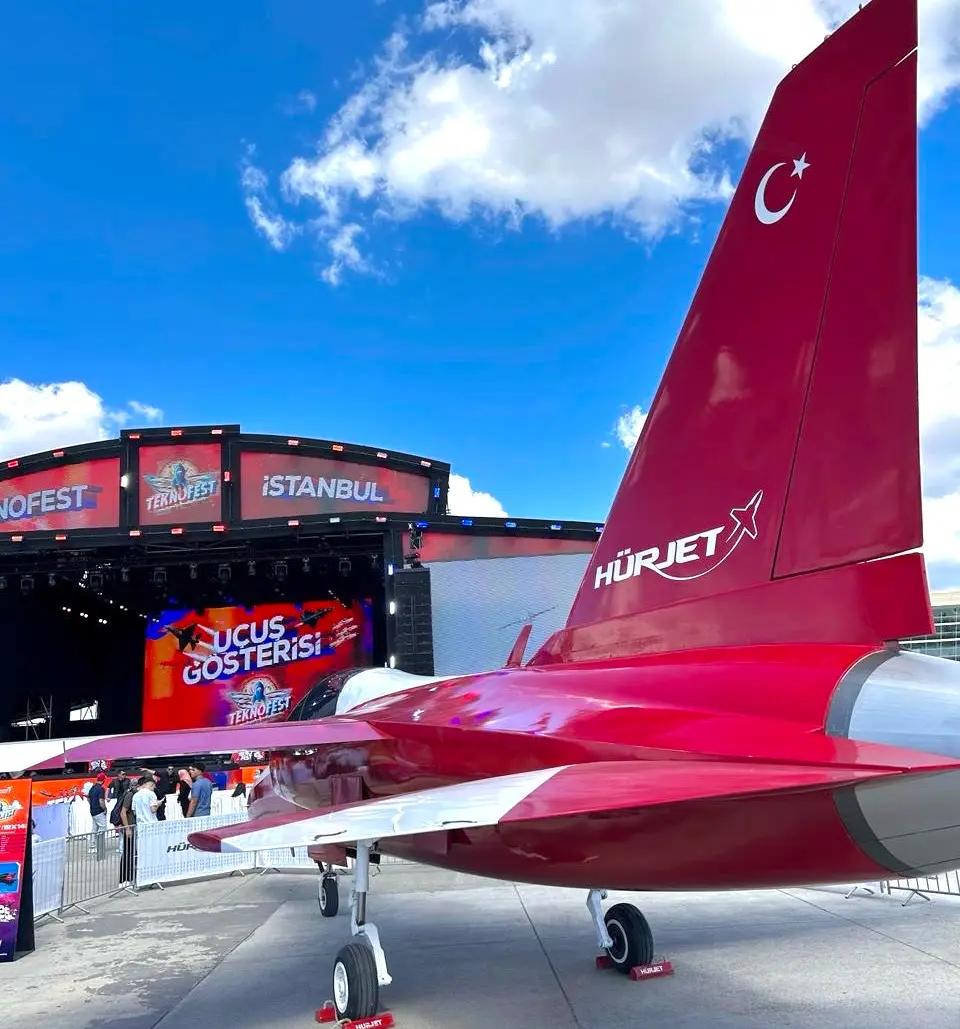
HÜRJET (Fotoğraf: Nida Üstün)
The embargo was not overcome; it was transformed. The door that was closed to us is not a tale of victimhood we circle around; it is the starting point of a skill we learned. The aircraft they refused to give us eventually became the aircraft we learned to build.
Now consider this possibility: perhaps the man wiping his glasses in front of the screen was one of those who donated a day’s wage fifty years ago. Perhaps that money never reached any aircraft. Perhaps no one ever thanked him. But the idea for which he gave his money outlived him—and one day appeared in the sky.
I am not declaring a victory when I say this. I am only noticing this: every sentence that told this country “You cannot do it,” was, in fact, written as the date of something that would one day be done.
We can now return to the question in the title. There is a small error in that question, and correcting it is the answer itself.
Why are we no longer surprised?
This question is usually posed as a reproach. It implies we have lost our excitement, forgotten our value, grown numb from habit. The mistake lies here. Not being surprised is not a loss; it is a result.
A piece of news no longer exciting does not mean the news has become smaller; it means expectations have grown larger. A person is astonished only by what they did not account for. If we no longer get surprised, it means we now account for it.
A society knows it believes in itself not by its noise, but by its silence.
The only person who can notice this is the one who remembers the illness.
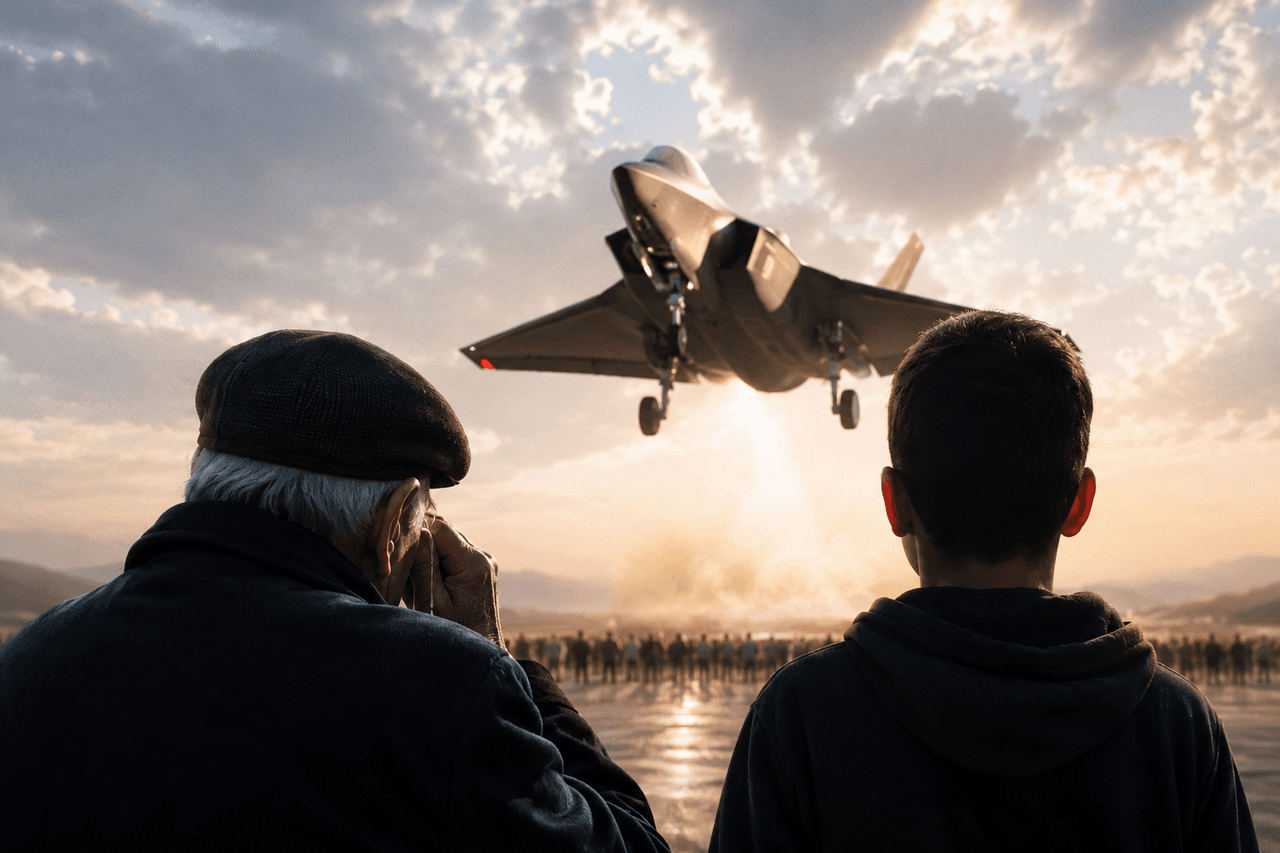
Millî Uçağın Uçuşunu Temsil Eden Görsel (Yapay Zeka ile Oluşturulmuştur.)
The two people in front of the screen witnessed two different things at the same moment. The old man saw a sentence he was taught finally proven wrong over the course of his life. The young man saw only the aircraft, because he had never been taught a sentence that needed to be disproven.
This is the National Technology Initiative’s output that will never be recorded in inventory, photographed, or delivered at a ceremony. It cannot be counted, but only measured by the difference in reaction between two generations witnessing the same image.
Next time an aircraft takes off, look not at the screen, but at the face beside you.
The journey this country has taken in fifty years is written there...
Aktan, Coşkun Can, and Serdar Yay. "Öğrenilmiş Çaresizlik ve Değişime Karşı Pasif Direnç." *Sosyal ve Beşeri Bilimler Dergisi* 8, no. 2 (2016): 58–71. Accessed August 30, 2026.https://dergipark.org.tr/tr/pub/sobiadsbd/issue/35987/403734
Maier, Steven F., and Martin E. P. Seligman. "Learned Helplessness at Fifty: Insights from Neuroscience." *Psychological Review* 123, no. 4 (2016): 349–367. Accessed August 30, 2026.
T.C. Ministry of Industry and Technology. *Sanayi ve Teknoloji Bakanlığı 2019-2023 Stratejik Planı*. Ankara: T.C. Ministry of Industry and Technology, 2019. Accessed August 30, 2026.
Tatlıoğlu, Sevra Su. "Öğrenmeye Sosyal-Bilişsel Bir Bakış: Albert Bandura." *Sosyoloji Notları* 5, no. 1 (2021): 15–30. Accessed August 30, 2026.https://dergipark.org.tr/tr/pub/sosnot/article/892420
Çavuş, Ragıp. "Ortaokul Öğrencilerinin Proje Yarışması Deneyimleri: Teknofest Örneği." *Disiplinlerarası Eğitim Araştırmaları Dergisi* 9, no. 21 (2025): 487–508. Accessed August 30, 2026.https://doi.org/10.57135/jier.1669387
Çolak, Recep, and Hanife Güz. "Bilim Halkla İlişkileri Bağlamında TEKNOFEST'in Ortaöğretim Öğrencilerinin Meslek Seçimleri Üzerine Yansımaları." *Selçuk İletişim* 18, no. 1 (2025): 203–237. Accessed August 30, 2026.https://doi.org/10.18094/josc.1585094
Şen, Onur, and Mustafa Özveren. "Ekonomik Yaptırımların Yerli Üretim ile İlişkisi: 1975-78 Silah Ambargosu'ndan CAATSA'ya Bir Çıkarım." *Ankara Üniversitesi SBF Dergisi* 79, no. 1 (2024): 27–60. Accessed August 30, 2026.https://doi.org/10.33630/ausbf.956772
[1]
Ministry of Industry and Technology of the Republic of Turkey, *Industrial and Technology Ministry 2019–2023 Strategic Plan* (Ankara: Ministry of Industry and Technology of the Republic of Turkey, 2019), p. iv, introduction by Deputy Minister Mehmet Fatih Kacır, Accessed August 30, 2026.
[2]
Coşkun Can Aktan ve Serdar Yay, "Öğrenilmiş Çaresizlik ve Değişime Karşı Pasif Direnç," Sosyal ve Beşeri Bilimler Dergisi 8, sy. 2 (2016): 58, https://dergipark.org.tr/tr/pub/sobiadsbd/issue/35987/403734
[3]
Aktan ve Yay, "Öğrenilmiş Çaresizlik ve Değişime Karşı Pasif Direnç," 59.
[4]
Aktan ve Yay, "Öğrenilmiş Çaresizlik ve Değişime Karşı Pasif Direnç," 61-63.
[5]
Aktan ve Yay, "Öğrenilmiş Çaresizlik ve Değişime Karşı Pasif Direnç," 60.
[6]
Onur Şen and Mustafa Özveren, "Ekonomik Yaptırımların Yerli Üretim ile İlişkisi: 1975-78 Silah Ambargosu'ndan CAATSA'ya Bir Çıkarım," *Ankara Üniversitesi SBF Dergisi* 79, no. 1 (2024): 37.
[7]
Şen ve Özveren, "Ekonomik Yaptırımların Yerli Üretim ile İlişkisi," 39.
[8]
Steven F. Maier ve Martin E. P. Seligman, "Learned Helplessness at Fifty: Insights from Neuroscience," Psychological Review 123, sy. 4 (2016): 349, https://ppc.sas.upenn.edu/sites/default/files/learnedhelplessnessat50.pdf
[9]
Maier ve Seligman, "Learned Helplessness at Fifty," 349.
[10]
T.C. Sanayi ve Teknoloji Bakanlığı, 2019-2023 Stratejik Planı, s. 2, "Amaç 4".
[11]
Sevra Su Tatlıoğlu, "Öğrenmeye Sosyal-Bilişsel Bir Bakış: Albert Bandura," Sosyoloji Notları 5, sy. 1 (2021): 25, Erişim tarihi: 30 Ağustos 2026, https://dergipark.org.tr/tr/pub/sosnot/article/892420
[12]
Recep Çolak and Hanife Güz, "Bilim Halkla İlişkileri Bağlamında TEKNOFEST'in Ortaöğretim Öğrencilerinin Meslek Seçimleri Üzerine Yansımaları," *Selçuk İletişim* 18, no. 1 (2025): 203.
[13]
Ragıp Çavuş, "Ortaokul Öğrencilerinin Proje Yarışması Deneyimleri: Teknofest Örneği," Disiplinlerarası Eğitim Araştırmaları Dergisi 9, sy. 21 (2025): 487, https://doi.org/10.57135/jier.1669387
[14]
Şen ve Özveren, "Ekonomik Yaptırımların Yerli Üretim ile İlişkisi," 41.
[15]
Şen ve Özveren, "Ekonomik Yaptırımların Yerli Üretim ile İlişkisi," 42.
The Door Was Open, But They Did Not Leave
The Aircraft We Were Not Given, the Sentence We Were Taught
Then the Man Who Built the Theory Returned
What Does Astonishment Actually Measure?
The Generation That No Longer Gets Surprised
What Was Written Over
Answer