


This article was automatically translated from the original Turkish version.
A gladiator lying on the ground, defeated, begs for mercy with three fingers raised toward the sky. The victorious warrior standing over him has placed his foot on his opponent’s throat and waits for the final decision from the stands. The spectators, alongside the foremost Vestal Virgins, mimic the same gesture: thumbs down.
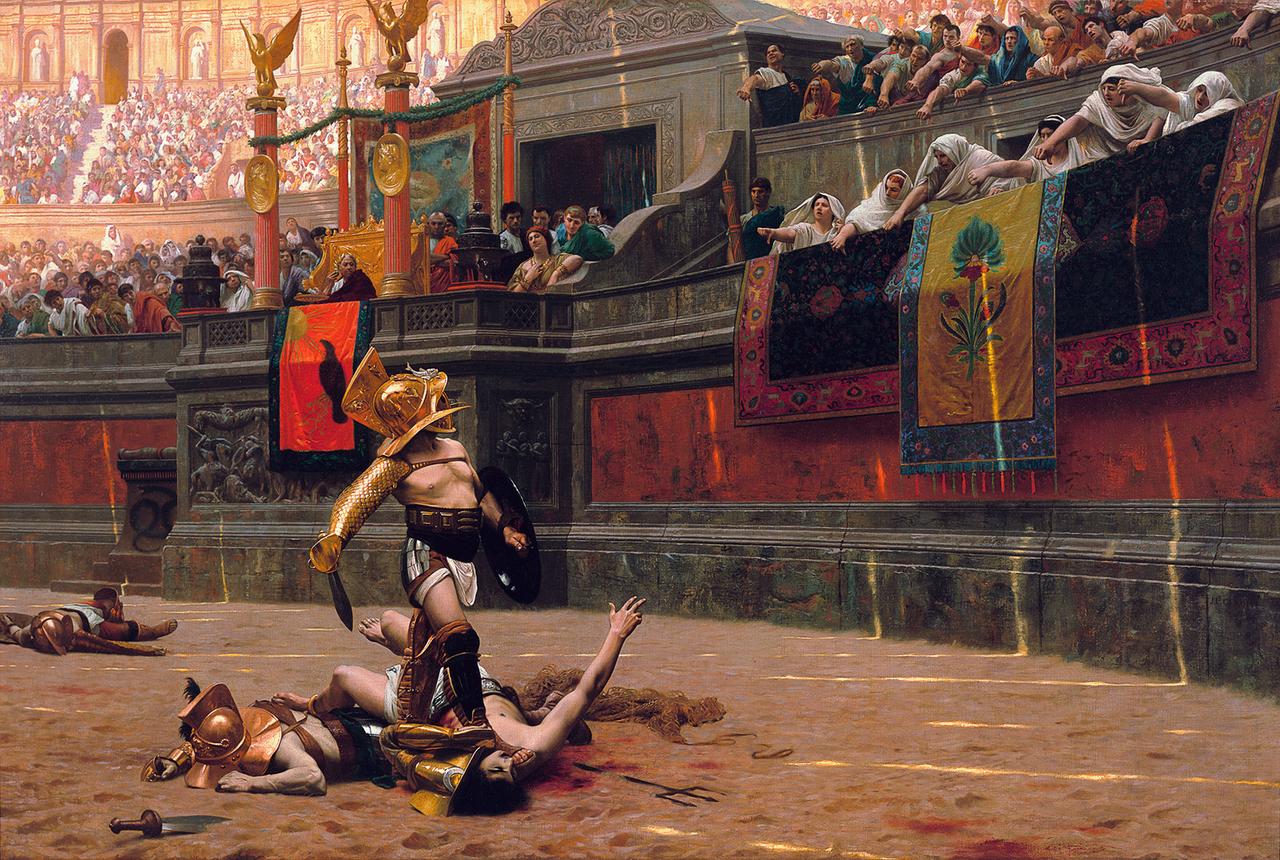
Pollice Verso (flickr)
If the thumb is down, death is inevitable. Yet this universal belief about the arena and gladiators is merely an optical illusion.
In 1872, Jean-Léon Gérôme painted a work titled Pollice Verso. Gérôme was an artist renowned for capturing the most dramatic and tense moments of events on canvas, with an obsession for detail. In this painting, a gladiator who has subdued his opponent is depicted with his foot pressed on the man’s throat. The fallen warrior raises three fingers in supplication for mercy, while the entire crowd—including the six Vestal Virgins seated in the front row—turn their thumbs downward in a cry for death. It is striking that these women, symbols of purity and sanctity in Roman society and occupying a privileged position, are shown thirsting for blood as they demand the death of the fallen fighter. Through this contrast, Gérôme confronts the viewer with an unsettling truth: our fascination with the suffering and brutality of others.
In Latin, pollice verso simply means “turned thumb”【1】 and does not specify a direction. However, the etymological and cultural significance of the thumb in the Roman world reveals the true nature of the matter. Considered superior to the other fingers due to its strength, rejected for wearing rings, and believed to be connected to reproductive organs, the thumb was regarded as a symbol of authority in its own right. When the crowd in the Roman arena wished for the defeated gladiator to die, they did not turn their thumbs down. On the contrary, they raised their thumbs into the air or extended them toward the opponent in a gesture resembling the drawing of a sword from its scabbard—a movement known as the “hostile thumb.”
When spectators wished to show mercy, they did not raise their thumbs. Instead, they concealed their thumbs within their palms or pressed them firmly against their index fingers. This gesture symbolized sheathing the sword, the end of danger, and the cessation of violence.
When painting his work, Gérôme either misinterpreted ancient texts or deliberately adopted this visual convention to heighten the dramatic impact. The misconception created by the painting became so deeply entrenched over time that it came to seem more real than the truth itself. For instance, in the 2000 film Gladiator, historical accuracy had to be sacrificed to ensure modern audiences could understand what was happening on screen. To avoid confusing viewers, the emperor in the film makes the “thumbs up” gesture popularized by Gérôme to signal mercy.
The decisions of life and death in the arena were not always as they are commonly imagined. The visual power of a single painting replaced reality and rewrote history with a single thumb gesture.
Davi Medeiros Oliveira. “Pollice Verso, by Jean-Léon Gérôme.” Flickr. Accessed August 27, 2026.https://flic.kr/p/2rWX2CH
Eclectic Light Company. “Too Real: the narrative paintings of Jean-Léon Gérôme, 4.” eclecticlight.co. Accessed August 27, 2026.https://eclecticlight.co/2018/07/26/too-real-the-narrative-paintings-of-jean-leon-gerome-4/
Phoenix Art Museum. "Pollice Verso." phxart.org. Accessed August 27, 2026.
The University of Chicago. “The Gladiator and the Thumb.” Encyclopaedia Romana. Accessed August 27, 2026.https://penelope.uchicago.edu/encyclopaedia_romana/gladiators/polliceverso.html
[1]
The University of Chicago, “The Gladiator and the Thumb,” Encyclopaedia Romana, Son erişim 27 Ağustos 2026, https://penelope.uchicago.edu/encyclopaedia_romana/gladiators/polliceverso.html
