


This article was automatically translated from the original Turkish version.
The Society of the Spectacle is a sociological theory developed by French thinker Guy Debord to explain modern capitalist societies. According to Debord, the spectacle is not limited to visual and media representations; it is a phenomenon that structures individuals’ social relations, patterns of cultural consumption, and lived experiences. The spectacle replaces authentic life, transforming individuals into passive observers.
The concept of the Society of the Spectacle is closely linked to the economic, technological, and cultural transformations in Western societies after World War II. In the post-industrial society, the proliferation of mass media and the rise of consumer culture distanced individuals from direct experience, reconstructing life through representations and simulations.
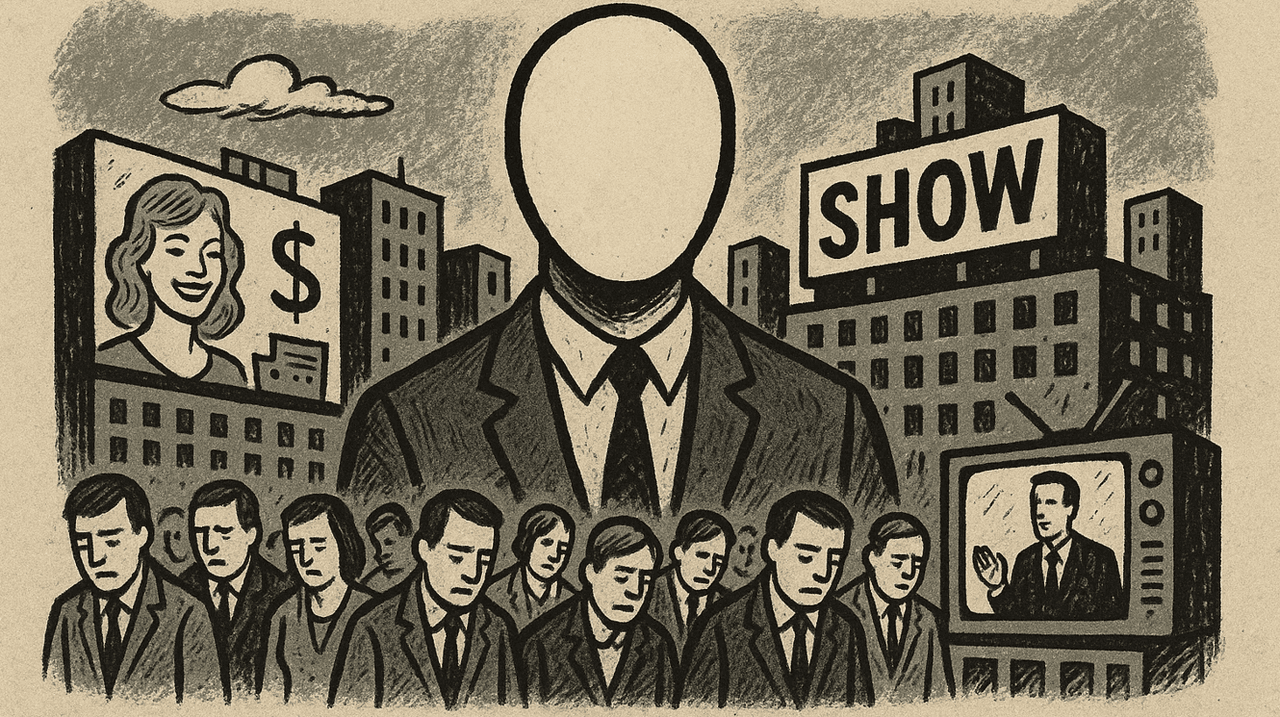
The Society of the Spectacle (Generated with Artificial Intelligence)
Mass media functions as the primary instrument of the spectacle. Newspapers, television, cinema, and digital media shape individual perception by substituting representational and visual information for direct experience. In this process, individuals form connections not with lived reality but with the mediated life presented to them.
The spectacle encompasses not only consumer goods but also lifestyles and symbols of social status. Products and services are consumed not merely for their functional value but for their symbolic meanings. Individuals’ sense of identity and social position are shaped through the images that are displayed and consumed.
According to Debord, the spectacle alienates individuals from active participation and pushes them into a position of passive observation. Social interaction occurs not through direct experience but through representation and spectacle, leading to a decline in individual subjectivity and social awareness.
The Society of the Spectacle is not merely a cultural phenomenon but also a political one. The capitalist system employs the spectacle as an instrument of social control and ideological reproduction. The spectacle serves as an effective mechanism for the reproduction of politics, ideology, and social norms. Individuals’ lived experiences are shaped and directed through the spectacle.
In the 21st century, the internet, social media, and digital platforms have expanded the scope of the Society of the Spectacle. Social networks encourage individuals to share their lives through representations, transforming the spectacle into both a personal and a social phenomenon. Digital spectacle, merging with global media and cultural industries, emerges as a universal phenomenon.


No Discussion Added Yet
Start discussion for "The Society of the Spectacle" article
Historical and Social Context
Core Dynamics of the Spectacle
Media and Representation
Consumption and Symbolism
Social Isolation and Passivity
Political and Cultural Dimensions
Digitalization and Contemporary Relevance