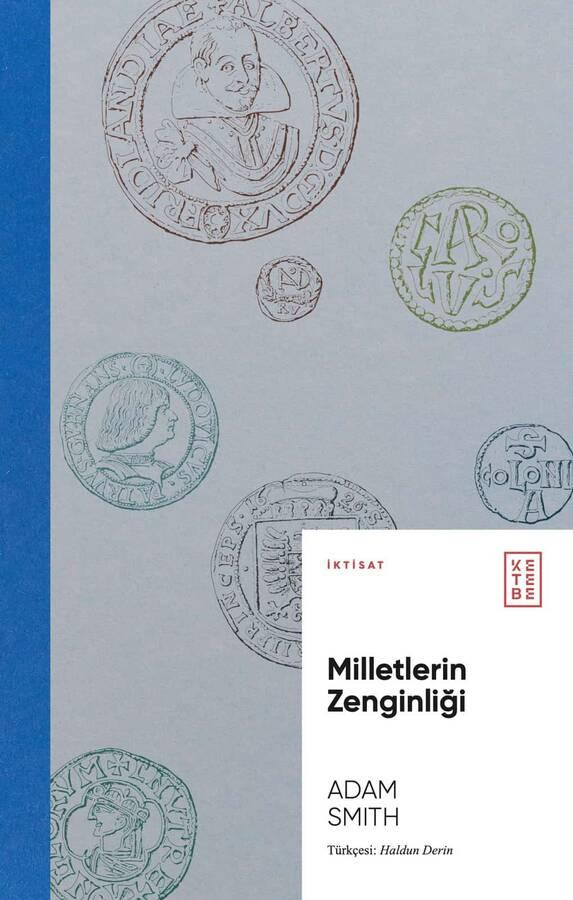
This article was automatically translated from the original Turkish version.
Full Title of the Work | An Inquiry into the Nature and Causes of the Wealth of Nations | ||||||||
|---|---|---|---|---|---|---|---|---|---|
Author(s) | Adam Smith | ||||||||
Publication Date | 1776 | ||||||||
Original Language | English | ||||||||
Genre | Economics Political Philosophy | ||||||||
The Wealth of Nations (An Inquiry into the Nature and Causes of the Wealth of Nations) is a five-volume economic treatise written by Scottish philosopher and economist Adam Smith and first published in 1776. This work is regarded as a turning point in the development of economics as a scientific discipline and forms the foundation of modern economics. It is considered one of the foundational texts of the classical school of economics.
The book systematically examines topics such as production trade division of labor government intervention and taxation. Smith argues that the foundation of economic activity lies in individuals’ desire to maximize their own self-interest. He contends that under conditions of a free market this individual pursuit of self-interest is guided by an invisible hand to promote societal benefit without deliberate planning.
The key concepts introduced in the work include:
The Wealth of Nations was written within the intellectual climate of the Enlightenment. It reflects the belief that natural laws could be applied to human society. When considered alongside Smith’s earlier work The Theory of Moral Sentiments (1759) a coherence emerges between economic rationality and moral philosophy.
Smith’s ideas advance a critique of mercantilism and laid the groundwork for later liberal economic theories. From the late 18th century onward the principles articulated in this work shaped the economic policies of many nations.
The Wealth of Nations holds a significant place not only in the history of economics but also in the broader history of social thought. The book directly influenced subsequent classical economists such as David Ricardo Thomas Malthus and John Stuart Mill. It also played a crucial role in helping to establish the theoretical foundations of market economies following the Industrial Revolution.
The influence of the work extended beyond economists to political scientists historians and sociologists who have consistently referenced it. Even today it remains one of the foundational texts taught in economics faculties worldwide.
Coase, Ronald H. “The Wealth of Nations.” Economic Inquiry 15 (July 1977): 309–325. https://web.ntpu.edu.tw/~guan/courses/Coase77.pdf.
Library of Economics and Liberty. “David Ricardo.” *Library of Economics and Liberty*. Accessed August 8, 2025. https://www.econlib.org/library/Enc/bios/Ricardo.html.
Mill, John Stuart. *Principles of Political Economy*. Project Gutenberg, 2009. https://www.gutenberg.org/files/30107/30107-pdf.pdf.
Smith, Adam. The Wealth of Nations. İstanbul: Ketebe, 2024. 1. baskı.

Full Title of the Work | An Inquiry into the Nature and Causes of the Wealth of Nations | ||||||||
|---|---|---|---|---|---|---|---|---|---|
Author(s) | Adam Smith | ||||||||
Publication Date | 1776 | ||||||||
Original Language | English | ||||||||
Genre | Economics Political Philosophy | ||||||||
No Discussion Added Yet
Start discussion for "The Wealth of Nations (Book)" article
Content and Core Ideas
Historical and Intellectual Context
Impact