

This article was automatically translated from the original Turkish version.
The Ship of Theseus paradox is a classical philosophical thought experiment that questions the concepts of identity and change. It raises the question of whether an object remains the same object if all of its components are replaced over time. This problem has not been limited to objects alone but has inspired significant debates in fields such as personal identity, consciousness, and existence. The paradox has captured the attention of philosophers throughout history and has enriched philosophical thought through various variations.
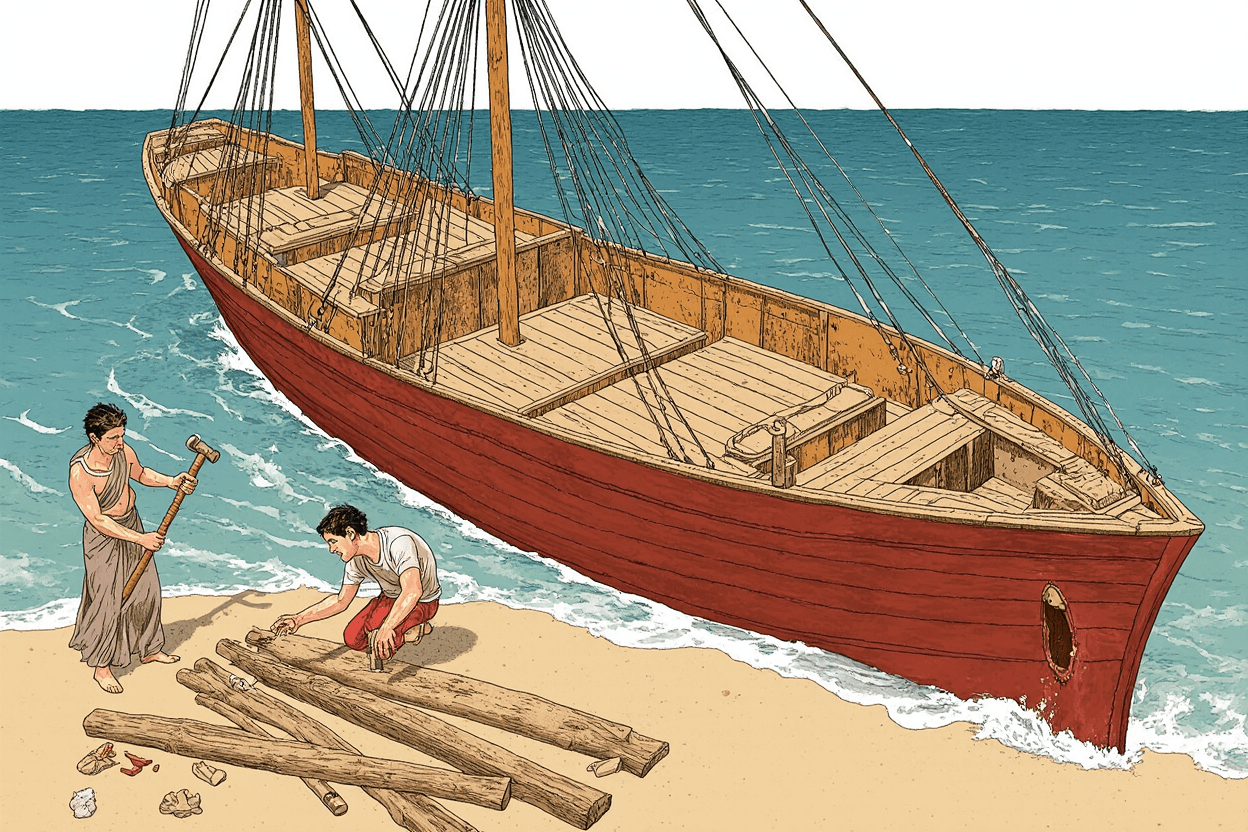
The Ship of Theseus (Generated with Artificial Intelligence)
The Ship of Theseus paradox was most clearly articulated in the late first century BCE by the Greek historian and biographer Plutarch in his work “Life of Theseus.” Plutarch recounts how the Athenians preserved the ship that Theseus and the young men used to return from Crete by replacing each rotted plank with a new one, thereby questioning whether the ship remained the same ship. The paradox was discussed even before Plutarch by philosophers such as Heraclitus and Plato, and later addressed in different forms by thinkers such as Thomas Hobbes and John Locke.
According to Plutarch, the ship was used by the Athenians for many years, and every decayed part was replaced with a more durable wooden one. This situation led to two opposing views among philosophers regarding whether the ship remained the same. Thomas Hobbes introduced a new dimension to the paradox by asking which of the two ships—the one rebuilt with new planks or the one reconstructed from the original parts—would truly be the original Ship of Theseus.
The classic formulation of the Ship of Theseus paradox focuses on the gradual replacement of all parts over time. However, this fundamental problem has been reinterpreted and expanded in various ways to apply to other objects and situations.
John Locke illustrated the paradox with an everyday example: a favorite sock that begins with a hole being patched. As more patches are added and the original material of the sock is entirely replaced, the question arises whether it is still the same sock. This example demonstrates how the incremental replacement of parts complicates the issue of identity.
Similarly, stories such as “my grandfather’s axe” or “George Washington’s axe” are common variations. Even if both the handle and the head of the axe have been replaced, the question remains whether it is still the same axe. In some cultures, such tales have become idioms like “family axe” or “family knife.” For instance, in French culture, Jeannot’s knife is considered the same knife despite having been replaced fifteen times—fifteen times for the blade and fifteen times for the handle. In Hungarian culture, “Lajos Kossuth’s pocket knife” is still referred to as the same knife despite continuous replacement, and this expression is used to describe objects that are entirely renewed yet remain the same.
Variations of the paradox are also discussed in modern legal and ethical contexts. For example, if both the grip and the barrel of a firearm used in a murder are replaced, is it still considered the “murder weapon”? Such questions point to practical applications of the paradox in daily life and challenge the boundaries of the concept of identity.
The paradox has not only raised questions about objects but has also provided a foundation for deep discussions on personal identity and continuity. The fact that human cells are constantly renewed while the individual remains the same reveals a direct connection between the Ship of Theseus paradox and personal identity. Some philosophers argue that even though the body changes continuously, personal identity persists; others contend that psychological continuity and consciousness are the essential elements of identity. The core question underlying the paradox is the tension between change and continuity: at what point does the gradual replacement of parts transform an object or person into something fundamentally different? In such cases where criteria for identity are not definitive, different perspectives and philosophical approaches have emerged. Some maintain that identity can be determined by fixed criteria (criterialism), while others deny the possibility of such certainty (anti-criterialism). These debates are especially prominent in metaphysical issues such as personal identity, death, and resurrection.
The Ship of Theseus thought experiment is now used to understand issues of identity and continuity related to artificial intelligence, organ transplantation, brain research, and technological advancements. In legal and ethical contexts, it serves as a reference for practical questions such as whether a firearm remains the same weapon after its parts are replaced.
EBSCO Research Starters. "Ship of Theseus." Accessed August 8, 2025.
Internet Encyclopedia of Philosophy. "Immortality." Accessed August 8, 2025. https://iep.utm.edu/immortal/.
Internet Encyclopedia of Philosophy. "Resurrection." Accessed August 8, 2025.
Levin, Noah. "Ship of Theseus." *Philosophical Thought*. Oklahoma State University, 2022. Accessed August 8, 2025. https://open.library.okstate.edu/introphilosophy/chapter/ship-of-theseus/
Meyer, Chris. "Ship of Theseus: How to Solve the Ancient Paradox." The Mind Collection. Accessed August 11, 2025. https://themindcollection.com/ship-of-theseus-identity-paradox/.
Stanford Encyclopedia of Philosophy. "The Unity of Consciousness." Last modified April 21, 2025. Accessed August 11, 2025.

No Discussion Added Yet
Start discussion for "Theseus's Ship (Thought Experiment)" article
History
The Ship of Theseus Paradox
Variations
Philosophical Debates on Identity and Continuity
Contemporary Applications of the Paradox