

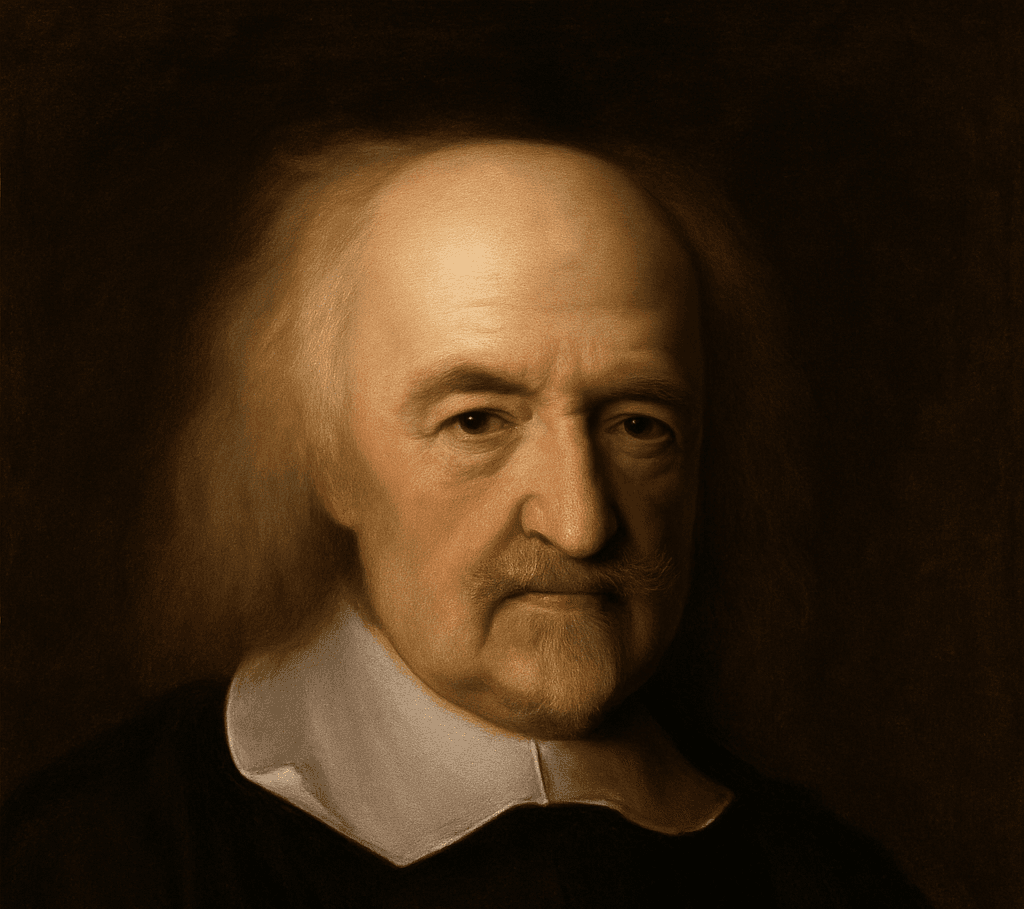
+2 More

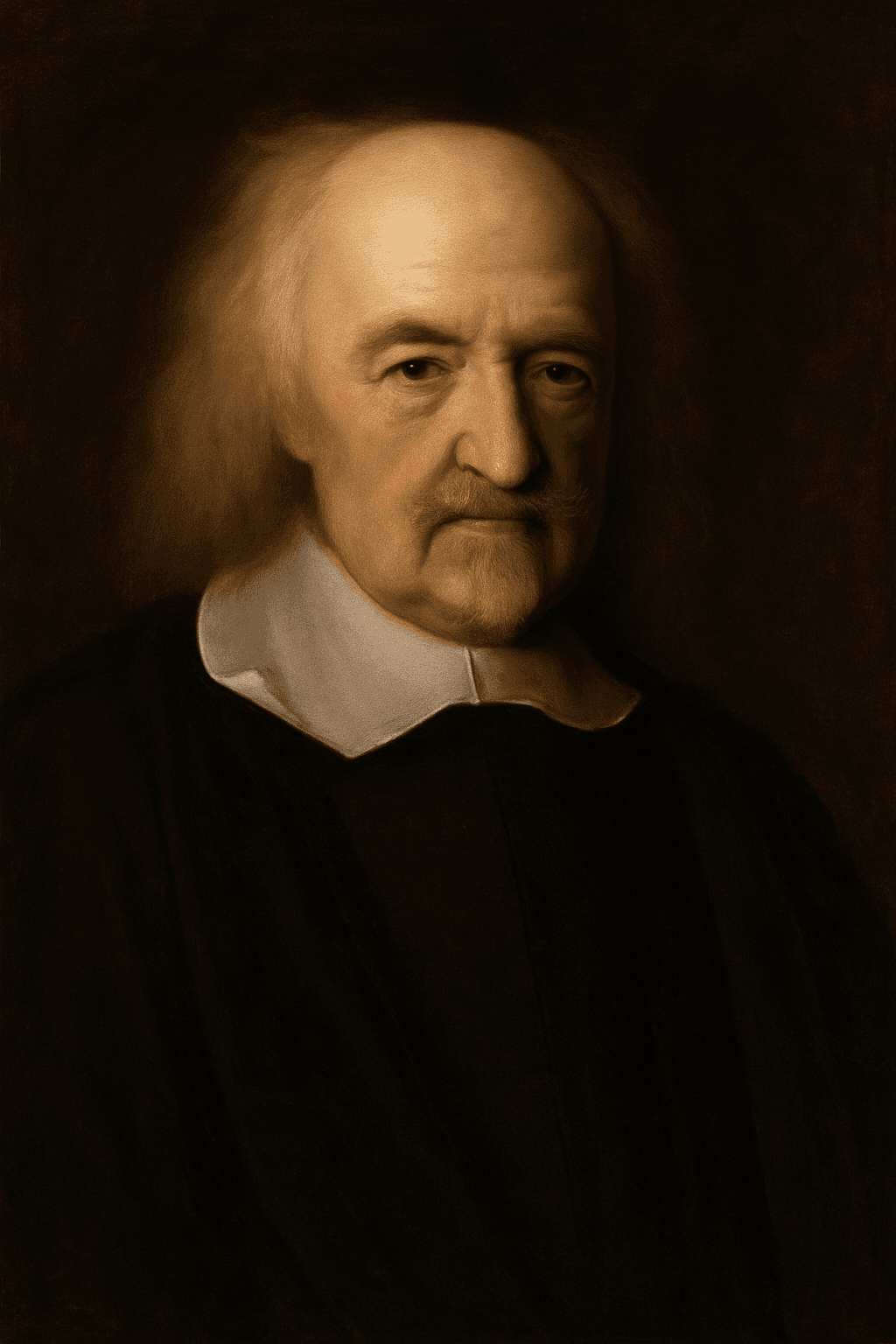
Generated with artificial intelligence.
Thomas Hobbes
Birth Year | 1588 | ||||||||
|---|---|---|---|---|---|---|---|---|---|
Death Year | 1679 | ||||||||
Nationality | English | ||||||||
Profession(s) | Philosopher Political Theorist | ||||||||
Important Work | Leviathan (1651) | ||||||||
Thomas Hobbes was born on 5 April 1588 in Westport, near the town of Malmesbury in England. His father was an Anglican priest but was removed from his position due to his violent temper and ignorance. Hobbes’s early life was largely under the guardianship of his uncle. He began his education in Malmesbury and later studied classical philology and logic at Magdalen Hall, part of the University of Oxford. Even at the age of fourteen, he translated Euripides’s Medea into Latin. After completing his university education, he joined the Cavendish family as a tutor, a relationship that lasted until the end of his life.
Through the Cavendish family, Hobbes gained access to leading thinkers and politicians of his time. His travels across Europe enabled him to observe political institutions firsthand, particularly in Italy and France. In the 1630s, he met Galileo in Florence and Descartes and Gassendi in Paris. These intellectual encounters significantly influenced his development of the idea that the methodology of the natural sciences could be applied to political philosophy.
Hobbes’s philosophy is a holistic system based on a mechanical understanding of nature. His thought aims to explain human behavior and social order using methods derived from the natural sciences. This system took shape in four major works: De Cive (1642), De Corpore (1655), De Homine (1658), and most importantly, Leviathan (1651).
Leviathan is the central work of Hobbes’s political philosophy. It addresses issues such as human nature, the state of nature, the social contract, sovereignty, and the necessity of absolute authority. According to Hobbes, human beings in the state of nature are equal and free, but this condition is also one of insecurity and constant conflict. Therefore, individuals enter into a contract with one another, relinquishing their natural rights and submitting to a sovereign authority—the Leviathan—to ensure peaceful coexistence.
Hobbes’s political philosophy is founded on the pursuit of authority and order. For him, social peace and security can only be achieved when individuals surrender their freedoms and grant absolute power to a sovereign. The sovereign’s will constitutes the source of law. According to Hobbes, law is the command of the sovereign; justice exists only when defined by a political authority. Thus, law does not derive from natural law but from the will of the sovereign authority established by the social contract.

The characteristics of the sovereign are as follows:
Hobbes subordinates religious authority to civil authority within the framework of Christianity. According to him, the church must operate only in accordance with the sovereign’s will. He criticizes the Roman Catholic Church for causing fragmentation of authority. This view is elaborated in detail in the fourth book of Leviathan, titled “The Kingdom of Darkness.”
Hobbes’s ideas generated widespread反响 across Europe, especially in England. Throughout his life, his views provoked strong reactions, and some of his works were banned from publication in England. His critical stance toward the church and traditional authorities led to accusations of atheism, and he was even blamed for the outbreaks of plague and fire in England.
His major works include:
Thomas Hobbes died in 1679 at the age of 91. Throughout his life, his ideas in politics, law, and religion became foundational pillars of modern political thought. His contributions to legal philosophy, the theory of sovereignty, and the concept of the social contract have left lasting impacts on subsequent thinkers. He is regarded as one of the architects of the theoretical foundations of the modern state.
Stanford Encyclopedia of Philosophy. “Thomas Hobbes.”
World History Encyclopedia. "Thomas Hobbes." Accessed [insert date]. https://www.worldhistory.org/trans/tr/1-22450/thomas-hobbes/

Generated with artificial intelligence.
Thomas Hobbes
Birth Year | 1588 | ||||||||
|---|---|---|---|---|---|---|---|---|---|
Death Year | 1679 | ||||||||
Nationality | English | ||||||||
Profession(s) | Philosopher Political Theorist | ||||||||
Important Work | Leviathan (1651) | ||||||||
Philosophical and Political Thought
Political Theory and Concept of Sovereignty
Critique of Religion and the Church
Works and Influence
Death and Legacy