

This article was automatically translated from the original Turkish version.
+2 More
Location | Maya Forest Petén Region Guatemala | ||||||||
|---|---|---|---|---|---|---|---|---|---|
Area(s) | 57 600 hectares | ||||||||
UNESCO Status | World Heritage Site since 1979 (mixed heritage: cultural + natural) | ||||||||
Settlement Period | 6th century BC – 10th century AD | ||||||||
Original Name(s) | Yax Mutal Mutul | ||||||||
Important Structure(s) | Mundo Perdido Complex North and Central Acropolis Great Plaza Temple IV Temple II Temple I (Jaguar Temple) | ||||||||
Population | Approximately 50,000 to 100,000 people | ||||||||
Excavation Date | systematic excavations in the 1950s Rediscovery in the 19th century | ||||||||
Tikal National Park is located in the Petén region of northern Guatemala as one of Central America’s most significant archaeological and natural sites. The park holds universal value due to its role as the center of the Maya civilization and its containment of one of Central America’s tropical ecosystems.
It is one of the rare sites inscribed on UNESCO’s World Heritage List in 1979 under both cultural and natural criteria. The park reflects the political religious and artistic development of the Maya civilization through its monumental temples palaces stelae and extensive settlement remains while also being of critical importance for biodiversity conservation due to its rich fauna including jaguars pumas and hundreds of bird species.

Tikal National Park (roaming-the-planet)
Tikal National Park is situated in northern Guatemala within the Petén department and forms part of the extensive ecological corridor known as the Maya Forest. The area covers 57600 hectares and constitutes one of the core zones of the Maya Biosphere Reserve. The Maya Forest is one of the largest forest areas in Central America extending into Mexico and Belize.
The park’s ecosystem comprises wetlands savannas tropical broadleaf forests and palm groves. Over 200 tree species and more than 2000 plant species have been recorded here. The fauna is equally remarkable: five feline species (jaguar puma ocelot margay and jaguarundi) Baird’s tapir black-tailed deer sloths anteaters and various monkey species inhabit the park. Additionally over 330 bird species including the harpy eagle scarlet macaw and great curassow have been observed. This biological diversity has secured Tikal’s status as a world heritage site not only for its archaeological significance but also for its ecological value.

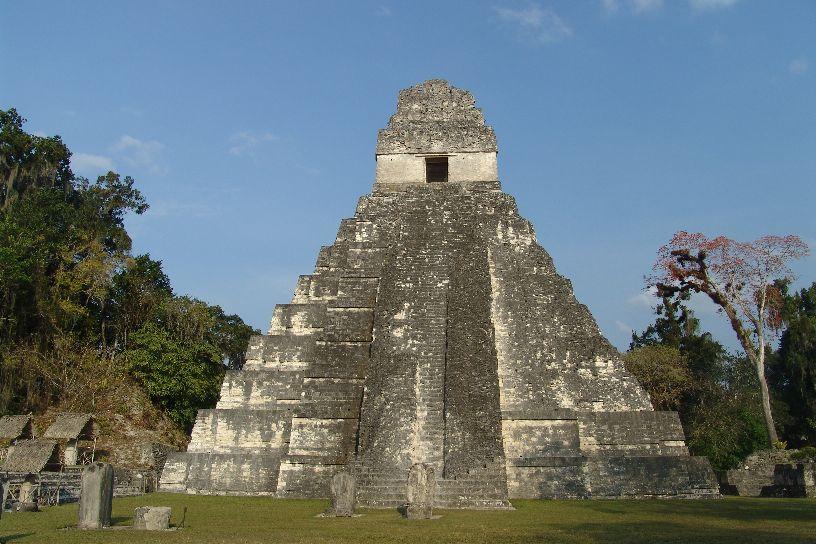
Tikal Great Jaguar Temple (Welly Huang)
Settlement at Tikal began around 600 BCE with the city’s monumental architecture emerging from the 1st century CE onward. In Maya sources the city is referred to as Mutul or Yax Mutal. Tikal’s growth was made possible through the effective use of surrounding natural resources. Cedar wood copal resin flint red dye wood and above all maize agriculture formed the economic foundation of the city.
In the 4th century CE Tikal encountered strong influences from Teotihuacan. Both trade relations and political interventions left their mark on the city’s architecture and culture. During this period Tikal became a regional power by defeating rival cities such as Uaxactún and Río Azul.
Tikal’s golden age began during the reign of Jasaw Chan K’awiil in the 7th century. During this period the city defeated rivals such as Calakmul and accelerated the construction of monumental temples and pyramids. It is estimated that the population of the city and its surrounding settlements exceeded 50000 and its area of dominance reached approximately 200 km².
During the 8th and 9th centuries CE Tikal began to decline due to environmental pressures drought population growth and agricultural challenges. By the end of the 9th century the city was abandoned and its structures became buried under forest vegetation. Tikal remained concealed beneath dense vegetation until it was rediscovered by European researchers in the mid-19th century.

Tikal National Park and Great Jaguar Temple (Matthias Stutzman)
The structures preserved at Tikal include temples palaces stelae ball courts and extensive water systems. Approximately 3000 structures have been documented to date.
Additionally Tikal contains numerous stelae (upright stone slabs) and inscribed monuments. These stelae depict the city’s rulers military victories and religious rituals. One of the oldest stelae is dated to 292 CE.
Tikal was officially rediscovered in 1848 but systematic excavations began only in the mid-20th century. The Tikal Project conducted by the University of Pennsylvania Museum between 1956 and 1970 lasted approximately 14 years and uncovered hundreds of structures. During this period both monumental architecture and numerous artifacts related to daily life were documented.
It is now known that only about 15 percent of Tikal has been excavated with the majority still buried beneath forest vegetation. Modern technologies such as lidar surveys have revealed that Tikal was in fact part of a much larger metropolitan area.

Tikal National Park (Diueine Monteiro)
Tikal was inscribed on UNESCO’s World Heritage List in 1979. The park is designated as a mixed heritage site due to its cultural and natural values.
Tikal was declared a national monument in 1931 and a national park in 1955. Today it is protected as part of the Maya Biosphere Reserve. However the site faces numerous threats: illegal hunting illegal logging fires climate change and uncontrolled tourism pressure are among the most significant.
According to UNESCO and IUCN assessments mass tourism waste management and ecological pressure are identified as the greatest future threats to Tikal. Management plans aim to integrate archaeological preservation with the sustainable use of natural resources.
Tikal National Park is a world heritage site that unites the cultural legacy of the Maya civilization with the tropical ecosystems of Central America. Through its monumental architecture inscribed monuments and biological diversity it represents the shared heritage of human history and nature. Recognized by UNESCO as a mixed heritage site Tikal holds global significance for understanding past civilizations and conserving biodiversity.
Cartwright, Mark. “Tikal.” World History Encyclopedia. Accessed October 3, 2025. https://www.worldhistory.org/Tikal/
Huang, Welly. “The Great Jaguar, Tikal in Guatemala.” Pexels. Accessed October 3, 2025. https://www.pexels.com/photo/the-great-jaguar-tikal-in-guatemala-20506127/
IUCN World Heritage Outlook. "Tikal National Park." Accessed October 3, 2025. https://worldheritageoutlook.iucn.org/explore-sites/tikal-national-park
Instituto de Rehabilitación y Preservación del Medio Zootropológico y Cultural de la Comunidad (IRPMZCC). "Parque Nacional de Tikal." Accessed October 3, 2025. https://irpmzcc2.org/patrimonio/mixto/parque-nacional-de-tikal
Leonard, Nick. “Tikal by Jungle Boy.” *Flickr*. Accessed October 3, 2025. https://www.flickr.com/photos/jungle_boy/136034067
Monteiro, Diueine. “Tikal, Guatemala.” Flickr. Accessed October 3, 2025. https://www.flickr.com/photos/diueine/8326620885/
Rainey, Froelich. “Tikal.” *Penn Museum.* Accessed October 3, 2025. https://www.penn.museum/sites/expedition/tikal/
Stutzman, Matthias. “The Great Jaguar, Tikal in Guatemala.” Pexels. Accessed October 3, 2025. https://www.pexels.com/photo/the-great-jaguar-tikal-in-guatemala-19254797/
UNESCO World Heritage Centre. “Tikal National Park.” Accessed October 3, 2025. https://whc.unesco.org/en/list/64/
World Heritage Sites. "Tikal National Park." Accessed October 3, 2025. https://worldheritagesites.net/tikal-national-park/
roaming-the-planet. "The Jungle Ruins of Tikal, Guatemala." Flickr. Accessed October 3, 2025. https://www.flickr.com/photos/roaming-the-planet/2490592497

Location | Maya Forest Petén Region Guatemala | ||||||||
|---|---|---|---|---|---|---|---|---|---|
Area(s) | 57 600 hectares | ||||||||
UNESCO Status | World Heritage Site since 1979 (mixed heritage: cultural + natural) | ||||||||
Settlement Period | 6th century BC – 10th century AD | ||||||||
Original Name(s) | Yax Mutal Mutul | ||||||||
Important Structure(s) | Mundo Perdido Complex North and Central Acropolis Great Plaza Temple IV Temple II Temple I (Jaguar Temple) | ||||||||
Population | Approximately 50,000 to 100,000 people | ||||||||
Excavation Date | systematic excavations in the 1950s Rediscovery in the 19th century | ||||||||
No Discussion Added Yet
Start discussion for "Tikal National Park" article
Geographical Location and Natural Environment
Historical Development
Early Settlement and Rise
Climax of the Classic Period
Decline and Collapse
Archaeological Structures
Research and Excavations
World Heritage Status
Conservation and Management