


This article was automatically translated from the original Turkish version.
+2 More
Tillo (District)
Foundation Date | On 18 May 1990, it gained district status under Law No. 3647 | ||||||||
|---|---|---|---|---|---|---|---|---|---|
Meaning(s) | Syriac for 'High Spirits' | ||||||||
Historical Origin | It came under Ottoman rule in 1514 with the Chaldiran Campaign; in the early years of the Republic, it was a subdistrict attached to Siirt, later becoming a township and then a district | ||||||||
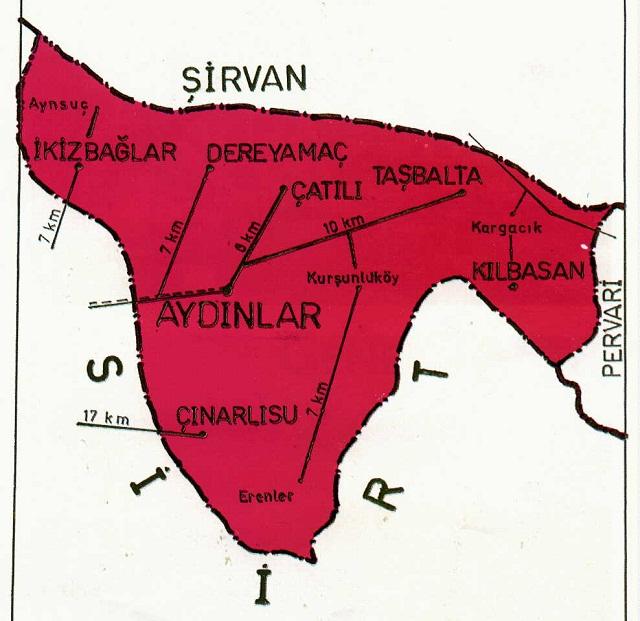
Tillo District attained district status on 18 May 1990 under Law No. 3647. Tillo, meaning “High Spirits” in Syriac, came under Ottoman rule in 1514 following Sultan Selim I’s campaign at Çaldıran. In the early years of the Republic, Tillo was a subdistrict under Siirt Province, later elevated from subdistrict to district status and renamed Aydınlar. This name reflects the region’s emphasis on knowledge and spirituality, indicating the presence of an enlightened community. Tillo is culturally significant due to the lives of scholars and mystics such as İsmail Fakirullah and İbrahim Hakkı. İbrahim Hakkı, in his work “Marifetname,” notes that his teacher İsmail Fakirullah’s ancestor, Mevlana Molla Ali, fled persecution from Cizre in 1504 and settled in Tillo, where he served as imam and teacher. This role was later continued by İsmail Fakirullah.
Tillo District lies between 42nd longitude and 38th latitude degrees and is located 7 kilometers from Siirt. It is bordered by Pervari to the east, Şirvan to the northeast, and Siirt Province to the west. The district has a continental climate with hot, dry summers and cold, rainy winters. The eastern part of the district is traversed by the Botan River in a winding course. Tillo’s terrain is hilly and its soil is calcareous, with limited arable land. The vegetation cover consists primarily of steppe; low shrubs and bushes are common. Although the forest cover is not abundant, oak, pistachio, bıttım, pear, almond trees and grape vineyards can be found. The district is not rich in water sources; numerous old cisterns and wells are present, but the water is generally too calcareous and salty for use. There are no flat areas such as plains or plateaus within the district.
Tillo’s economy is primarily based on agriculture and animal husbandry, but economic development remains weak. Aside from a few shops and tea houses in the district center, there are no other registered commercial enterprises. Its proximity to Siirt has negatively affected its development. A large portion of the population has migrated, and this trend continues. The local population generally sustains itself through agriculture and animal husbandry; pistachios, grapes and bıttım are cultivated depending on environmental conditions. Although some engage in beekeeping, the number of hives is very low. However, the district has significant potential for tourism. The tombs of prominent figures such as İsmail Fakirullah and İbrahim Hakkı attract both local residents and numerous visitors from outside the region.
Pistachio is one of the important agricultural products of Southeastern Anatolia. The pistachios grown intensively in Tillo are distinguished by their larger size and are comparable in quality to those from Antep and Iran. Pistachio cultivation is highly favored in the district due to its drought resistance and low maintenance requirements. Production is carried out either by grafting wild pistachio trees known locally as “bıttım” or by planting saplings grown in nurseries. Pistachio orchards in Siirt are concentrated especially in Tillo, and the pistachios produced here are marketed across the national market.
Tillo’s culture reflects a synthesis of spiritual values and communal unity shaped by literary works, traditions and customs. The traditions, rituals and artistic expressions of the civilizations that once dominated the region have shaped this culture, integrating them into a unified religious worldview. The district has a rich history in education and culture. The abundance of religious sites and places of pilgrimage attracts interest from both local residents and visitors from other regions. Additionally, there is a special museum displaying the works and personal belongings of İsmail Fakirullah and İbrahim Hakkı. In “Marifetname,” İbrahim Hakkı describes Tillo as a place with clean air, abundant orchards and trees, and beautiful buildings made of lime, where Mevlana Molla Ali settled in 1504. At that time, it is recorded that Tillo had 200 house, several shops, one inn, one bathhouse, three mosques and one Friday mosque.
Siirt Valiliği. "Tillo." Accessed April 8, 2025. http://www.siirt.gov.tr/tillo.
Siirt İl Kültür ve Turizm Müdürlüğü. “Tillo.” Accessed April 8, 2025. https://siirt.ktb.gov.tr/TR-56335/tillo.html
Tillo Kaymakamlığı. "Foto Galeri." Accessed April 8, 2025. http://tillo.gov.tr/foto-galeri.
Tillo Kaymakamlığı. “Tillo İsminin Tarihçesi.” Accessed April 8, 2025. http://www.tillo.gov.tr/tillo-isminin-tarihcesi-.
Tillo (District)
Foundation Date | On 18 May 1990, it gained district status under Law No. 3647 | ||||||||
|---|---|---|---|---|---|---|---|---|---|
Meaning(s) | Syriac for 'High Spirits' | ||||||||
Historical Origin | It came under Ottoman rule in 1514 with the Chaldiran Campaign; in the early years of the Republic, it was a subdistrict attached to Siirt, later becoming a township and then a district | ||||||||
Historical Development
Geographical Location
Economic Situation
Pistachio Cultivation
Cultural Situation