


This article was automatically translated from the original Turkish version.
Time capsule is a curated collection of documents and objects, deliberately sealed with the intent of preserving material and/or digital traces of a specific era for future generations, often designed to be opened on a predetermined date. Although related to archives and museums, time capsules are distinguished by their intentional structure of sealing and opening, their strategies for visibility (placement and marking), and the engineering choices made for longevity (materials, sealing, environmental conditions).
The selection of contents ranges from everyday objects to official documents, and from audiovisual recordings to eyewitness accounts; however, since every selection involves representation, capsules reflect not only “what” was preserved but also “how” it was intended to be remembered. Metadata, format descriptions, and multilingual or iconic indicators are critical to ensuring readability.

Opening of the 1915 time capsule embedded in the Cornerstone of the Memorial Amphitheater at Arlington National Cemetery (Flickr)
Time capsules are produced for diverse purposes including commemoration and celebration, public education, and institutional memory, as well as to leave a “message to the future.” They may take physical forms (tubes, cases, crypts), hybrid forms (paper–photographic–microfilm–magnetic/optical), or increasingly digital formats. The temporal horizon may span from several decades to a millennium; the opening date may be predetermined or left to be discovered in the future.
A robust time capsule is conceived as a program: the definition of purpose and scope, the design of content and narrative, the planning of preservation and storage conditions, the establishment of accessibility and documentation protocols, and the preparation of opening procedures and post-opening archival processing follow a logical sequence. This holistic framework positions the capsule both as a historical document set and as a public ritual of remembrance.
A time capsule is not merely an activity of “accumulating objects”; it is a deliberate practice of memory involving conscious processes of selection, representation, and transmission. The formation of collective memory is shaped by decisions about what to include and what to exclude; thus, capsules carry together the values, priorities, and blind spots of the social context in which they were created.
The capsule’s claim to “speak to the future” requires the sampling of a contemporary sense of time (through everyday objects, official records, audiovisual documents) alongside the co-design of keys to interpret this sample (explanatory texts, measurement and unit glossaries, technical format information). In this way, the capsule functions both as a “tool of remembrance” and as a communication system that enhances the validity of future interpretations.
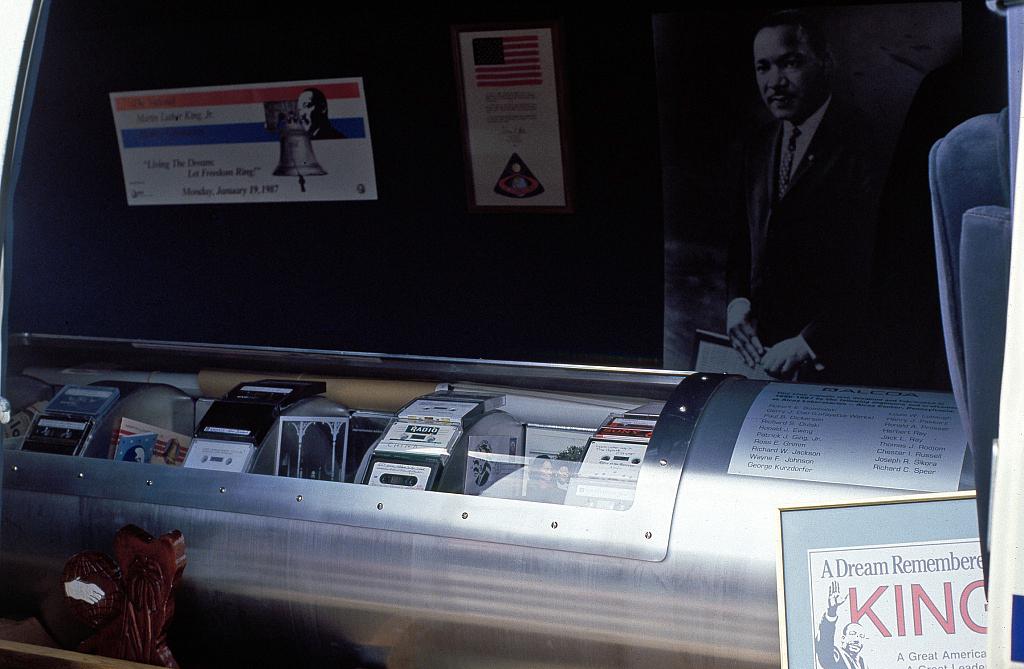
Time capsule containing some personal belongings of Dr. Martin Luther King Jr. (Library of Congress)
This practice rises on two fundamental tensions related to space and time. The first is the tension between representation and representativeness: a capsule is inevitably a limited selection; therefore, it reflects not the entirety of society but rather the perspective of a specific era and subject. The second is the tension between readability and accessibility: the longer the intended temporal horizon, the more “keys” are required to ensure future understanding of the contents—such as language, alphabet, iconography, technical formats, and copyright or privacy status.
Balancing these two tensions is the measure of a capsule’s conceptual success. The process intersects with principles of archiving and museology: documentation and contextualization, preservation and storage, followed by post-opening access policies, complement one another. Ultimately, when viewed as a program—with defined objectives, selection criteria, engineering and preservation decisions, visibility strategies, and public interpretation—the time capsule renders its relationship with collective memory transparent and sustainable.
The concept of the time capsule became prominent in the late 19th century with the institutionalization of the idea of “letters to the future,” emerging around exhibitions and ceremonial openings. Early examples aimed to leave behind samples of daily life and technical-administrative records for future generations. The first half of the 20th century marked the threshold at which this concept became systematic in scope and engineering. University-based “crypt” projects expanded the typology of contents and emphasized the need to design time capsules as programs. During this period, major exhibitions and fairs provided a public platform that heightened interest; capsules attracted attention not only through their contents but also through their visibility strategies and the ritualization of their opening.

Opening of the 1915 time capsule embedded in the Cornerstone of the Memorial Amphitheater at Arlington National Cemetery (Flickr)
The industrial-scale capsule developed for the 1938/39 New York World’s Fair marked a turning point in material selection (alloys, sealing), burial depth, and “location” strategies (logbooks, key texts, coordination). During the Cold War years, time capsules became widespread among local governments and educational institutions and acquired associations with the idea of a “secure message to the future,” linking them to concepts of crisis and disaster. From the 1990s onward, the inclusion of digital and hybrid media made the issue of readability more visible, highlighting the need to co-design technical formats, metadata, and multilingual or iconic keys.
With the 2000s, two new trends emerged: on one hand, large-scale, millennium-focused collective capsule initiatives and public ceremonies; on the other, the media coverage of planned or accidental openings of previously buried capsules. In recent years, discoveries and openings in various countries have renewed public interest; capsules are now discussed not only for their contents but also for the practices of exhibiting and interpreting their opening moments. During this process, museums and archives have developed protocols for triage, documentation, and balanced preservation-access strategies for found capsules; risks associated with digital carriers and magnetic-optical media have become inseparable components of post-opening processing.
In Türkiye, practices have followed a trajectory parallel to global trends. Throughout the Republican era, initiatives with the character of time capsules occasionally emerged through municipalities, educational institutions, and local efforts; in recent years, their connection to commemoration and public history has become more pronounced. At university and municipal levels, capsules have been linked to institutional anniversaries or major urban and cultural events; contents are typically organized around high-representational everyday objects, official documents, local press samples, and digital records.

The Loyola University Time Capsule, Buried for Opening in 2152 (Flickr)
In recent times, the concept of a “message to the future” has also been incorporated into projects aimed at commemorating social events. In these examples, decisions regarding engineering and storage conditions—material selection, placement, labeling, and opening schedule—have been planned to align with international standards; after-opening archival processing and access policies, however, vary according to institutional capabilities.
The general trend has been for time capsules to evolve from being perceived as singular objects into interdisciplinary design and documentation programs. This transformation has elevated time capsule projects beyond mere “memory boxes” of a specific era, turning them into enduring memory infrastructures that integrate representation, legibility, engineering, and ethical dimensions.
The success of a time capsule depends as much on its housing design and storage conditions as on its contents. The housing typically favors corrosion-resistant metals such as stainless steel or nickel-bronze alloys and inert filling approaches including desiccant packets, low humidity, and inert gases where applicable. Sealing must be dual-barrier and controllable: welded or threaded cap combinations supported by elastomeric gaskets are recommended to minimize damage during opening. Contents are packaged in acid-free, buffering materials; paper, photographs, magnetic-optical, and digital carriers are separated. Special microclimates, pH-neutral supports, and mechanical shock insulation are particularly important for photochemical and magnetic environments.
The storage location is selected to minimize environmental risks. If buried, a site below the frost line, distant from groundwater and flood hazards, with good drainage is preferred; soil chemistry including salinity and acidity is taken into account. Alternatively, indoor “crypt/niche” solutions offer an option that limits temperature-humidity fluctuations and enhances security. For long-term preservation, a protective intermediate space (secondary containment) can be designed between the outer housing and inner capsule; passive indicators such as corrosion coupons or external environmental data loggers are preferred to monitor integrity, while active electronic dependencies that could compromise the capsule’s integrity are kept to a minimum.

Diagram Showing the Double-Layer Protection of a Time Capsule (Flickr)
Discoverability design ensures that the capsule will be found and correctly interpreted in the future. Permanent surface markings such as monuments or plaques are supported by geodetic coordinates and multiple reference points; location data is duplicated in archival records held by different institutions. The “key text” package includes an inventory of contents, units of measurement and weight, date and numbering systems, language and alphabet explanations, and opening protocols; multiple languages and iconographic indicators are used where possible. For digital content, a long-lasting “reading guide” within the capsule—detailing file formats, checksums, schemas, and indexes—is considered alongside analog backups such as high-quality prints or microfilm.
Risk management is an integral part of the design. Physical protection and insurance strategies are planned against external threats such as vandalism, construction activity, earthquakes, and flooding; capsule information is duplicated so it is not reliant on a single location. Content that raises copyright or personal data concerns is excluded from the capsule; substances posing biological or chemical risks are avoided. Authority and timing for opening are defined in alignment with institutional and legal frameworks; pre- and post-opening procedures—triage, documentation, conservation, and access policies—are integrated into the program from the outset. This holistic approach aims to ensure that the capsule is not only durable but also discoverable and comprehensible.
Content selection is a strategic stage that directly affects the capsule’s representativeness and future legibility. First, the “purpose and scope” are clearly defined: Is the capsule intended to document an anniversary, convey an institution’s institutional memory, or communicate a social event to future generations? Based on this framework, a content typology is established: everyday objects (currency, tickets, packaging), official-administrative documents, local and national press samples, audiovisual recordings, measurement and technical documents, personal testimonies, and digital materials.
Selection should aim for “plural representation” and “contextual richness”: alongside singular or exceptional items, materials reflecting the ordinary experiences of the era must be included. Each item should be packaged with descriptive metadata—title, production date, creator/institution, material/format, and a brief content summary—and a key “reading guide” addressing language, measurement units, and date notation must be added. For digital content, format and integrity validators such as checksums should be considered alongside analog backups such as high-resolution prints or microfilm.
Adherence to ethical principles is decisive both during selection and in post-opening use. Personal data-containing documents—such as addresses, biometric data, health records, or information about children—must not be included in the capsule; materials with strong public interest, clear consent, and transparent information processes are preferred. Use of personal testimonies must be based on written consent and informed consent principles; anonymization should be applied where necessary. In terms of representation and bias, a balanced selection must reflect diverse social groups and perspectives; the selection committee must be pluralistic and interdisciplinary to prevent the capsule from being reduced to a mere institutional communication tool.

A Letter Recovered from a Time Capsule (Flickr)
Harmful or hazardous materials—biological samples, volatile chemicals, explosive or flammable contents—must not be placed in the capsule; consultation with relevant communities is required for objects with cultural sensitivities. The legal framework defines boundaries regarding copyright, ownership rights, and opening and access policies. Copyright permissions for publications, photographs, films, and audio recordings to be included must be clarified in advance; contractual agreements must cover rights and obligations arising from future opening and public exhibition. In institutional productions, licensing and transfer terms must be clearly stated; for third-party works, the license type (full license, limited license, public domain, open license, etc.) and geographic-temporal restrictions must be documented.
Administrative documentation must specify who owns the capsule, where it will be stored, and who holds the authority to open it; necessary permissions must be obtained for the legal status of the burial or placement site—private property, public land, or protected heritage area. The opening and access policy must be two-way: (i) conditions for public presentation and exhibition at the time of opening, and (ii) post-opening archival processing, digitization, researcher access, and reuse licensing. This policy can be supported by graduated access—restricting certain content for a limited period—and retention periods where appropriate.
The triad of selection, ethics, and law must be systematized through a management document: purpose and scope, content typology, exclusion criteria, metadata schema, copyright and consent forms, storage-access policy, and opening protocol must all be contained in a single file; decision-making processes must be formally recorded. In this way, the capsule becomes not merely a container preserving traces of its era, but a transparent, accountable, and sustainable memory program.
An archival approach to a time capsule requires a seamless workflow from discovery to long-term access. The first stage is stabilization and documentation: the capsule’s location, position, and environmental conditions are recorded photographically and via video; deformations on the outer housing, moisture and corrosion traces, and seal details are noted. Chain-of-custody records are initiated; the opening procedure is conducted, where possible, in a controlled temperature-humidity environment with appropriate personal protective equipment.
To mitigate potential risks from hazardous content (volatile chemicals, mold, biological load), a ventilated work station is preferred; surface cleaning and sampling (if necessary) are conducted prior to opening the container. During capsule opening, step-by-step documentation (high-resolution images and brief descriptions) and triage are applied: paper, photographs, magnetic–optical media, and objects are separated into distinct trays; items showing signs of wet or active deterioration are prioritized.
Conservation and preservation assessments are tailored according to the nature of the contents. For paper and photographic materials, surface dust and residues are removed using dry methods; acidic supports are removed and items are repackaged with acid-free intermediates. For magnetic–optical and native digital carriers, physical cleaning, detection of surface damage, and brief functional tests are performed prior to permanent reading. Simultaneously, basic identification and contextual information (title, date, creator/institution, brief content description) are collected for each item; this data will later be encoded into a standardized metadata schema for further elaboration. If a “key text” or logbook accompanies the capsule, its legibility and interpretive information (units of measurement, date/alphabetic explanations, opening instructions) form the foundation of the access strategy.
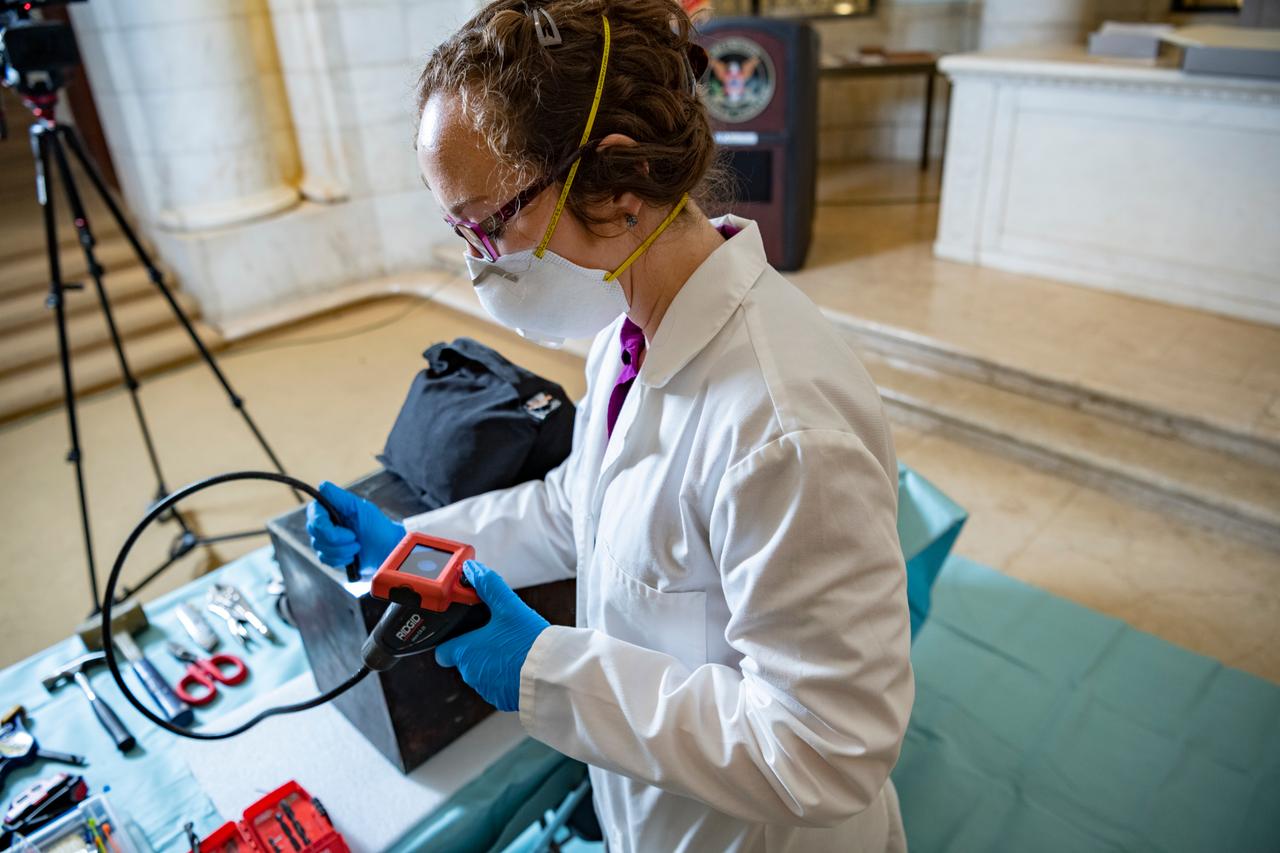
One Frame from Inspections Conducted Before Opening a 100-Year-Old Time Capsule (Flickr)
Processing of digital content is centered on integrity and traceability. The principle of write-protection on original carriers is strictly observed; where possible, bit-level imaging is performed, followed by generation and verification of integrity checkers (e.g., checksums). File and directory structures are preserved and transferred to a temporary quarantine area; malware scans are completed. Protection strategies including duplication and, where necessary, format migration are planned to address risks to long-term access of original file formats; each transformation step is recorded with date, tool, and parameter details. Explanatory “reading guides” and technical documentation for digital content are prepared alongside the capsule’s opening narrative for researcher access.
Before transitioning to access and display, short- and medium-term storage conditions are defined: acid-free boxes and appropriate microclimates are established; supportive transport and storage solutions are planned for large objects. When a decision is made to exhibit, light, temperature, and humidity limits; security measures and display materials are determined in accordance with conservation principles. Public announcements and educational materials are prepared to preserve the archival context; selections are described in transparent language that acknowledges the existence of non-selected items.
Finally, management and policy documents are updated: the opening protocol, access and reuse conditions (licenses, restrictions), personal data and copyright controls, retention periods, loan and usage procedures, and, where applicable, phased access models are formalized in writing. For long-term preservation, backup schedules and geographically dispersed copies, periodic condition assessments, and conservation reporting timelines are established. This comprehensive protocol aims to ensure that the capsule opening is not merely a one-time event but that its contents are securely, traceably, and fairly transmitted to future generations in accordance with principles of equitable access.
In recent times, time capsules have entered public discourse not only through planned opening ceremonies but also through serendipitous discoveries during restoration and maintenance work. At Ankara’s Middle East Technical University (METU), during its Alumni Day on 7 July 2023, a steel capsule prepared in commemoration of the 100th anniversary of the Republic was filled with a curated selection of messages, wishes, images, and photographs from students, alumni, and staff, and ceremonially buried for opening on 11 July 2048. The sole key symbolizing the authority to open it was entrusted to METU Rector Prof. Dr. Mustafa Verşan Kök.

Time Capsule Buried for Opening 50 Years After 15 July (Anadolu Agency)
Similarly, during the inauguration of the 15 July Democracy Martyrs Memorial Park in İzmit, Kocaeli, on 15 July 2017, a “15 July Time Capsule” containing images, photographs, MOBESE recordings, chronological presentations, and letters relating to the coup night was placed for opening on 15 July 2067. The capsule’s lid was formally handed over to the High Council of Monuments for preservation and authority transfer. In both cases, the capsule was designed not only through its content selection but also through its institutional chain of custody, opening schedule, and authority protocol.
In the United States, the National World War I Museum and Memorial in Kansas City publicly unveiled a capsule buried within the monument tower for nearly a century on 16 October 2024. Access required drilling through a 45-centimeter layer of concrete and limestone; during opening, a bomb disposal unit was on standby to mitigate risks from nitrate film typical of the 1920s.
Among the contents were metal engravings bearing the likenesses of U.S. presidents, local newspaper printing plates, a seed capsule, and a letter from President Calvin Coolidge; the institution simultaneously announced plans to create a new capsule. At the Massachusetts State House in Boston, a capsule attributed to Paul Revere and Governor Sam Adams from 1795 was discovered during renovation work in December 2014, removed from a cornerstone. After X-ray and preliminary examinations, it was opened on 6 January 2015, revealing coins, documents, and a metal plaque attributed to Revere, which were displayed briefly to the public.
In New York, a capsule prepared in 1914 by the Downtown Businessmen’s Association—originally intended to be opened in 1974—was lost after the association disbanded, only to be rediscovered in the 1990s in a Chelsea storage facility. It was opened on 9 October 2014 at the Museum of the City of New York, revealing 26 letters, various commercial documents, medallions, books, a telegram dated 23 May 1914 from Governor Martin Glynn, and a copy of the New York Times. During the same event, it was announced that a new capsule, to be opened in 2114, had been initiated with contributions from high school students.

Time Capsule Prepared by METU Students for Opening 25 Years Later (Anadolu Agency)
In Europe, within the cross atop the 100-meter dome of Esztergom Cathedral—the largest church in Hungary—a 176-year-old copper capsule was discovered during restoration work on 15 April 2021. Despite the building’s bombardment during World War II, the capsule had remained intact within the cross. Its seals were carefully opened, and records relating to its construction and historical context were cataloged.
The examples from these different contexts demonstrate that planned openings are supported by public-facing exhibitions and educational activities, whereas in accidental discoveries, the balance between technical access and preservation (for example, the risk of nitrate film) takes precedence. Additionally, it is noted that institutions plan their new capsule initiatives concurrently with the public interest and documentation opportunities generated by existing openings.

Conceptual Framework and Memory
History
Engineering and Design
Content Selection Principles, Ethics, and Law
Archival Practices and Opening Protocols
Recent Events and Media Chronology
