


This article was automatically translated from the original Turkish version.
Time Series Databases
History | and TimescaleDB emerged. Prometheus InfluxDB modern solutions such as OpenTSDB SCADA systems developed. In the 2000s It began with astronomical and meteorological observations. In the 20th century | ||||||||
|---|---|---|---|---|---|---|---|---|---|
Area(s) of Use | IoT: Sensor data monitoring. Finance: Stock and foreign exchange rate data. Telecommunications: Network traffic measurements. Energy: Electricity production and consumption monitoring. IT Monitoring: Server and system performance tracking. | ||||||||
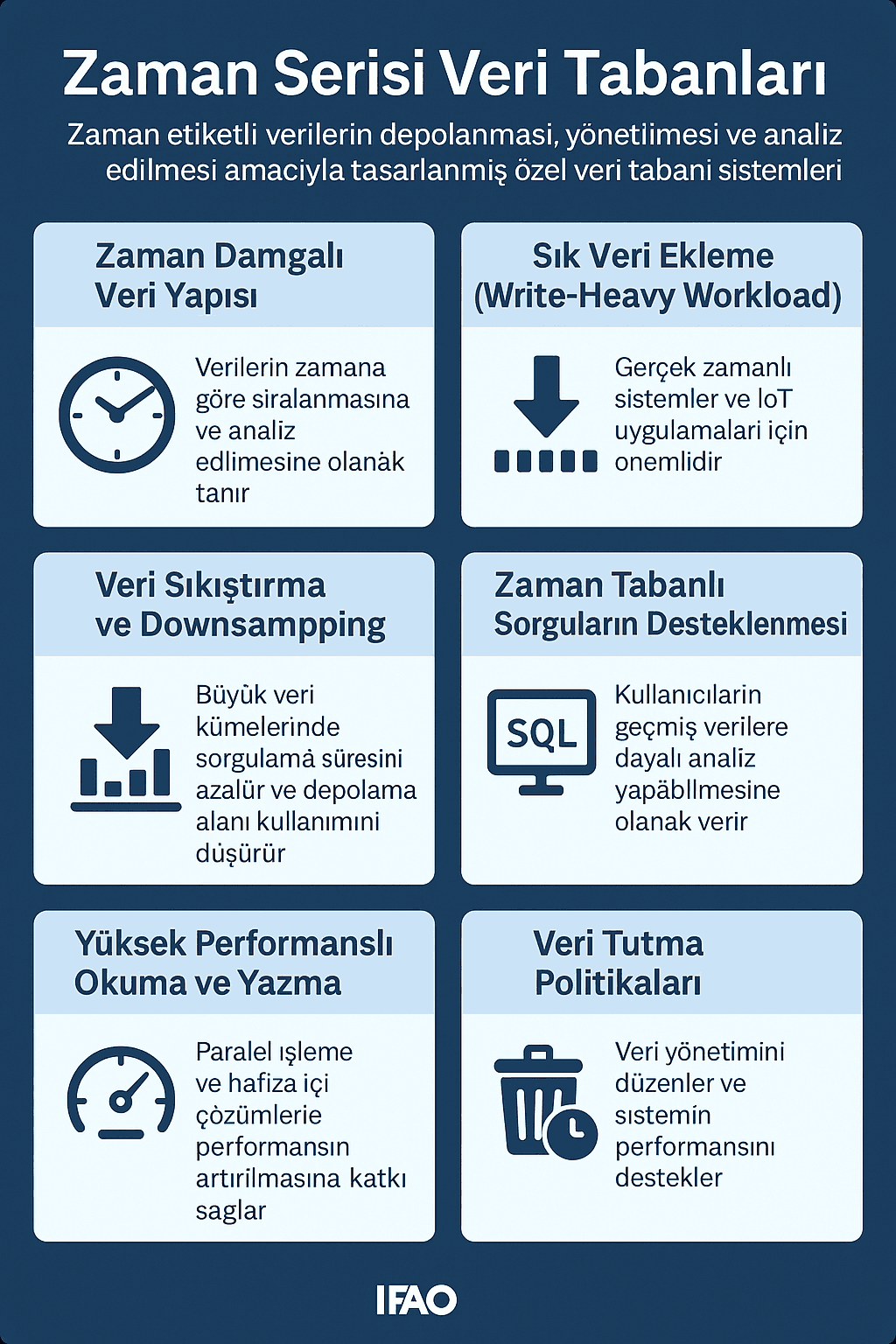
Time Series Databases (TSDB) are specialized database systems designed for the storage, management, and analysis of time-stamped data. These databases are commonly used to store continuously changing data such as sensor measurements, financial data, user activity, system performance metrics, and data from IoT devices. Data is stored with each entry tagged with a specific timestamp.
Each data record corresponds to a specific point in time. This structure facilitates the ordering and analysis of data over time. Analytical operations and statistical examinations are performed along the time dimension, which is particularly important for historical data analysis and trend monitoring.
TSDBs are optimized to support high-speed data ingestion, enabling thousands of data points to be safely recorded per second. This feature is critical in real-time systems and IoT applications. TSDBs are specifically engineered to manage rapid data streams without loss.
To reduce storage costs and enable fast access to historical data, techniques such as data compression and downsampling are employed. Downsampling involves aggregating data, for example, converting minute-level readings into hourly averages. This process improves query performance on large datasets while saving storage space.
These databases feature query languages that allow filtering and aggregation of data based on specific time intervals. In addition to SQL-like languages, specialized query engines may be used. This capability enables users to perform in-depth analyses based on historical data.
TSDBs are built with high-performance architectures that enable rapid time-dependent analyses and real-time monitoring. Performance is enhanced through parallel processing and in-memory solutions. This architecture is optimized for handling large data loads efficiently.
TSDBs typically allow the definition of policies that automatically delete or summarize data older than a specified duration. This feature simplifies data management and ensures system efficiency. Users can determine how long data should be retained, preventing unnecessary storage of obsolete information.
The systematic recording of time series data began with astronomical and meteorological observations. For instance, Galileo Galilei’s sky observations and temperature measurements in the 17th century are early examples of time series data collection. These observations represented the first efforts to understand how scientific data changes over time.
With the Industrial Revolution, performance data from mechanical systems began to be recorded. By the late 19th century, systematic monitoring of time-varying parameters in engineering applications—such as steam pressure and temperature—became common. Manual data collection was prevalent during this period, but devices like chart recorders were used to visualize the data.
In the mid-20th century, with the advancement of automation systems, data collection transitioned to electronic formats. Industrial control systems such as SCADA (Supervisory Control and Data Acquisition) enabled the digital recording of time-dependent data. In these systems, data was typically stored in relational databases, but these structures proved inadequate for handling high-volume, high-speed data ingestion.
With the rise of big data in the 2000s, the volume of time series data increased dramatically. During this period, the first specialized time series databases emerged. OpenTSDB (2011) was among the pioneers in this field, enabling distributed time series data management using the Hadoop and HBase infrastructure.
In the 2010s, advanced time series databases such as InfluxDB, Prometheus, TimescaleDB, and VictoriaMetrics were developed. These solutions gained prominence in the market due to higher performance, lower latency, and user-friendly interfaces. With the rise of cloud-based systems, these databases became widely adopted across various industries. In modern applications, TSDBs not only store data but also provide the foundation for advanced analytics and alerting systems.
Time series databases are extensively used in the following areas:
Continuous data streams from sensors are recorded and analyzed via TSDBs. For example, real-time monitoring of temperature, humidity, and pressure values is possible. Additionally, processes such as machine status and vibration measurements on production lines can be tracked.
Time-dependent data such as stock prices, exchange rates, and trading volumes are stored in TSDBs and used for financial analysis. They are also critical in algorithmic trading systems for rapid querying of real-time data.
Parameters such as network traffic, fault logs, and performance metrics are stored in time series databases. Fault detection and service quality analysis are based on this data.
TSDBs are used in applications such as electricity generation and consumption, energy efficiency, and infrastructure monitoring. Smart grids rely on TSDBs to track energy flow.
Metrics related to server, application, and network performance are recorded as time series to monitor system health. Prometheus, in particular, is widely used for system health monitoring.
Time series databases are used to monitor production efficiency, equipment status, and production parameters in factories. Each machine and sensor in the production process sends time-stamped data, providing insights into overall system efficiency.
Variables such as traffic density, air quality, noise levels, and public infrastructure status are monitored over time and used for urban planning.
Data such as heart rate, blood pressure, and sleep patterns collected from wearable devices are recorded as time series to enable health monitoring. This data is used for early disease diagnosis and treatment planning.
The growing volume and variety of time series data have led to the development of specialized database solutions designed to process such data. Below is an overview of some of the most widely used and prominent time series databases in current applications:
InfluxDB is known for its advanced query language (Flux) and built-in data visualization support. It is frequently chosen for scenarios such as IoT, application monitoring, and real-time analytics. Its lightweight architecture also allows deployment on edge devices.
Prometheus was developed for cloud-native architectures and is optimized for system monitoring and alerting. It integrates seamlessly with Kubernetes environments and features PromQL, a powerful time-based query language.
TimescaleDB is built on PostgreSQL and combines the flexibility of the relational data model with high-performance processing of time series data. Its SQL support makes integration with existing systems straightforward.
OpenTSDB is a distributed time series database that runs on HBase. It excels in long-term storage and analysis of large data volumes and is commonly used in telecommunications and infrastructure monitoring systems.
VictoriaMetrics stands out for its high compression ratio, fast query capabilities, and low system resource consumption. It can operate in both single-node and distributed modes and serves as a compatible alternative to Prometheus.
The architectures of time series databases are generally based on "append-only" data models. This structure aligns with the nature of time series data, where historical records are rarely modified and only new data is added. As a result, TSDBs store data as growing, sequential data blocks. Block-based storage enables efficient data compression and grouping by time intervals for optimized querying.
TSDBs use time-based sequential data compression algorithms to efficiently compress data. These algorithms typically rely on methods such as delta encoding, run-length encoding (RLE), and the Gorilla algorithm. Delta encoding stores only the differences between consecutive timestamps or data values, achieving high compression rates for measurements with low variability. The Gorilla algorithm, developed by Facebook, provides bit-level compression for time series data, optimizing both storage and in-memory usage.
TSDBs are not limited to data storage; they also provide real-time analytics and alert generation capabilities. For example, automated notifications or alarm systems can be triggered when system metrics exceed predefined thresholds. In systems like Prometheus, periodic queries are executed using PromQL on defined metrics to establish alerting rules.
In recent years, a notable trend in TSDB technology has been the increasing integration of machine learning. Time series forecasting models, anomaly detection, and automated control systems increasingly rely on TSDBs as their primary data source.
Doğan, Betül. "Zaman Seri Analizinde Temel Kavramlar." Academia.edu, 2019.
Kaynar, Oğuz, and Serkan Taştan. "Zaman Serileri Tahmininde ARIMA-MLP Melez Modeli." *Bilişim Teknolojileri Dergisi* 8, no. 3 (2015): 146-157.
Oktay, Aslinur. "Zaman Serileri Analizi 1." Academia.edu, 2015. https://www.academia.edu/20041611/Zaman_serileri_analizi_1
Çelik, Şenol. "Zaman Serileri Analizi ve Trafik Kazası Verilerine Uygulanması." *Iğdır Üniversitesi Fen Bilimleri Enstitüsü Dergisi* 3, no. 4 (2013): 43-51.
İslamoğlu, Ebrucan. *Aralık Değerli Zaman Serileri Öngörü Yöntemlerinin Karşılaştırılması.* PhD thesis, 2016.
Time Series Databases
History | and TimescaleDB emerged. Prometheus InfluxDB modern solutions such as OpenTSDB SCADA systems developed. In the 2000s It began with astronomical and meteorological observations. In the 20th century | ||||||||
|---|---|---|---|---|---|---|---|---|---|
Area(s) of Use | IoT: Sensor data monitoring. Finance: Stock and foreign exchange rate data. Telecommunications: Network traffic measurements. Energy: Electricity production and consumption monitoring. IT Monitoring: Server and system performance tracking. | ||||||||
No Discussion Added Yet
Start discussion for "Time Series Databases" article
Key Features
Time-Stamped Data Structure
Write-Heavy Workload
Data Compression and Downsampling
Support for Time-Based Queries
High-Performance Read and Write Operations
Data Retention Policies
History
Use Cases
Internet of Things (IoT)
Financial Systems
Telecommunications
Energy and Infrastructure Systems
Information Technology Monitoring
Industrial Automation
Smart City Applications
Healthcare Technologies
Popular Time Series Databases
InfluxDB:
Prometheus:
TimescaleDB:
OpenTSDB:
VictoriaMetrics:
Architecture and Data Model
Data Compression and Storage Techniques
Data Analytics and Alerting Systems
Future Developments