


This article was automatically translated from the original Turkish version.
+2 More
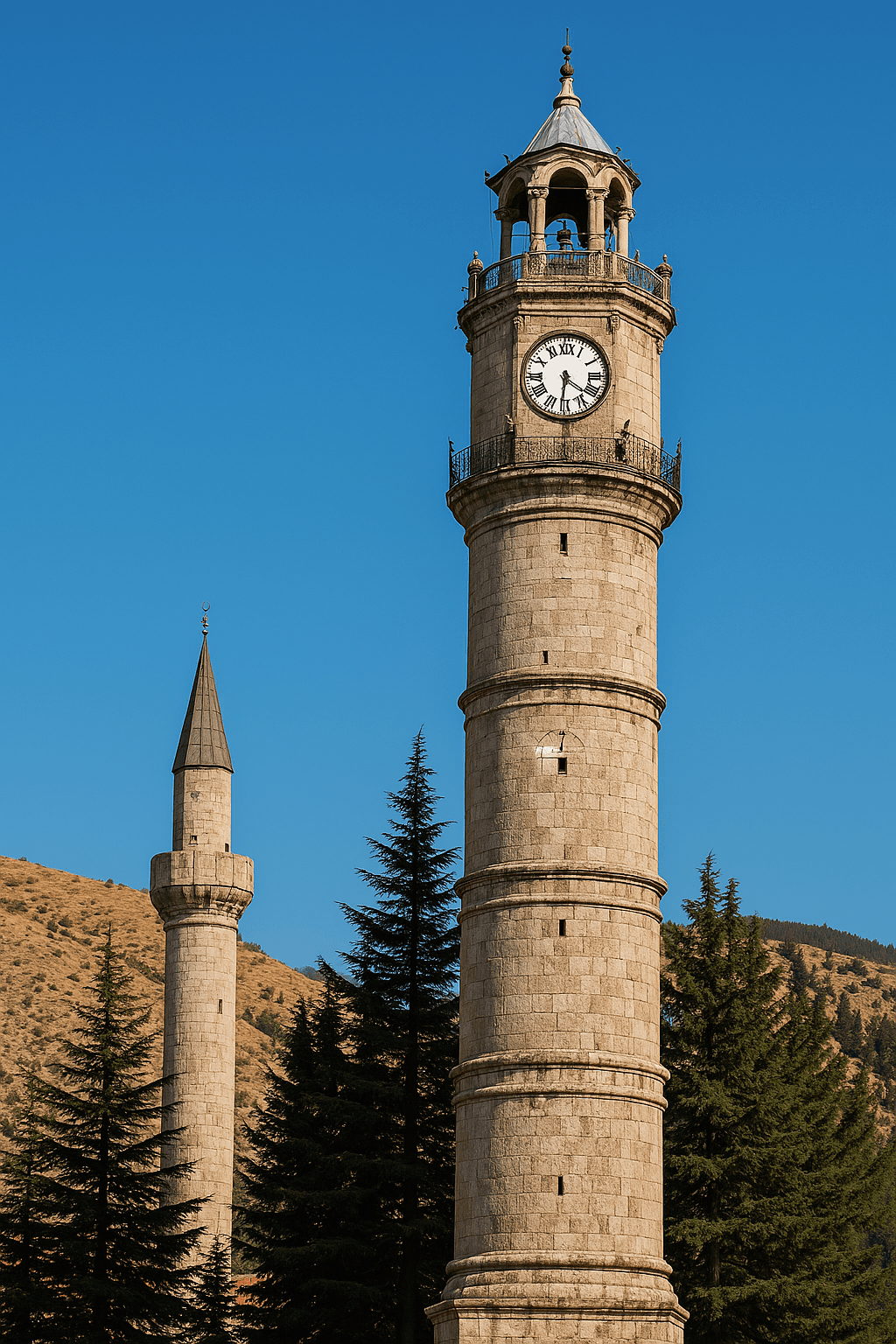
One of the symbols of Tokat is the Tokat Clock Tower, which has established its place in the city’s skyline as a historically and architecturally significant building. Built to commemorate the 25th anniversary of Sultan Abdülhamid II’s accession to the throne, the tower is one of the manifestations of the Ottoman State’s modernization process in the provinces. Located in the heart of the city, in the Behzat Neighborhood, right next to Behzat Camii, this structure has left deep imprints on Tokat’s social and cultural memory.

AI-generated image of the Tokat Clock Tower
The Tokat Time Tower was constructed in 1902 to mark the 25th anniversary of Sultan Abdülhamid II’s accession to the throne in 1901. The reign of Abdülhamid II (1876–1909) was a period marked by intensified efforts at modernization in the Ottoman Empire, during which structural transformations occurred in communication, transportation and education like. Clock towers built during this era carried great significance in the establishment of a standardized and centralized understanding of time. The rational and centralized control of time became an integral part of the empire’s modernization ideals. In this sense, clock towers represented symbolic instruments of temporal control.
As in many other provinces of the empire, the construction of a clock tower in Tokat served both as an expression of loyalty to the sultan and as a means of making the presence of central authority felt in the provinces. Most of these structures were realized through the combined contributions of the local population and municipal authorities within the framework of the sultan’s jubilee celebrations.
The Tokat Clock Tower’s construction was significantly influenced by Nuri Bey, the governor of Tokat at the time. Funding for the project was raised through donations from the local populace, with merchants and tradespeople providing support. In this regard, the tower emerged not merely as a top-down state project but as a collective work shaped by public participation. This collaboration between local administration and the community strengthened the sense of ownership toward the tower. Most of the stones used in its construction were sourced from the vicinity of Tokat and shaped by local craftsmen. This process not only utilized local labor but also resulted in a structure with a distinct architectural character unique to the city.
The Tokat Clock Tower has a cylindrical body and stands approximately 33.5 meters tall. Its base is wider, narrowing as it rises toward the top. The structure’s four facades each feature a clock, which were specially procured from Istanbul at the time. The tower culminates in an elegant architectural finish with a balcony-like projection at the upper level and a bell above it. A bell located at the top of the tower would ring at specific hours to announce the time to the public. This bell was also used to signal prayer times and important announcements. A narrow staircase inside the tower allows access to the upper levels. The clock mechanism, regularly maintained by a designated timekeeper, became one of the symbols of technological progress in Tokat.
In Ottoman cities, clock towers did not merely serve the function of timekeeping; they also functioned as social focal points. Similarly, the Tokat Clock Tower became a reference point for daily life and emerged as a space for specific gatherings. Through legends, memories and historical narratives passed down over generations, the tower has become an integral part of city memory. The introduction of the modern time system reorganized the rhythm of daily life, making the concept of time more prominent in areas such as education, trade, worship and public management. This shift represents a convergence point where traditional life practices encountered modernization.
Today, the Tokat Clock Tower serves both as a visual monument and a tourist gravity hub. Located in the Behzat Neighborhood at the center of the city, the tower complements a historic area that includes the nearby mosque, park and pedestrian paths. Periodic maintenance and restoration work are carried out under the supervision of the Ministry of Culture and Tourism to preserve the tower’s structural integrity. Additionally, initiated by the Tokat Municipality, the area surrounding the tower is used for cultural events and promotional activities. The Clock Tower continues to function as a meeting point and a symbol of Tokat’s urban identity.
The Tokat Clock Tower is one of the examples of Ottoman modernization reflected in the provinces. As a product of Abdülhamid II’s centralizing yet community-engaged architectural policies, the structure is not only a functional work that facilitated the publicization of time but has also become an inseparable part of the city’s urban memory. When considered in terms of its architectural aesthetics, symbolic meaning and its connection with the public, the Tokat Clock Tower is more than just a clock tower; it is a monument to time, belonging and modernization.
Ministry of Culture and Tourism of the Republic of Türkiye. "Saat Kulesi (Tokat)." *Kültür Portalı*. Accessed April 11, 2025. https://www.kulturportali.gov.tr/turkiye/tokat/kulturenvanteri/saat-kulesi521421.
Tokat Valiliği. "Tokat Saat Kulesi." T.C. Tokat Valiliği Resmî Web Sitesi. Accessed April 11, 2025. http://www.tokat.gov.tr/tokat-saat-kulesi.
Topal, Mehmet. "Sultan II. Abdülhamid’in Saltanatının 25. Yılında Tokat ve Tokat Saat Kulesi." *History Studies* 13, no. 4 (2021): 1263–1274. https://www.historystudies.net/sultan-ii-abdulhamidin-saltanatinin-25-yilinda-tokat-ve-tokat-saat-kulesi_2027.

History
Construction Process
Architectural Features
Socio-Cultural Role of the Clock Tower
The Tokat Clock Tower Today and Conservation Efforts