


This article was automatically translated from the original Turkish version.
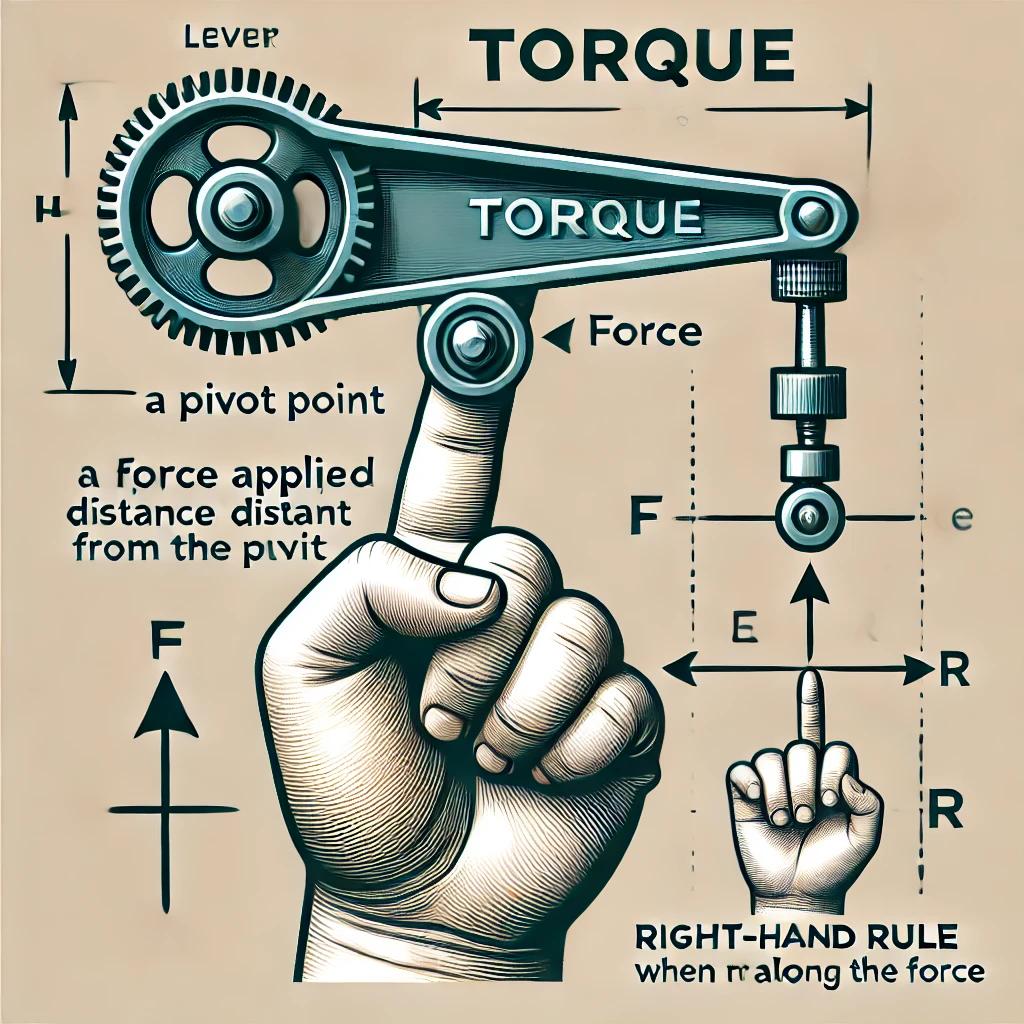
Torque and Rotational Motion
Description | Torque is a physical quantity that describes the ability of a force to rotate an object. In everyday life, torque is applied when opening a door, pedaling a bicycle, or tightening a nut with a wrench. | ||||||||
|---|---|---|---|---|---|---|---|---|---|
Factors Affecting Torque | Direction of the force Point of application of the force Magnitude of the force | ||||||||
Daily Areas of Use | Opening a door, Pedaling a bicycle, Tightening a screw with a wrench, Motion of a motor vehicle | ||||||||
Torque is a physical quantity that describes the ability of a force to rotate an object. We encounter the concept of torque in many everyday situations; for example, torque is applied when opening a door, tightening a nut with a key, or turning a bicycle pedal. This article will examine the definition of torque, its calculation, the factors affecting it, and its applications in daily life.
Torque is a vector quantity that measures the effect of a force on a body about a Dönme. Torque is calculated using the following formula:
Since torque is a vector quantity, it has a direction. The direction of torque is determined by the right-hand rule. When the four fingers of the right hand are curled in the direction of the force, the thumb points in the direction of the axis of rotation. If the torque produces rotation in the hour direction, it is negative; if it produces rotation counterclockwise, it is positive.
For an object to remain in equilibrium, both the linear forces and the torques acting on it must be balanced. In rotational equilibrium:
must hold. That is, an object fixed is rotating at constant speed or is completely at rest, the sum of all torques acting on it is zero.
The concept of torque appears in many aspects of daily life:
- When opening a door, pushing at a point farther from the hinge requires less force.
- When turning a bicycle pedal, a longer crank arm provides greater torque.
- The engine power applied to the Car wheels generates torque, enabling the vehicle to move.
- When using a wrench to tighten a bolt, a longer wrench increases torque and makes the task easier.
Torque is a fundamental physical concept in daily life and engineering applications. The point and direction of force application influence the magnitude of torque and cause objects to rotate. Understanding this concept plays a critical role in the design and analysis of mechanical systems. Thanks to torque, many technological vehicle and system can operate efficiently.
BYJU'S. "Torque." BYJU'S Physics. Accessed February 17, 2025. https://byjus.com/physics/torque/.
Khan Academy. "Torque." Accessed February 17, 2025. https://www.khanacademy.org/science/physics/torque-angular-momentum/torque-tutorial/a/torque#:~:text=What%20is%20torque%3F,object%20to%20acquire%20angular%20acceleration.
New World Encyclopedia. "Torque." New World Encyclopedia. Accessed February 17, 2025. https://www.newworldencyclopedia.org/entry/Torque.
University of Guelph. "Torque and Rotational Motion Tutorial." Accessed February 17, 2025. https://www.physics.uoguelph.ca/torque-and-rotational-motion-tutorial.

Torque and Rotational Motion
Description | Torque is a physical quantity that describes the ability of a force to rotate an object. In everyday life, torque is applied when opening a door, pedaling a bicycle, or tightening a nut with a wrench. | ||||||||
|---|---|---|---|---|---|---|---|---|---|
Factors Affecting Torque | Direction of the force Point of application of the force Magnitude of the force | ||||||||
Daily Areas of Use | Opening a door, Pedaling a bicycle, Tightening a screw with a wrench, Motion of a motor vehicle | ||||||||
No Discussion Added Yet
Start discussion for "Torque and Rotational Motion" article
Definition and Formula of Torque
Direction of Torque and the Right-Hand Rule
Equilibrium and Rotational Motion
Examples of Torque in Daily Life