

This article was automatically translated from the original Turkish version.
+2 More
Trabzon Kuymağı
Name of the Geographical Indication | Trabzon Kuymağı | ||||||||
|---|---|---|---|---|---|---|---|---|---|
Registration Number | 1644 | ||||||||
Registration Date | 02.10.2024 | ||||||||
Application Number | C2023/000128 | ||||||||
Application Date | 07.04.2023 | ||||||||
Product / Product Group(s) | Kuymak / Dishes and Soups | ||||||||
Type of Geographical Indication | Mahreç sign | ||||||||
Applicant/Registrant(s) | Trabzon Chamber of Commerce and Industry | ||||||||
Address of the Registrant | Haşim Street, Pazarkapı Neighborhood, Ortahisar TRABZON | ||||||||
Geographical Boundary | Trabzon (Province) Türkiye | ||||||||
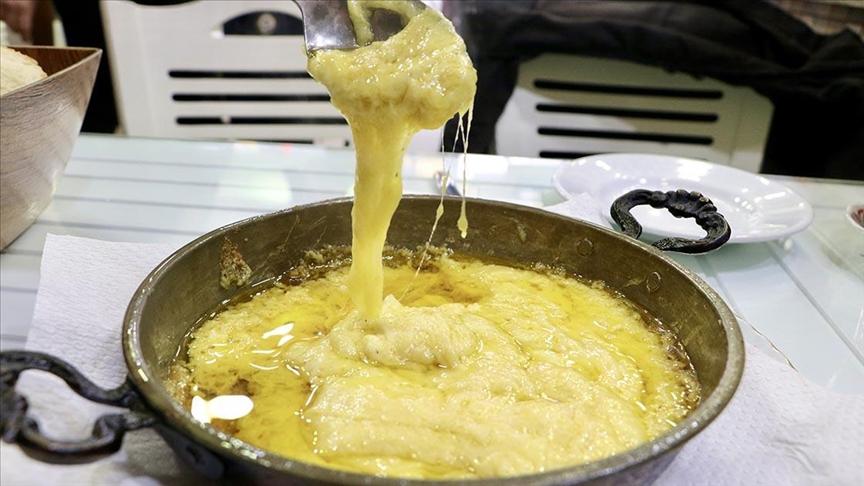
Kuymak is a traditional hot dish native to Türkiye’s Black Sea Region. Often consumed at breakfast, it is prepared using cornmeal, butter, and a local melting cheese. It is distinguished by its thick consistency and stretchy texture. Although kuymak is also known locally as “mıhlama,” some sources classify the two dishes separately due to technical and regional differences.
Kuymak is one of the traditional dishes widely consumed in rural settlements of the Eastern Black Sea region of Türkiye. Its origins are rooted in the region’s agricultural practices. The high production of corn, combined with pastoral activities linked to transhumance, led to increased use of butter and cheese. It is believed that kuymak emerged from the combination of these ingredients.

Trabzon Kuymağı (generated by artificial intelligence.)
Kuymak is primarily made using three key ingredients: cornmeal, butter, and cheese. The cheese used is typically a local variety such as Trabzon cheese, telli cheese, or kolot cheese—high-melting, low-salt or unsalted cheeses. Cornmeal is toasted in butter to form a base, after which melted cheese is added to achieve the desired consistency. Continuous stirring results in a homogeneous, stretchy texture. Water or milk may be added to adjust the thickness.
Kuymak is prepared using three main ingredients:
To prepare kuymak, butter is first melted in a pan, then cornmeal is added and toasted. A small amount of warm water or milk is then added gradually while stirring continuously to prevent lumps. Grated or diced cheese is incorporated and the mixture is cooked until the cheese has fully melted and the texture becomes stretchy. It is served hot, preferably with cornbread.
Telli cheese is a medium-fat, firm-textured, yellowish cheese made from sheep, goat, and/or cow milk, or a mixture thereof. Traditionally, Trabzon Kuymağı is prepared using a copper pan and a wooden spoon. The butter used must contain at least 82% fat, and the cornmeal must be ground in a water mill. First, butter is placed in the copper pan and melted. Once fully melted, cornmeal is added and continuously stirred with a wooden spoon until it toasts and blends with the butter. At this stage, salt is added (the amount may be adjusted according to the salt content of the telli cheese). When the cornmeal turns pink, pre-boiled warm water is added and stirring continues to prevent clumping. Once the mixture begins to thicken and absorb the water, cubed telli cheese is added. The mixture is stirred with the wooden spoon for approximately five minutes until the cheese has fully melted and the fat rises to the surface. Trabzon Kuymağı is served hot.
In industrial production, a chrome-plated industrial cauldron, a mixer, and a grater are used. The butter must contain at least 82% fat, and the cornmeal must be ground in a water mill. No additives may be added to the product. Butter is placed in the industrial cauldron and melted at 180 °C. Once fully melted, cornmeal is added and the chrome-plated mixer is activated. The mixture is stirred for approximately one hour until the cornmeal is thoroughly toasted with the butter. Pre-boiled warm water is then added, followed by rock salt. The mixture is brought to a boil and then cooled to 65 °C. At this temperature, cheese grated using an industrial grater is added, and stirring continues until the cheese is evenly distributed. The entire cooking process lasts approximately 3.5 hours, after which packaging begins.
The cooked product is packaged in 200-gram portions, equivalent to one serving, using heat- and cold-resistant, food-safe paper packaging and laminated cardboard. Packaged products are shock-frozen for eight hours at -35 °C and then transferred to a storage room at -18 °C.
The best-before date is one year from the production date. Packaged and cooked Trabzon Kuymağı is held in the storage room for eight hours before being moved to the preservation room.
Frozen Trabzon Kuymağı may be heated and consumed after thawing using one of the following methods:
Kuymak is listed among geographical indication products. The Turkish Patent and Trademark Office has registered “Trabzon Kuymağı” as a geographical indication. This registration aims to standardize the ingredients and methods used in its preparation and to preserve its regional characteristics. The geographical indication certificate confirms that the ingredients and cooking techniques used in this dish meet specific standards. This geographical indication was registered on 02.10.2024 under Article 41 of Law No. 6769 on Industrial Property and has been protected since 07.04.2023. Trabzon Kuymağı can be produced using either traditional or industrial methods. In the traditional method, copper pans and wooden spoons are used, while industrial production exclusively employs chrome-plated industrial cauldrons and mixers.
Inspections are conducted by a minimum three-member inspection body composed of representatives from the Trabzon Chamber of Commerce and Industry, the Trabzon Provincial Directorate of Agriculture and Forestry, and the Department of Nutrition and Dietetics at Karadeniz Technical University Faculty of Health Sciences. Inspections are carried out at least once annually. Additional inspections may be conducted at any time upon request or complaint.
Official Bulletin of the Turkish Patent and Trademark Office No. 2024/183
Publication Date: 15.10.2024
Geographical Indication and Traditional Product Name Bulletin, No. 183
The inspection body may obtain support from public institutions, private organizations, or qualified individuals employed by such entities, or may procure services within this scope. The registering institution is responsible for legal proceedings to protect the product’s rights.
Kuymak is most commonly consumed in the provinces of Trabzon, Rize, and Giresun. In Trabzon, it is known as “kuymak,” while similar recipes in neighboring provinces such as Rize and Artvin are called “mıhlama.” Through internal migration, populations from these regions have introduced kuymak to other parts of Türkiye.
Kuymak, rich in fat and protein, is considered an energy-rich dish. It is especially favored during morning meals in the highland areas of the Black Sea region, where agricultural and physical labor are intensive. It is typically served hot, accompanied by cornbread or tea. Although commonly eaten at breakfast, it may also be served at other meals of the day.
Kuymak may be confused with similar dishes prepared under different names in other regions of Türkiye. While the term “mıhlama” is sometimes used interchangeably with kuymak in certain areas, mıhlama recipes may include eggs and different types of flour as additional ingredients. Kuymak, by contrast, traditionally contains only cornmeal, butter, and cheese, distinguishing it from other hot cereal-cheese mixtures.
Kuymak is an important gastronomic element of Black Sea culture and is preserved in local kitchens through traditional preparation methods. Registered as a geographical indication, this dish maintains strong ties to the region both culturally and in terms of its agricultural production chain.
Regional Usage:
Ingredient Composition:
Consistency and Presentation:
Cheese Type:
Avunduk, Duygu. ““Trabzon kuymağı” coğrafi işaret belgesi aldı.” Anadolu Ajansı. Accessed May 16, 2025. https://www.aa.com.tr/tr/ekonomi/trabzon-kuymagi-cografi-isaret-belgesi-aldi/3384663
Kabak, Turgay. “Yerel Mutfaktan Ulusal Mutfağa Kuymak’ın Seyrinin Kültür Endüstrisi Açısından İncelenmesi.” *Karadeniz Araştırmaları Enstitüsü Dergisi* 4, no. 6 (2018): 347–352. https://www.academia.edu/38068595/.
Turkish Patent and Trademark Office. 2024. *Geographical Indication and Traditional Product Name Bulletin*, no. 183. "Trabzon Kuymağı." Accessed May 16, 2025. https://webim.turkpatent.gov.tr/file/3299d4e6-ad2e-4d89-8db3-e4fc90a3b88a?download=&name=183.

Trabzon Kuymağı
Name of the Geographical Indication | Trabzon Kuymağı | ||||||||
|---|---|---|---|---|---|---|---|---|---|
Registration Number | 1644 | ||||||||
Registration Date | 02.10.2024 | ||||||||
Application Number | C2023/000128 | ||||||||
Application Date | 07.04.2023 | ||||||||
Product / Product Group(s) | Kuymak / Dishes and Soups | ||||||||
Type of Geographical Indication | Mahreç sign | ||||||||
Applicant/Registrant(s) | Trabzon Chamber of Commerce and Industry | ||||||||
Address of the Registrant | Haşim Street, Pazarkapı Neighborhood, Ortahisar TRABZON | ||||||||
Geographical Boundary | Trabzon (Province) Türkiye | ||||||||
History and Origin
Ingredients and Preparation Method
Production Method
Preparation (Traditional Method)
Preparation (Industrial Method)
Packaging
Consumption Instructions
Cultural Status and Registration
Some Physical and Chemical Properties of Trabzon Kuymağı
Inspection Process
Legal Basis
Inspection Criteria
Consumption Regions
Nutritional Value and Consumption Pattern
Similar Dishes and Distinguishing Features
Differences Between Mıhlama and Kuymak