


This article was automatically translated from the original Turkish version.
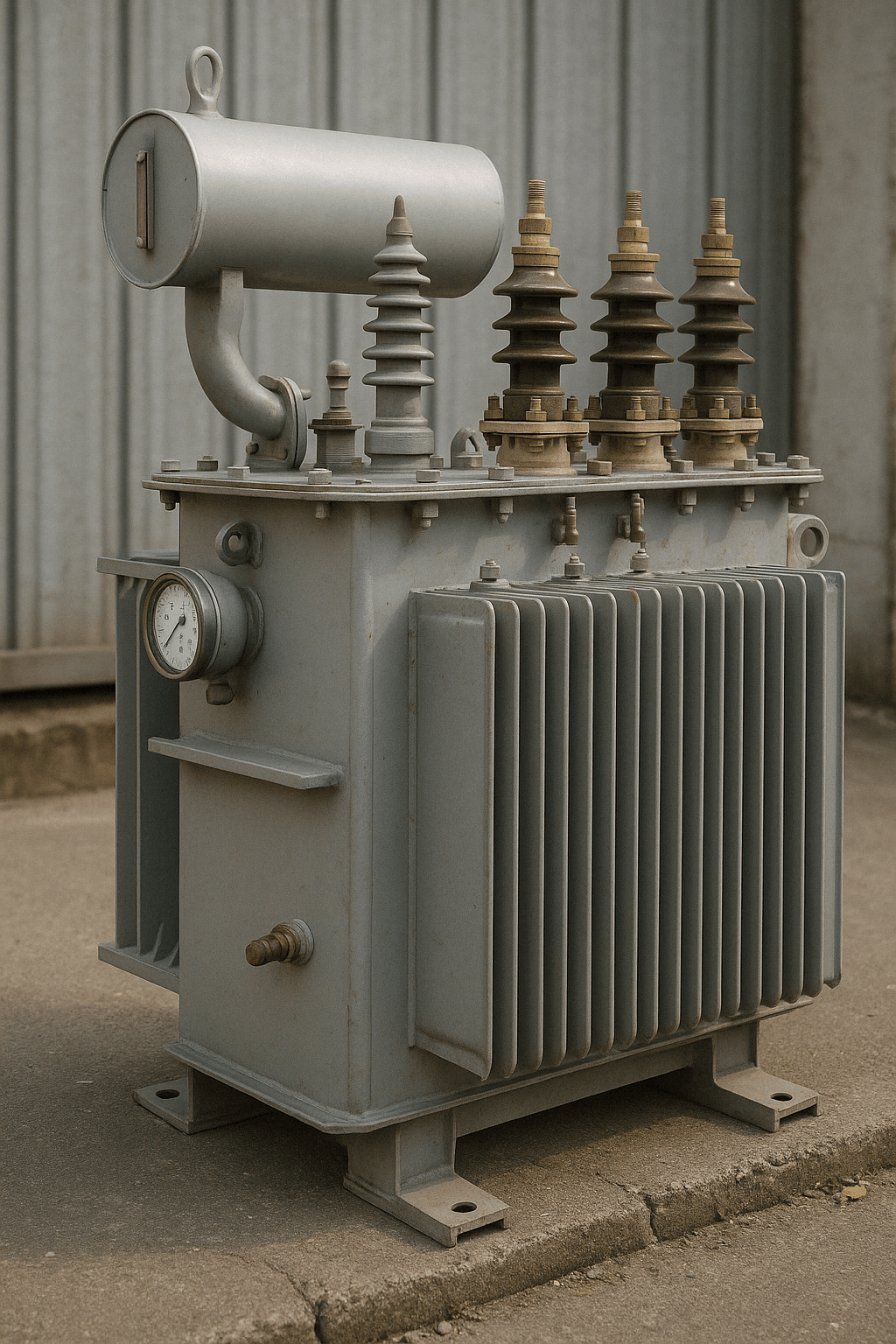
Transformer
Principle of Operation | Magnetic Induction | ||||||||
|---|---|---|---|---|---|---|---|---|---|
Type(s) | Power Transformers Audio Frequency Transformers Isolation Transformers Instrument Transformers Distribution Transformers | ||||||||
A transformer is a static electrical machine that transfers energy between two or more circuits, typically at different voltage and current levels, without changing the frequency, through magnetic induction. Transformers, one of the fundamental pillars of the electrical system, enable the conversion of electrical energy from the high voltage levels at which it is generated in power plants to even higher voltages for efficient long-distance transmission, and then step-by-step reduction through distribution networks to safe and suitable levels for use in homes and industry.
The scientific foundations of the transformer were laid in 1831 with the discovery of the principle of magnetic induction by Michael Faraday. Faraday observed that a change in current in one coil induces a voltage in another nearby coil. However, the practical implementation of this principle and its adaptation for use with alternating current (AC) systems did not occur until the late 19th century.
The first practical transformer designs were developed in the 1880s by Hungarian engineers Károly Zipernowsky, Ottó Bláthy, and Miksa Déri in Budapest. They recognized the inefficiency of "open-core" transformers and invented "closed-core" transformers that directed the magnetic flux more effectively. These transformers could be connected in parallel, a significant advancement for electrical distribution networks.
In America, George Westinghouse recognized the potential of the transformer, licensed the technology, and collaborated with engineer William Stanley Jr. In 1886, Stanley established the first commercial AC power distribution system using transformers in Great Barrington, Massachusetts. These developments demonstrated the superiority of AC systems over Thomas Edison's direct current (DC) systems and played a decisive role in the AC victory in the "War of Currents."
The operating principle of the transformer is based on Faraday's law of electromagnetic induction and Lenz's law. Fundamentally, it consists of at least two insulated conductive windings wrapped around a magnetic core: the primary winding and the secondary winding.
1. Application of AC to the Primary Winding: When an alternating voltage (AC) is applied to the primary winding connected to the transformer input, an alternating current (Ip) flows through it.
2. Generation of a Varying Magnetic Field: The primary current creates a time-varying magnetic flux (Φ) within the core. Due to the core's high magnetic permeability, this flux is largely confined and guided along the core.
3. Induction of Voltage in the Secondary Winding: The varying magnetic flux passing through the core also passes through the secondary winding wrapped around the same core. According to Faraday's law, when the magnetic flux around a conductor changes over time, a voltage (electromotive force — EMF) is induced in that conductor. The induced voltage in the secondary winding (Vs) is directly proportional to the rate of change of the magnetic flux through the core and the number of turns in the secondary winding (Ns). Similarly, a self-induced voltage (opposing EMF) is generated in the primary winding, opposing the applied voltage.
4. Voltage and Current Transformation: In an ideal transformer, the ratio of voltages between the primary and secondary windings equals the ratio of their number of turns: Vs/Vp = Ns/Np. Here, Vp is the primary voltage, Vs is the secondary voltage, Np is the number of primary turns, and Ns is the number of secondary turns. This ratio is called the turns ratio and is commonly denoted as a = Np/Ns.
In an ideal transformer, there are zero losses, meaning input power equals output power (Pinput = Poutput). Since AC power is given by P = Veff Ieff cos(ϕ) and transformers generally do not alter the phase angle (except with inductive loads), the relationship between voltage and current can be approximately expressed as Vp Ip = Vs Is. From this, the current ratio is found to be the inverse of the turns ratio: Ip/Is = Ns/Np. Thus, if voltage is stepped up (Ns > Np, Vs > Vp), current is stepped down proportionally (Is < Ip), and vice versa. Lenz's law states that the direction of the induced current opposes the change in magnetic flux that produced it.

Generated with the assistance of artificial intelligence.
The fundamental structural components of a transformer are as follows:

Generated with the assistance of artificial intelligence.
Transformers are classified into various types based on different criteria:

Generated with the assistance of artificial intelligence.
Real transformers, unlike ideal models, have energy losses. These losses cause a portion of the input power to be converted into heat, reducing efficiency (η). Efficiency is the ratio of output power to input power, usually expressed as a percentage: η = Poutput / Pinput × 100% = Poutput / (Poutput + Ploss) × 100%. The main types of losses are:
Transformers are among the most efficient electrical machines. In large power transformers, efficiency can exceed 99% at full load. Efficiency is typically highest near full load.
Transformers are the technology that enables alternating current to form the foundation of modern electrical systems. Efficient voltage conversion is difficult in DC systems, making long-distance transmission impractical. Transformers allow AC voltage to be easily stepped up and down, enabling energy to be transmitted over thousands of kilometers with minimal losses. Major applications include:
In conclusion, transformers are machines that efficiently convert voltage and current levels of electrical energy using electromagnetic induction. They play a critical role at every stage of electrical energy, from generation to final consumption, forming a fundamental pillar of modern life.
Coltman, John W. "Transformatör." Trans. F. Levent Değertekin. *Elektrik Mühendisliği*, no. 361–362 (1988): 395–399. Original article: “The Transformer.” *Scientific American* 258, no. 1 (January 1988). https://www.emo.org.tr/ekler/de55409d1224074_ek.pdf?dergi=4.
Electric Istanbul. "Transformatörler – Birinci Bölüm." Accessed March 21, 2025. https://www.electricistanbul.com/2023/10/10/transformatorler-birinci-bolum/.
IEEE, "An Adaptive Protection Scheme for Distribution Systems with High Penetration of Distributed Generation," *IEEE Xplore Digital Library*, 2008, Accessed March 21, 2025, https://ieeexplore.ieee.org/document/4562642.

Transformer
Principle of Operation | Magnetic Induction | ||||||||
|---|---|---|---|---|---|---|---|---|---|
Type(s) | Power Transformers Audio Frequency Transformers Isolation Transformers Instrument Transformers Distribution Transformers | ||||||||
History
Operating Principle
Structure and Key Components
Types of Transformers
Losses and Efficiency
Importance and Applications