


This article was automatically translated from the original Turkish version.
+1 More
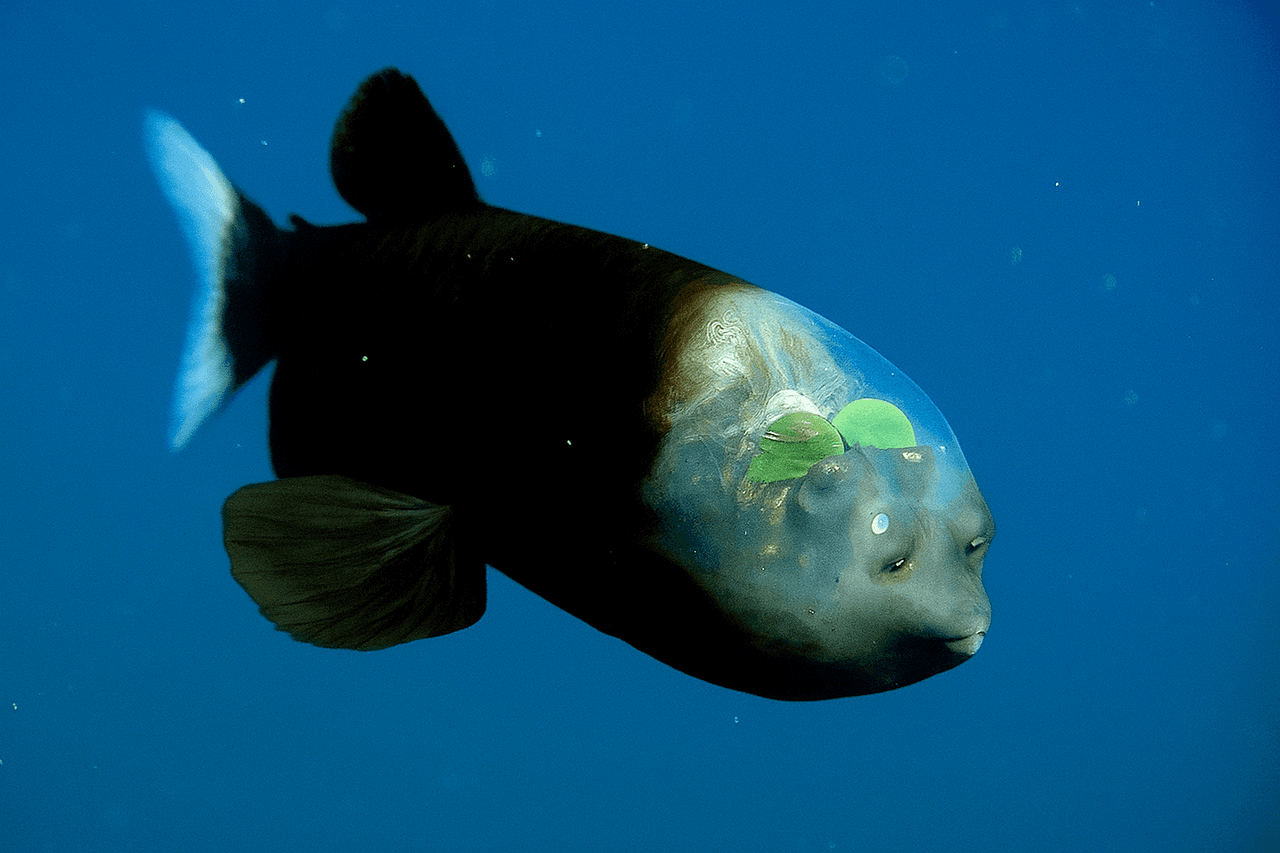
Generated by artificial intelligence.
Transparent-headed Fish (Macropinna microstoma)
Team(s) | Opisthoproctiformes | ||||||||
|---|---|---|---|---|---|---|---|---|---|
Family | Opisthoproctidae | ||||||||
Average Length | Approximately 15 cm | ||||||||
Distinguishing Feature | Transparent, fluid-filled head capsule and internally upward-facing rotatable eyes | ||||||||
Eye Structure | Green, tubular; capable of rotating both upward and forward | ||||||||
Dark Spots on the Head Region | Olfactory organs (not eyes) | ||||||||
Feeding | Zooplankton, small crustaceans, siphonophores | ||||||||
Habitat | North Pacific Ocean (from Japan to California) | ||||||||
Depth Range | 600 – 800 metres | ||||||||
The transparent-headed fish, scientifically known as Macropinna microstoma, is a rare species that inhabits deep-sea environments. Belonging to the family Opisthoproctidae, this species is distinguished by a transparent dome-shaped structure located on the upper part of its head. This structure protects the fish’s light-sensitive eyes while allowing it to perceive its surroundings over a wide angle. With an average length of 15 centimetres, this fish exhibits characteristic traits of deep-sea organisms.
The most distinctive feature of the transparent-headed fish is a fluid-filled transparent dome on the upper part of its head. Inside this dome, the green-colored eyes point upward in their normal position but can rotate forward when the fish is tracking prey. The dark circular structures surrounding the eyes are often mistaken for eyes, but they are in fact olfactory organs. The transparent dome shields the eyes from both mechanical damage and light refractions in the deep sea.
Macropinna microstoma is typically found in the northern Pacific Ocean, ranging from Japan and the Bering Sea to the coasts of California. It lives at depths between 600 and 800 metres. Due to the extremely low light levels in these regions, its visual adaptations are highly developed.
This species usually remains motionless in the water column. It is known for its slow and controlled swimming movements. Feeding behavior occurs while looking upward through the water column. It feeds on pelagic organisms such as zooplankton, small crustaceans and siphonophores. After detecting prey, it rotates its eyes forward and directs them precisely toward the target.
Although the transparent-headed fish was first described in 1939, it was known for a long time only from dead specimens. It was first observed alive in 2004 by the Monterey Bay Aquarium Research Institute (MBARI) using a specially designed remotely operated underwater vehicle. This enabled detailed insights into the species’ behavior and eye structure.
There is insufficient data on the conservation status of the transparent-headed fish. However, as a deep-sea species, it is thought to be relatively isolated from fishing pressures. Nevertheless, increasing human activities in deep-sea ecosystems—such as bottom trawling and deep-sea mining—may indirectly threaten its habitat.
Macropinna microstoma is one of the important examples in deep-sea biology due to its transparent head structure and unusual visual organs. It holds scientific value because of both its evolutionary adaptations and its rarity in observation.
MBARI (Monterey Bay Aquarium Research Institute). “Barreleye Fish (Macropinna microstoma).” *MBARI*. Accessed July 20, 2025. https://www.mbari.org/animal/barreleye-fish/
Okatan, Ayşenur. “En İlginç Canlılar: Şeffaf Başlı Balık.” *Bilim Genç*, *TÜBİTAK*. Accessed July 20, 2025. https://bilimgenc.tubitak.gov.tr/makale/en-ilginc-canlilar-seffaf-basli-balik
Whitt, Kelly Kizer. “Barreleye Fish: Rare Video Shows Transparent Head.” EarthSky. Accessed July 20, 2025. https://earthsky.org/earth/barreleye-fish-rare-video-transparent-head/

Generated by artificial intelligence.
Transparent-headed Fish (Macropinna microstoma)
Team(s) | Opisthoproctiformes | ||||||||
|---|---|---|---|---|---|---|---|---|---|
Family | Opisthoproctidae | ||||||||
Average Length | Approximately 15 cm | ||||||||
Distinguishing Feature | Transparent, fluid-filled head capsule and internally upward-facing rotatable eyes | ||||||||
Eye Structure | Green, tubular; capable of rotating both upward and forward | ||||||||
Dark Spots on the Head Region | Olfactory organs (not eyes) | ||||||||
Feeding | Zooplankton, small crustaceans, siphonophores | ||||||||
Habitat | North Pacific Ocean (from Japan to California) | ||||||||
Depth Range | 600 – 800 metres | ||||||||
No Discussion Added Yet
Start discussion for "Transparent-headed Fish (Macropinna microstoma)" article
Morphological Structure
Habitat and Distribution
Behavior and Feeding
Discovery and Observations
Conservation Status