

This article was automatically translated from the original Turkish version.
Signing Parties | Allied Powers Bulgaria | ||||||||
|---|---|---|---|---|---|---|---|---|---|
Place(s) | Neuilly-sur-Seine France | ||||||||
Date(s) | 27 November 1919 | ||||||||
The Treaty of Neuilly, signed on 27 November 1919 between Bulgaria and the Allied Powers following Bulgaria’s defeat in World War I, imposed significant territorial losses and heavy military and economic obligations. World War I (1914–1918) was a period in which Bulgaria failed to achieve its national objectives and suffered massive losses. Having entered the war with the ambition of establishing regional dominance in the Balkans, Bulgaria emerged in an even more precarious position. The Treaty of Neuilly represented not only a military defeat for Bulgaria but also an expression of economic, social, and political collapse. Referred to as “Bulgaria’s Second Great Catastrophe”【1】, this treaty is regarded as one of the most severe diplomatic defeats in the country’s history.
Bulgaria emerged from the Balkan Wars of 1912–1913 with substantial territorial losses. In particular, during the Second Balkan War, Bulgaria suffered defeat at the hands of Greece, Serbia, and Romania and lost numerous strategic territories under the Treaty of Bucharest (1913). These losses strengthened revanchist policies within Bulgaria, and the desire to reclaim regions such as Macedonia and Western Thrace came to shape the country’s foreign policy.
In 1915, Bulgaria decided to join the Central Powers (Germany, Austria-Hungary, and the Ottoman Empire) in the war, motivated by the goal of recovering its lost territories, especially Macedonia. However, the eventual victory of the Allied Powers dashed these ambitions and forced Bulgaria to accept harsh terms.
After World War I, the victorious powers signed a series of peace treaties with the defeated nations. Bulgaria participated in the Paris Peace Conference (1919) but had no meaningful influence over the decisions made. The Treaty of Neuilly was signed in Neuilly-sur-Seine, France, specifically to impose the costs of the war on Bulgaria. The treaty subjected Bulgaria to territorial losses, economic sanctions, and military restrictions.
Territorial Losses: The most striking feature of the Treaty of Neuilly was Bulgaria’s loss of significant territories.
These territorial losses dealt a severe strategic and economic blow to Bulgaria, particularly affecting trade and agricultural activities.
Economic Sanctions: The treaty imposed heavy economic burdens on Bulgaria.
Military Restrictions: Severe limitations were placed on Bulgaria’s military capabilities.
The treaty also provided for a population exchange between Bulgaria and Greece. Bulgaria accepted Bulgarian minorities from Greece, while ensuring that Greek minorities within its own borders were sent to Greece. This process created major economic and social problems for both countries.
The harsh conditions of the Treaty of Neuilly triggered widespread social unrest in Bulgaria. Public trust in the government eroded, and nationalist opposition to the treaty’s terms intensified. Especially in rural areas, the economic collapse led to a loss of popular support for the government.
War reparations and the extraction of economic resources plunged Bulgaria into a severe economic crisis. Declining agricultural output and the closure of trade routes increased famine and unemployment. Particularly in rural regions, widespread hardship triggered a major wave of emigration.
The Treaty of Neuilly redrew borders in the Balkans and altered regional balances of power. Bulgaria faced persistent border disputes with its neighbors—Greece, Romania, and Yugoslavia—contributing to increased regional instability.
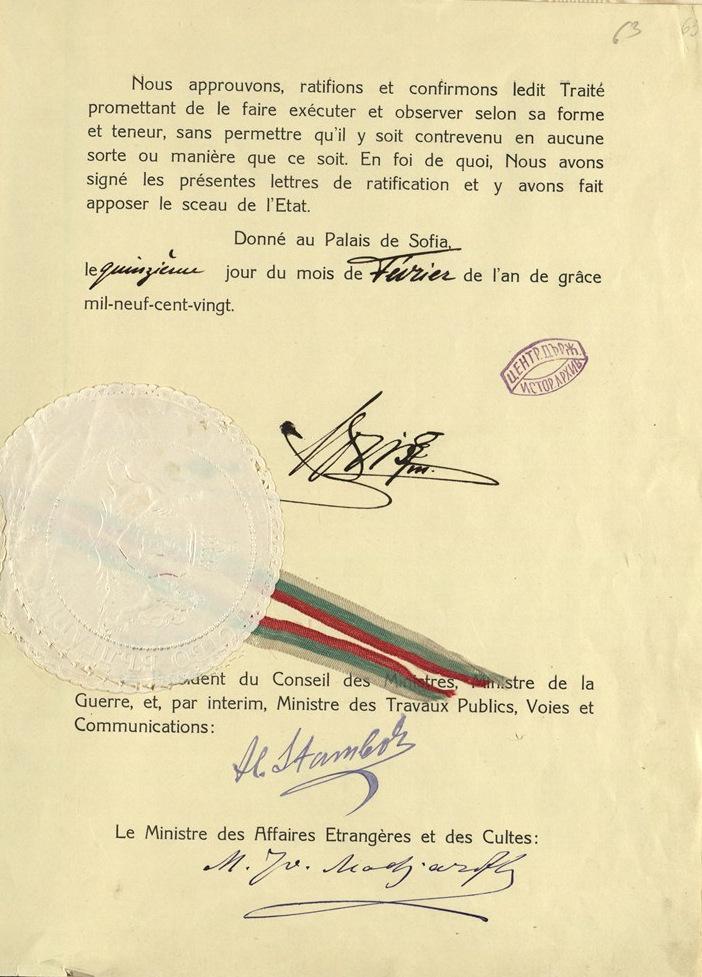
Bulgarian Archives State Agency. "BASA-284K-2-218-63-Ratification of the Treaty of Neuilly-sur-Seine." Picryl. Accessed November 27, 2025. https://picryl.com/media/basa-284k-2-218-63-ratification-of-the-treaty-of-neuilly-sur-seine-e5a9a9
Jelavich, Barbara. Balkan Tarihi 2 / 20. Yüzyıl. Çev. Zehra Savan and Hatice Uğur. İstanbul: Küre Yayınları, 2017.
Kamil, İbrahim. "Neuilly Barış Antlaşması ve Bulgaristan-Yunanistan Nüfus Mübadelesi (1919-1927)." *Ankara Üniversitesi Türk İnkılâp Tarihi Enstitüsü Atatürk Yolu Dergisi* 60 (Spring 2017): 91–118. Accessed November 27, 2025. https://dergipark.org.tr/tr/download/article-file/628425.
Koyuncu, Aşkın. "Neuilly Antlaşması (27 Kasım 1919): Bulgaristan’ın İkinci Büyük Felaketi." *Doğu Batı* 22, no. 90 (2019): 199–243. Accessed November 27, 2025. https://www.researchgate.net/publication/338950653.
[1]
Aşkın Koyuncu, "Neuilly Antlaşması (27 Kasım 1919): Bulgaristan’ın İkinci Büyük Felaketi," Doğu Batı, C. 22, no. 90, 199-243, 2019.

Signing Parties | Allied Powers Bulgaria | ||||||||
|---|---|---|---|---|---|---|---|---|---|
Place(s) | Neuilly-sur-Seine France | ||||||||
Date(s) | 27 November 1919 | ||||||||
Bulgaria Before World War I and the Balkan Wars
Historical Context of the Treaty of Neuilly
Terms of the Treaty
Consequences of the Treaty of Neuilly