

This article was automatically translated from the original Turkish version.
Signature Date | 7 June 1494 | ||||||||
|---|---|---|---|---|---|---|---|---|---|
Termination | Treaty of Madrid (1750) | ||||||||
Agreement Completing the Process | Treaty of Zaragoza (1529) - Pacific division | ||||||||
Division | West: Spain (America), East: Portugal (Africa-Brazil-Asia) | ||||||||
Baseline | 370 leagues west of the Cape Verde Islands | ||||||||
Mediator | Pope Alexander VI | ||||||||
Parties | Spain (Castile and Aragon), Kingdom of Portugal | ||||||||
Signature Place | Tordesillas, Castile (Spain) | ||||||||
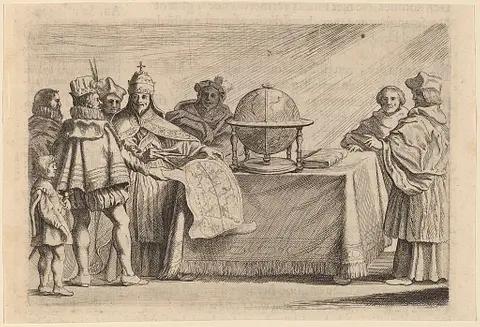
Treaty of Tordesillas (Portuguese: Tratado de Tordesilhas, Spanish: Tratado de Tordesillas), is an international agreement signed on 7 June 1494 in the town of Tordesillas,隶属于 Spain’s Valladolid, dividing newly discovered lands outside Europe between the Kingdoms of Castile (Spain) and Portugal.【1】 The treaty was ratified by the Catholic Monarchs (Isabella I and Ferdinand II) and King John II of Portugal; it was formally accepted by Spain on 2 July 1494 and by Portugal on 5 September 1494. The document divided the world into two exclusive spheres of influence by establishing an imaginary line across the Atlantic Ocean.
Treaty of Tordesillas was rooted in the competition for dominance in the Atlantic between the two powers on the Iberian Peninsula. Portugal, having colonized Madeira from 1420, the Azores from 1439, and the Cape Verde Islands from 1462, held a leading position in oceanic exploration.
The Treaty of Alcáçovas-Toledo (1479–1480), which ended the War of the Castilian Succession between 1474 and 1479, divided the Atlantic into two spheres of influence and placed the region under Portuguese control with the exception of the Canary Islands.【2】 This arrangement was later confirmed by the papal bull Aeterni regis in 1481.

Page from the Manuscript of the Treaty of Tordesillas, 1494 (Picryl)
The lands reached by Christopher Columbus in 1492 on behalf of Spain created a risk of conflict with Portugal’s existing claims. In 1493, Pope Alexander VI issued the bulls Inter caetera and Dudum siquidem, establishing a line 100 leagues west of the Cape Verde Islands and granting all lands west of it to Spain.【3】
King John II of Portugal protested this arrangement, arguing that it obstructed Portugal’s ambitions toward India and left insufficient maritime space for its navigation activities, and initiated direct negotiations.
Treaty of Tordesillas moved the papal demarcation line established by Pope Alexander VI further west, creating a meridian 370 leagues (approximately 1500–1700 kilometers) west of the Cape Verde Islands.【4】 All lands and seas east of this imaginary line were assigned to Portugal, while those to the west were assigned to Spain. According to the treaty, if any discovered lands were already under the rule of a Christian monarch, neither party could claim sovereignty over them.
Due to technological limitations of the era and the lack of accurate methods for measuring longitude, different calculations were made regarding the precise location of the line. Jaime Ferrer in 1495 placed the line 18° west of Fogo Island, while the 1502 Cantino planisphere showed it near the mouth of the Amazon River.【5】
Spanish pilots Thomas Duran, Sebastian Cabot, and Juan Vespuccius argued in 1524 that the line lay 22° west of Santo Antão. These uncertainties made practical implementation difficult, and the planned joint expeditions to determine the exact boundary were never carried out.
At the time of the treaty’s signing, much of the world remained unknown to Europeans. However, in 1500, when Pedro Álvares Cabral reached the coast of what is now Brazil, it became clear that this territory lay east of the Tordesillas line, leading to its recognition as a Portuguese colony.【6】 The Portuguese gradually extended their claims westward, and Spain was largely unable to resist this expansion. In North America, Spanish expansion later encountered opposition from other European powers such as France and England.
Treaty of Tordesillas (NBC News Learn)
The Portuguese developed the navigational technique known as "volta do mar" (return to the sea), which enabled long-distance oceanic voyages by exploiting ocean currents and wind systems. This technique played a crucial role in both Portuguese activities in the Indian Ocean and later in the Spanish Manila-Acapulco trade route connecting the Philippines with New Spain (Mexico).
When European powers reached East Asia, the location of the Tordesillas line’s antimeridian on the other side of the globe became a new source of conflict. Both Spain and Portugal claimed sovereignty over the Moluccas (Spice Islands), the center of the clove and spice trade. Although Spain was the first to reach the region during the Magellan-Elcano expedition between 1519 and 1522, Portugal argued that the islands lay within its sphere of influence.
To resolve this dispute, the Treaty of Zaragoza was signed on 22 April 1529.【7】 This new agreement established a second demarcation line 297.5 leagues east of the Moluccas. In exchange for Spain’s renunciation of its claims over the Moluccas, Portugal paid 350,000 ducats in gold.【8】 Together, these two treaties divided the world into two unequal hemispheres: Portugal gained approximately 191° of influence, while Spain received 169°.
Treaty of Tordesillas established a legal framework that completely disregarded the millions of indigenous peoples and existing civilizations of the Americas (Inca, Aztec, Taíno, etc.).【9】 The treaty ignored the property rights or political boundaries of native populations, contributing to the conquest and collapse of empires such as the Inca and Aztec.
Other rising European powers—England, France, and the Netherlands—did not recognize the treaty or the Iberian monopoly and pursued their own colonial ambitions.【10】 The treaty’s most enduring legacy is visible in the linguistic map of Latin America: while Brazil, lying east of the line, became a Portuguese-speaking nation, Spanish became the dominant language throughout the rest of the continent.
The treaty effectively became obsolete during the Iberian Union (1580–1640), when the crowns of Spain and Portugal were united under a single monarch (Philip II and his successors). The Treaty of Madrid, signed on 13 January 1750, formally abolished the Treaty of Tordesillas and redefined borders in South America according to the principle of uti possidetis, recognizing actual territorial occupation.
The original documents of the treaty are preserved today in Spain’s Archivo General de Indias and in Portugal’s Arquivo Nacional da Torre do Tombo.
Cartwright, Mark. "Treaty of Tordesillas." *World History Encyclopedia*. June 16, 2021. Accessed March 9, 2026. https://www.worldhistory.org/Treaty_of_Tordesillas/
NBC News Learn. "Treaty of Tordesillas." YouTube, 1:49. May 1, 2020. Accessed March 9, 2026. https://www.youtube.com/watch?v=OKyzxCNgX6Y
National Geographic Society. "Treaty of Tordesillas." Resource. Accessed March 9, 2026. https://education.nationalgeographic.org/resource/treaty-tordesillas/
New World Encyclopedia. "Treaty of Tordesillas." Accessed March 9, 2026. https://www.newworldencyclopedia.org/entry/Treaty_of_Tordesillas.
Picryl. "The Partitioning of the Globe Between Spain and Portugal." Accessed March 9, 2026. https://picryl.com/media/the-partitioning-of-the-globe-between-spain-and-portugal-7a1442
Picryl. "Treaty of Tordesillas." Accessed March 9, 2026. https://picryl.com/media/treaty-of-tordesillas-84b8a8
University of Cambridge. "Splitting the world in two: the 525th anniversary of the Treaty of Tordesillas." *European Languages and Cultures* (blog). June 7, 2019. Accessed March 9, 2026. https://languagecollections-blog.lib.cam.ac.uk/2019/06/07/13950/
[1]
University of Cambridge. "The Treaty of Tordesillas (1494)." European Languages and Cultures (blog). 7 Haziran 2019. Erişim tarihi: 9 Mart 2026. https://languagecollections-blog.lib.cam.ac.uk/2019/06/07/13950/
[2]
University of Cambridge. "The Treaty of Tordesillas (1494)." European Languages and Cultures (blog). 7 Haziran 2019. Erişim tarihi: 9 Mart 2026. https://languagecollections-blog.lib.cam.ac.uk/2019/06/07/13950/
[3]
New World Encyclopedia. "Treaty of Tordesillas." Erişim tarihi: 9 Mart 2026. https://www.newworldencyclopedia.org/entry/Treaty_of_Tordesillas
[4]
National Geographic Society. "Treaty of Tordesillas." Resource. Erişim tarihi: 9 Mart 2026. https://education.nationalgeographic.org/resource/treaty-tordesillas/
[5]
New World Encyclopedia. "Treaty of Tordesillas." Erişim tarihi: 9 Mart 2026. https://www.newworldencyclopedia.org/entry/Treaty_of_Tordesillas
[6]
New World Encyclopedia. "Treaty of Tordesillas." Erişim tarihi: 9 Mart 2026. https://www.newworldencyclopedia.org/entry/Treaty_of_Tordesillas
[7]
University of Cambridge. "The Treaty of Tordesillas (1494)." European Languages and Cultures (blog). 7 Haziran 2019. Erişim tarihi: 9 Mart 2026. https://languagecollections-blog.lib.cam.ac.uk/2019/06/07/13950/
[8]
University of Cambridge. "The Treaty of Tordesillas (1494)." European Languages and Cultures (blog). 7 Haziran 2019. Erişim tarihi: 9 Mart 2026. https://languagecollections-blog.lib.cam.ac.uk/2019/06/07/13950/
[9]
National Geographic Society. "Treaty of Tordesillas." Resource. Erişim tarihi: 9 Mart 2026. https://education.nationalgeographic.org/resource/treaty-tordesillas/
[10]
National Geographic Society. "Treaty of Tordesillas." Resource. Erişim tarihi: 9 Mart 2026. https://education.nationalgeographic.org/resource/treaty-tordesillas/


Signature Date | 7 June 1494 | ||||||||
|---|---|---|---|---|---|---|---|---|---|
Termination | Treaty of Madrid (1750) | ||||||||
Agreement Completing the Process | Treaty of Zaragoza (1529) - Pacific division | ||||||||
Division | West: Spain (America), East: Portugal (Africa-Brazil-Asia) | ||||||||
Baseline | 370 leagues west of the Cape Verde Islands | ||||||||
Mediator | Pope Alexander VI | ||||||||
Parties | Spain (Castile and Aragon), Kingdom of Portugal | ||||||||
Signature Place | Tordesillas, Castile (Spain) | ||||||||
No Discussion Added Yet
Start discussion for "Treaty of Tordesillas" article
Historical Background and Preceding Developments
Terms of the Treaty and the Demarcation Line
Geographical and Colonial Expansion
Treaty of Zaragoza and Global Division
Political and Social Impacts