
This article was automatically translated from the original Turkish version.
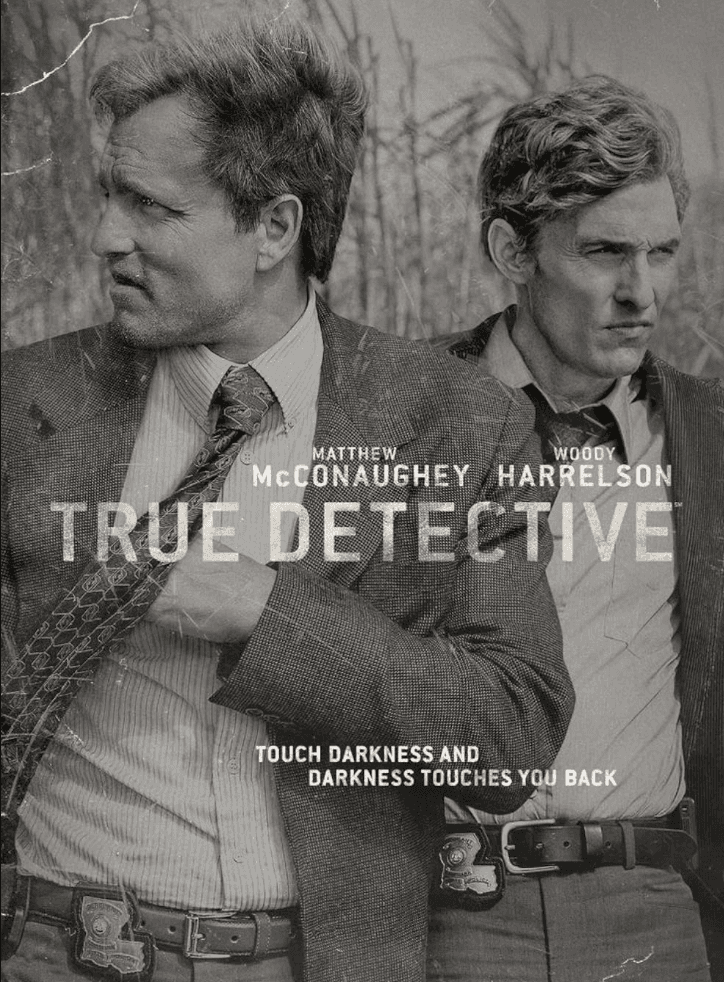
True Detective
Type(s) | Crime Psychological Thriller Mystery | ||||||||
|---|---|---|---|---|---|---|---|---|---|
Creator | Nic Pizzolatto | ||||||||
Producer(s) | Cary Joji Fukunaga, Nic Pizzolatto, Steve Golin, Richard Brown, Woody Harrelson, Matthew McConaughey, Issa López | ||||||||
Actors | Matthew McConaughey, Woody Harrelson, Colin Farrell, Rachel McAdams, Mahershala Ali, Jodie Foster | ||||||||
Platform | HBO | ||||||||
Number of Episodes | 30 (4 seasons) | ||||||||
Duration | Approximately 1 hour | ||||||||
First aired on HBO in 2014, True Detective established a unique place in modern television history through its anthology format, presenting a different story and character universe each season. This series pushed the boundaries of police procedural fiction by bringing to the forefront psychological conflicts that left deep impressions not only in the narrative but also in the inner worlds of its detectives.
True Detective is an anthology series, with each season featuring a distinct event structure and cast of characters. This format allowed the show’s creators to explore new themes and atmospheres with every new season. The first season, set in the swamps of Louisiana, stood out with its Southern Gothic atmosphere, while the second season shifted the narrative entirely by centering on California politics and the triangle of organized crime. The third season adopted a fragmented narrative with temporal leaps, and the fourth season focused on two female detectives investigating mysteries beneath the ice of the Arctic.
The most striking aspect of this structure was the freedom each season had to build its own internal world. However, this same freedom also created viewer expectations for consistency, leading every new season after the first to be met with the question: “Can the magic of the first season be recaptured?”
The first season of the series offered a cinematic television experience unlike any other, thanks to the writing of Nic Pizzolatto and the direction of Cary Joji Fukunaga. The characters Rust Cohle and Marty Hart transcended the conventional “opposing detective duo” trope, leaving a powerful impression on viewers. McConaughey’s preparation of a 450-page character dossier reflected the depth of commitment given to character development.
Fukunaga’s cinematography reached its peak with a six-minute uninterrupted tracking shot. When the visual power of the imagery merged with Pizzolatto’s nihilistic dialogue, the first season ascended to short status within a short time.
Although the second and third seasons unfolded in different geographies and narrative structures, they moved away from the mystical, metaphysical, and psychological depth of the first season. Nevertheless, each season contained strong elements within its own framework and in terms of performances. For instance, Mahershala Ali’s performance in the third season drew attention through its narrative structure that moved between past and present.
However, the prevailing sentiment among critics and viewers was that these seasons failed to escape the shadow of the first. The fourth season, titled “Night Country,” aimed to deliver a new ‘mirror’ through its female detectives, Arctic atmosphere, and pagan themes; yet it did not match the structural depth or character chemistry of the first season.
Interestingly, the series that carried forward True Detective’s real legacy were not direct spin-offs but independent productions. The 2018 series Sharp Objects similarly explores a psychological unraveling and Gothic-tinged murder investigation, presenting a narrative in which both the protagonist and the evil are embodied through female characters. This miniseries, crafted through the collaboration of Jean-Marc Vallée and Gillian Flynn, also leveraged its origin as a novel adaptation to deliver a cohesive and complete ending.
Similarly, Mare of Easttown reimagined the dramatic police procedural through a female-centered lens. These series became exemplary models of how the atmospheric crime storytelling initiated by True Detective evolved.
True Detective was more than a crime drama; it was a project testing the narrative possibilities of modern television. It presented an experiential narrative woven with secular themes, metaphysical symbols oscillating between paganism and Christianity, the aesthetics of futility, and intense interpersonal tension. Yet this approach did not satisfy every viewer with a fulfilling conclusion. In particular, the fractures surrounding the first season’s finale sparked serious debates about the show’s internal structure.
Viewed from a broader perspective, True Detective’s true impact lies in the “incomplete yet striving toward completion” world it offered its audience. Even when the stories end, the darkness within the characters endures.
HBO. Accessed March 24, 2025. https://www.hbo.com/true-detective
IMDb. Accessed March 24, 2025. https://www.imdb.com/title/tt2356777
New York Times. Accessed March 24, 2025. https://www.nytimes.com/2024/02/23/opinion/true-detective.html
Warner Bros. Accessed March 24, 2025. https://www.warnerbros.com/tv/true-detective
YouTube. Accessed March 27, 2025. https://www.youtube.com/watch?v=fVQUcaO4AvE.

True Detective
Type(s) | Crime Psychological Thriller Mystery | ||||||||
|---|---|---|---|---|---|---|---|---|---|
Creator | Nic Pizzolatto | ||||||||
Producer(s) | Cary Joji Fukunaga, Nic Pizzolatto, Steve Golin, Richard Brown, Woody Harrelson, Matthew McConaughey, Issa López | ||||||||
Actors | Matthew McConaughey, Woody Harrelson, Colin Farrell, Rachel McAdams, Mahershala Ali, Jodie Foster | ||||||||
Platform | HBO | ||||||||
Number of Episodes | 30 (4 seasons) | ||||||||
Duration | Approximately 1 hour | ||||||||
No Discussion Added Yet
Start discussion for "True Detective (TV Series)" article
The Power of the Anthology Format
The Enduring Legacy of Season One: The Pizzolatto & Fukunaga Duo
Subsequent Seasons: Innovation or Imitation?
Spiritual Successors: “Sharp Objects” and “Mare of Easttown”
Aesthetics, Narrative, and the Search for Identity