This article was automatically translated from the original Turkish version.
+2 More
World | Fungi | ||||||||
|---|---|---|---|---|---|---|---|---|---|
Branch | Ascomycota | ||||||||
Class | Pezizomycetes | ||||||||
Regions of Origin | Europe (France, Italy, Spain), Türkiye, China, North Africa, Australia | ||||||||
Growth Depth | 5–30 cm below the soil | ||||||||
Truffles are special fungi that develop underground and possess high economic value. These fungi typically belong to the genus Tuber and form a symbiotic relationship with the roots of tree species such as oak, hazel, and beech. Known in nature as “black diamonds,” truffles are regarded as luxury food items, especially in the culinary world. Their growth depends on specific soil and climatic conditions, making them rare and further increasing their value. Truffles attract attention with their distinctive sharp aroma and complex flavor.
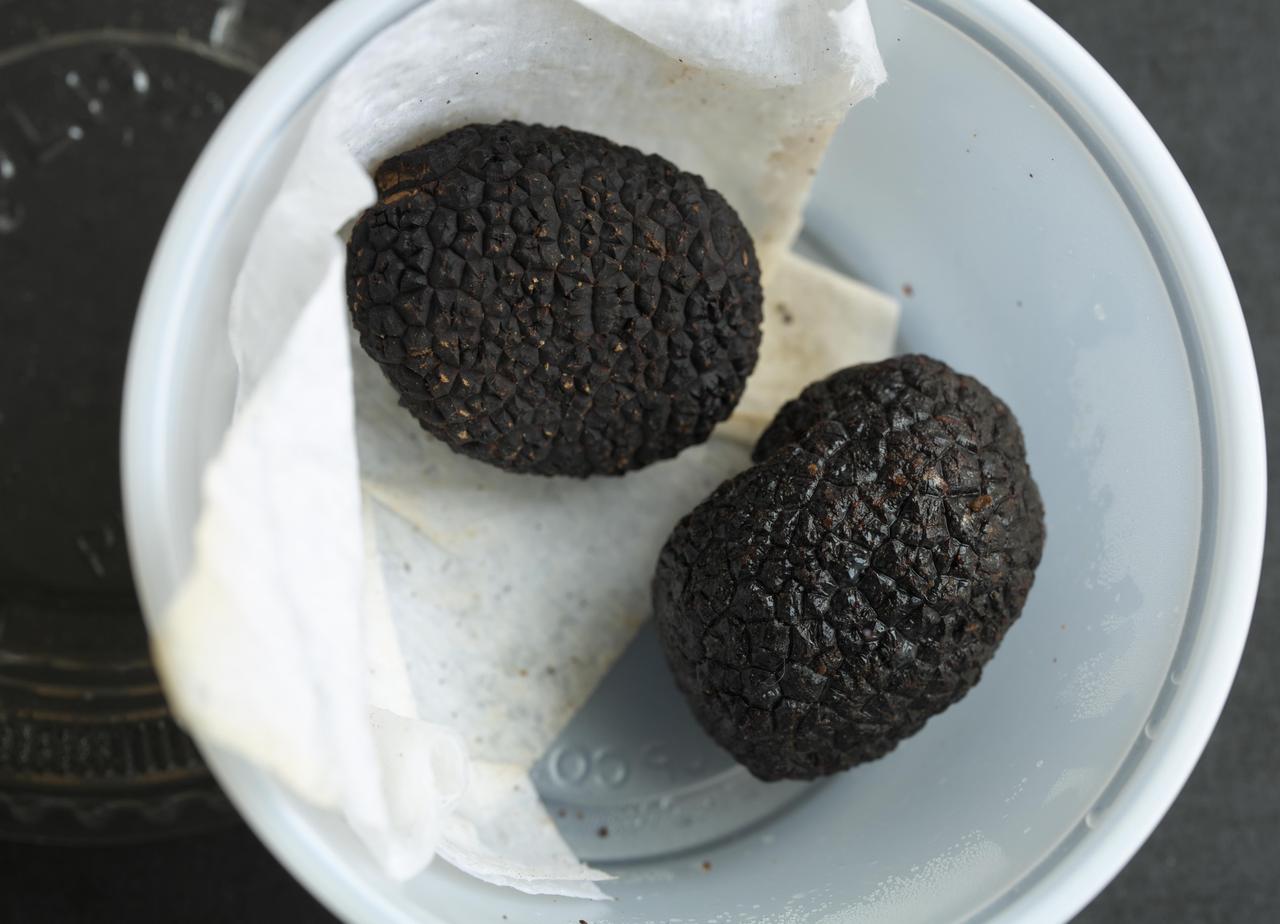
Truffles are generally irregularly spherical in shape and have a rough or net-like surface. Their color varies by species, ranging from black, brown to white tones. Their internal tissue has a marbled appearance, with dark areas surrounded by white veins. This vein structure is a key diagnostic criterion for identifying truffle species. Their spores are microscopic and disperse into the environment through the mycelium upon maturation.
Truffles live in symbiosis with tree roots through a relationship known as mycorrhiza. In this relationship, the fungus provides the tree with water and minerals, while in return it receives carbon compounds produced by the tree through photosynthesis. Truffles typically grow in calcareous, well-drained soils rich in organic matter. They develop in moist layers near the surface and usually mature during autumn and winter months. The natural distribution of truffles is concentrated in Mediterranean climate regions such as France, Italy, Spain, and Türkiye.
Although hundreds of truffle species have been identified worldwide, the most economically valuable are Tuber melanosporum (black truffle), Tuber magnatum (white truffle), and Tuber aestivum (summer truffle). The black truffle is commonly found in France and Spain, while the white truffle is particularly abundant in the Piedmont region of Italy. In Türkiye, species such as Tuber aestivum and Tuber borchii grow naturally. Each species carries distinct aromatic properties depending on the soil composition and climatic conditions of its region. This diversity enriches the culinary applications of truffles.
Since truffles grow underground and are invisible to the naked eye, they are located using specially trained dogs or pigs. Truffle dogs can detect the strong aroma emitted by the fungi from several meters away. During harvesting, the soil must be carefully excavated, as damage to the mycelial network can negatively affect the following year’s yield. Harvested truffles can be sold fresh or stored briefly under cold conditions. The harvesting season varies by species but generally coincides with autumn and winter months.
Truffles are regarded as one of the most valuable aroma sources in global cuisine. They are commonly used in thin slices in dishes such as risotto, pasta, eggs, and meats to impart an aromatic flavor. Derived products such as truffle oil, truffle cheese, and truffle sauce are also widely produced. Due to their intense and distinctive aroma, even small quantities significantly enhance the flavor of a dish. Described by chefs as “nature’s hidden treasure,” truffles offer a sophisticated culinary experience both visually and taste-wise.
With prices reaching thousands of dollars per kilogram, truffles are a significant component of the global luxury food market. Truffle festivals are held in Europe, and auctions are conducted for sales. In Türkiye, truffle farming has been encouraged in recent years, and natural truffle habitats are being preserved. Truffle cultivation also holds considerable potential for rural development. Furthermore, truffle-hunting activities, as part of gastronomic tourism, serve as an economic income source in many countries.
Loo, John. "Black Truffle." *Flickr*. Accessed October 22, 2025. https://www.flickr.com/photos/johnloo/49259943933/
Riccioni, C., B. Belfiori, A. Rubini, V. Passeri, S. Arcioni, and F. Paolocci. “Tuber melanosporum Outcrosses: Analysis of the Genetic Diversity within and among Its Natural Populations under This New Scenario.” New Phytologist 180, no. 2 (2008): 466–78. Accessed October 20, 2025. https://doi.org/10.1111/j.1469-8137.2008.02560.x
Rubini, A., B. Belfiori, C. Riccioni, E. Tisserant, S. Arcioni, F. Martin, and F. Paolocci. “Isolation and Characterization of MAT Genes in the Symbiotic Ascomycete Tuber melanosporum.” New Phytologist 189, no. 3 (2011): 710–22. Accessed October 20, 2025. https://doi.org/10.1111/j.1469-8137.2010.03492.x

World | Fungi | ||||||||
|---|---|---|---|---|---|---|---|---|---|
Branch | Ascomycota | ||||||||
Class | Pezizomycetes | ||||||||
Regions of Origin | Europe (France, Italy, Spain), Türkiye, China, North Africa, Australia | ||||||||
Growth Depth | 5–30 cm below the soil | ||||||||
Morphological Characteristics
Ecological Characteristics and Growth Conditions
Truffle Species and Distribution Areas
Harvesting and Detection Methods
Gastronomic Value and Culinary Uses
Economic and Cultural Significance