


This article was automatically translated from the original Turkish version.
The Tuba Tree Theory is an approach that formed the basis of one of the most significant debates in Turkish educational history during the Second Constitutional Era, particularly concerning where educational reform should begin. Proposed by Minister of Education Emrullah Efendi, this theory generated widespread反响 among educational circles and intellectuals of the time and led to disagreements with prominent educators such as Satı Bey.
Emrullah Efendi compared the education system to the Tuba tree, believed to exist in paradise with its roots above and branches below. This metaphor formed the foundation of the theory. Contrary to the traditional view that education must proceed from the base (primary education) upward toward higher levels (higher education), Emrullah Efendi argued that educational reform should begin at the level of higher education. According to him, the stronger the roots of a tree, the more lush and robust its branches become. Through this metaphor, he predicted that strengthening higher education would produce qualified individuals (the branches) capable of driving necessary reforms and developments at all levels of society—including primary education. The central idea of the theory is that higher education serves as a “root” that nourishes and guides the entire educational system.
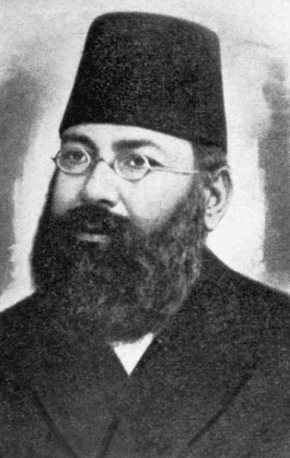
Emrullah Efendi (Dia)
The political, social, and economic conditions of the Second Constitutional Era made fundamental changes to the education system imperative.
The existing education system proved inadequate in meeting the nation’s urgent need for trained human resources.
Debates over educational reform centered on the question: “Where should education begin?” One faction argued that success at advanced levels could not be achieved without first establishing a solid foundation, and therefore advocated strengthening primary education. Another faction, responding to the immediate need for qualified personnel, insisted that priority must be given to higher education. Emrullah Efendi’s Tuba Tree Theory became the most prominent representative of this second viewpoint.
The Tuba Tree Theory sparked a heated debate between Emrullah Efendi and Satı Bey, another leading educator of the era. Satı Bey maintained that education should follow its natural developmental process, growing upward from the base like a tree—starting with primary education and progressing gradually. He argued that without a strong foundation in primary education, achievements in higher education would remain superficial. This debate is regarded as a pivotal moment in Turkish educational history within the context of the “problem of educational renewal.” Emrullah Efendi’s position as Minister of Education and his efforts to implement his theory further intensified the controversy. Periodicals such as Muallim Dergisi provided platforms for these discussions, ensuring that diverse viewpoints reached the public.
The Tuba Tree Theory was one of the key theories shaping educational reform efforts during the Second Constitutional Era. Although it faced opposition from perspectives like that of Satı Bey, Emrullah Efendi’s theory drew attention for its emphasis on enhancing the quality of higher education as a means to achieve social development.
While interpretations of its direct success and impact in practice vary, the theory has secured an important place in the history of Turkish educational thought. Even today, whenever the question “Where should reform begin?” arises in discussions on educational renewal, the debate between Emrullah Efendi and Satı Bey serves as a reference point. This demonstrates that the theory is not merely a historical episode but continues to offer insight into contemporary educational challenges.
Keklik, Ebubekir. "Maarif Nazırı Emrullah Efendi ve Tuba Ağacı Nazariyesi: Eğitim Reformuna Nereden Başlamalı?" *ÇAKÜ Sosyal Bilimler Enstitüsü Dergisi/Journal of Institute of Social Sciences* 11, no. 2 (November 2020): 79–96. Accessed June 20, 2025. https://dergipark.org.tr/tr/download/article-file/1097729
Polat, Murat, and İ. Bakır Arabacı. "Emrullah Efendi ve Satı Bey’den Günümüze: Eğitimde Yenileşme Sorunsalı." *Pamukkale Üniversitesi Sosyal Bilimler Enstitüsü Dergisi*, no. 21 (2015): 35-43. Accessed June 20, 2025. https://dergipark.org.tr/tr/download/article-file/411663
Yavaş Taşdelen, Tuba, Cemil Oruç, and Volkan Çiçek. "Yükseköğretimin Yapılandırılmasında Emrullah Efendi’nin “Tuba Ağacı Nazariyesi”ni Yeniden Düşünmek." *Turkish Studies, International Periodical For The Languages, Literature and History of Turkish or Turkic* 10, no. 2 (Winter 2015): 1007-1024. Accessed June 20, 2025. https://www.researchgate.net/publication/275220625_Yuksekogretimin_Yapilandirilmasinda_Emrullah_Efendi'nin_Tuba_Agaci_Nazariyesini_Yeniden_Dusunmek

Origin and Definition of the Theory
Historical Context and Contemporary Trends
The Tuba Tree Theory and the Debate with Satı Bey
Impacts and Legacy