This article was automatically translated from the original Turkish version.
+1 More
Foundation | 31 August 1911 | ||||||||
|---|---|---|---|---|---|---|---|---|---|
Initial Form of Emergence | as publication of the Turkish Homeland Society | ||||||||
Founder(s) | Mehmet Emin (Yurdakul) | ||||||||
Director(s) | after Mehmet Emin was appointed governor Yusuf Akçura | ||||||||
Original Slogan | Works for the Benefit of the Turks | ||||||||
Current Slogan | Unity in Language, Thought and Action | ||||||||
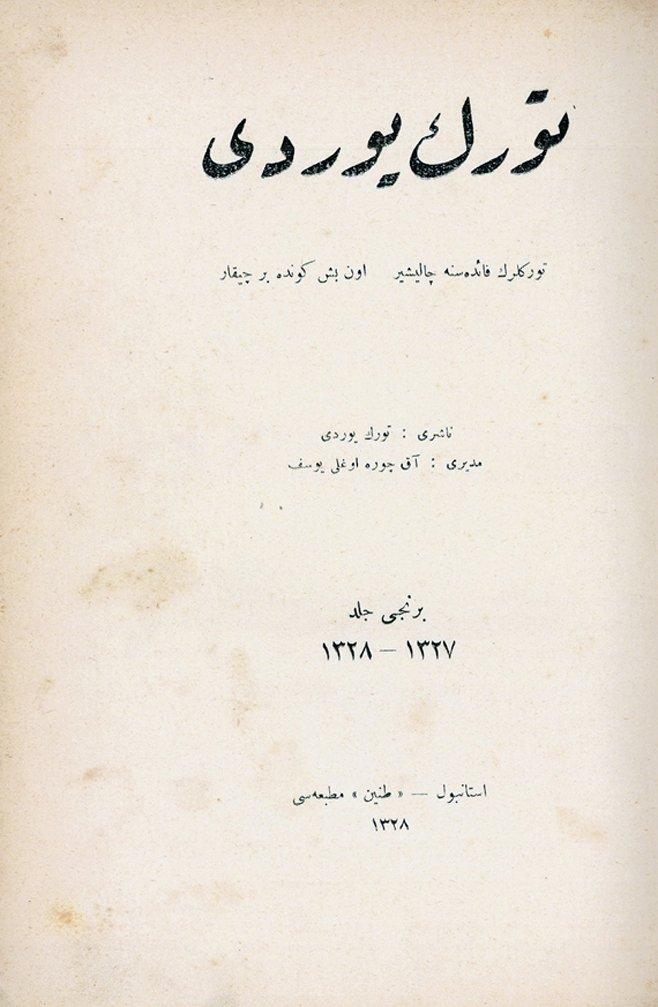
Türk Yurdu Dergisi is a nationalist periodical that emerged as the publication of the Türk Yurdu Society, founded on 31 August 1911 under the leadership of Mehmed Emin (Yurdakul), and shortly thereafter merged with the Türk Ocağı to become its official publication organ.

【1】
From its first issue, the magazine defined its program as safeguarding the rights of the Turkish element within the Ottoman territories, promoting Turkish nationalism, and reporting events from all corners of the Turkish world to protect the interests of the Turkish community. Its editorial policy was conducted in accordance with these principles. The early slogan “Works for the Benefit of the Turks” was associated with İsmail Gaspıralı’s principle of “unity in language, thought and action” as the magazine became linked with this ideal in later years.
The magazine’s name was given by Mehmet Emin (Yurdakul). Upon his appointment as governor of Erzurum in August 1911, Yusuf Akçura assumed the editorship.
The publication history of Türk Yurdu coincided with the turbulent political and social events spanning the Balkan Wars, the First World War, the War of Independence and the Bolshevik Revolution.【2】 These major upheavals were systematically documented in its pages, forming a comprehensive record of the era.
In this context, Türk Yurdu Dergisi was not merely an institutional publication but an intellectual platform that systematically collected news, commentary and opinion pieces on the Turkish world, facilitating the public circulation of nationalist thought.
In the second half of the nineteenth century, the Ottoman State had become economically semi-colonial, shaken by European interventions and nationalist separatist movements among its subject populations. Intellectuals and statesmen seeking solutions proposed various ideologies such as Ottomanism, Islamism, Westernism and Constitutionalism. Alongside these, Turkism or Turkish nationalism gradually emerged as a new path for the empire’s future.
The intellectual foundation of Turkism was partly nourished by European orientalist research on Central Asian and Turkish history. The works of figures such as Joseph de Guignes, Léon Cahun, Arminius Vambéry, W. Radloff, E. J. W. Gibb and V. Thomsen influenced Ottoman intellectuals and expanded their knowledge of Turkish history and identity. The earliest signs of this intellectual current appeared in literature; Şinasi, Ziya Paşa, Ahmed Vefik Paşa and Ali Suavi made this orientation visible through their advocacy of simplified Turkish and studies of Turkish culture.
The declaration of the Second Constitutional Monarchy in 1908 opened the way for organized efforts to promote and spread Turkish nationalism. In 1908, the Türk Derneği was founded as a cultural association without political ambitions. Its short-lived journal, published in only seven issues, emphasized linguistic reform and the simplification of the Turkish language.
This was followed by the establishment of the Türk Yurdu Society on 31 August 1911 under Mehmed Emin (Yurdakul). Shortly thereafter, the society merged with the more comprehensive Türk Ocağı, which shared the same goals, and Türk Yurdu Dergisi continued publication as the official organ of Türk Ocağı.
The common denominator of these developments was a program summarized as safeguarding the rights of the Turkish element within Ottoman territories, promoting Turkish nationalism, and reporting developments from every corner of the Turkish world. From its first issue, Türk Yurdu Dergisi institutionalized this framework as a systematic publishing policy, thereby establishing itself as the institutional and periodic expression of Turkism that had taken root during the dissolution of the empire, and creating a lasting platform for cultural, political and social debates on nationalism.
The magazine published a total of 161 issues between 30 November 1911 and 15 August 1918, excluding the period from 10 August to 6 December 1914. Its publication cycle was primarily biweekly. This initial phase unfolded under the shadow of the Balkan Wars and the First World War.
Publication was suspended during the National Struggle/ War of Independence years.
In October 1924, the magazine resumed monthly publication with issue 162, bearing the imprint “Published by the Central Board of Türk Ocağı.” It ceased publication with issue 233 in March 1931.
Publication continued intermittently during 1942–1943 (third period), 1954–1957 (fourth period), 1959–1968 (fifth period), and 1970 (sixth period).
Since 1987, the magazine has been published without interruption.
Until February 1929, the magazine published 205 issues in 22 volumes using the old Ottoman script. In 1997, a transcription project was initiated to enhance accessibility to the old-script corpus. The plan aimed to restructure the 22 volumes into a 26-volume set, preserving the original volume sequence, combining certain volumes, and applying new orthographic rules. Selected volumes from the early period (1911–1918) were reprinted between 1998 and 2000.
The founding program of the magazine was clearly defined from its first issue: to safeguard the rights of the Turkish element within Ottoman territories, promote Turkish nationalism, and report both positive and negative events from all parts of the Turkish world in order to protect the interests of the Turkish community. This editorial line has remained unchanged since inception.
This program was embodied in the early slogan “Works for the Benefit of the Turks” printed on the magazine’s masthead. Over time, the magazine became associated with İsmail Gaspıralı’s principle of “unity in language, thought and action.” Thus, Türk Yurdu systematically disseminated a nationalist ideology that extended from linguistic simplification to intellectual unity and collective action.
This principled foundation found broad resonance within the political climate of the time and attracted the attention of the Committee of Union and Progress circles. This context generated both legitimacy and influence, sustaining the magazine’s institutional weight and its production of news, commentary and opinion centered on the Turkish world.
Since uninterrupted publication resumed in August 1987, Türk Yurdu has updated its founding principles by grounding its civilization concept in the goal of “uniting Turkish geographies under a single civilization umbrella.” Within this framework, it positions the national language and national culture as foundational axes.
The magazine defines civilization not merely in terms of cultural elements but as a human-centered constructive activity encompassing both material and spiritual dimensions, emphasizing that the continuity of civilization requires a philosophical consciousness. After 1987, this concept became especially focused on language as the “primary carrier of civilization.” The nation’s boundaries, it argues, are defined not by geography or politics but by language; Turkish is upheld as the essential bond that constructs collective identity and transmits it across generations.
The foundational elements of civilization—language, science, philosophy, religion, art, family and state—are systematically examined as an integrated whole. Within this framework, the concept of “Turkish Islam” is interpreted as a civilizational ideal in which religion, science and philosophy coexist harmoniously without conflict, even amid modernization.
Türk Yurdu’s new civilization proposal is nourished by the idea of historical continuity (from the Uyghurs through the Seljuks and Ottomans to the modern era) and symbolic ideals such as the “Kızılelma.” At the same time, it consistently warns of the danger of losing tradition, identity and aesthetic heritage.
Since 1987, the magazine’s publishing stance has been designed not as an academic journal but as an editorial policy aimed at youth, aimed at sustaining national sentiment. Formal consistency—such as standardized cover design and regular page layout—supports this ideological unity. Overall, Türk Yurdu has contributed to Turkish modernization by integrating its civilization concept with a language-centered identity theory, philosophical-spiritual depth and the principle of historical continuity, offering a “civilization-centered Turkology” vision.
Türk Yurdu has created a primary source corpus through which the major political and social transformations of the turbulent transition from empire to republic—the Balkan Wars, the First World War, the War of Independence and the Bolshevik Revolution—can be traced step by step. The fact that every significant development of the era was documented in its pages grants the magazine foundational value for both historical scholarship and memory studies.
Within a short time, Türk Yurdu became the official organ of Türk Ocağı and emerged as the principal medium for the institutional circulation of nationalist thought. This position transformed the magazine into a bridge between decision-makers and intellectual circles.
The publication program formulated as “safeguarding the rights of the Turkish element within Ottoman territories, promoting Turkish nationalism, and reporting events from all parts of the Turkish world” extended the magazine’s influence beyond the intellectual sphere into the realms of news and commentary. Thus, a continuous public discourse on the Turkish world was produced.
Extensive archives of articles, essays and poems related to the Gallipoli Campaign and other wartime events reinforced the magazine’s role in moral and ideological production.
The 1997 plan to transcribe the old-script corpus into the new Latin-based Turkish alphabet, along with the principles and methods applied—such as restructuring 22 volumes into a 26-volume set, combining volumes and adopting new orthography—opened the magazine’s historical content to new generations and facilitated the renewal of its legacy. This technical intervention liberated the magazine’s influence from being confined solely to its original era.
Through its institutional ties, ideological program, content on war and society, and transcription and reprint initiatives, Türk Yurdu has left a lasting impact as a preeminent journal that standardized the public language of Turkish nationalism and simultaneously provided historians, literary scholars and sociologists with a vast documentary foundation.
Karabulut, Sevinç. *Türk Yurdu Dergisi’nde Medeniyet Tasavvuru (1987’den Günümüze).* Master's thesis, Ankara Yıldırım Beyazıt Üniversitesi, Sosyal Bilimler Enstitüsü, 2022. Accessed October 2, 2025. https://tez.yok.gov.tr/UlusalTezMerkezi/TezGoster?key=RsTBl6RWK25OBMIKtIgYYeX0bRGPQfYJLzJmETBWWF50ffXdTBxC8d1HgEQZ4l3R.
Karaca, Erdem. "Türk Yurdu Dergisi." *Çanakkale Savaşları Ansiklopedisi.* Accessed October 2, 2025. https://canakkalesavaslariansiklopedisi.com/wp-content/uploads/2024/09/csa-18-09-2024-turk-yurdu-dergisi.pdf.
Tuncer, Hüseyin. "Türk Yurdu." *TDV İslâm Ansiklopedisi.* Accessed October 2, 2025. https://islamansiklopedisi.org.tr/turk-yurdu.
Uçman, Abdullah. "Mehmet Emin Yurdakul." TDV İslâm Ansiklopedisi. Accessed October 2, 2025. https://islamansiklopedisi.org.tr/yurdakul-mehmet-emin.
Yüce, Nuri. "Yusuf Akçura." *TDV İslâm Ansiklopedisi.* Accessed October 2, 2025. https://islamansiklopedisi.org.tr/akcura-yusuf.
[1]
Abdullah Uçman. "Yurdakul, Mehmet Emin", TDV İslâm Ansiklopedisi, .
[2]
Nuri Yüce. "Akçura, Yusuf", TDV İslâm Ansiklopedisi. https://islamansiklopedisi.org.tr/akcura-yusuf.

Foundation | 31 August 1911 | ||||||||
|---|---|---|---|---|---|---|---|---|---|
Initial Form of Emergence | as publication of the Turkish Homeland Society | ||||||||
Founder(s) | Mehmet Emin (Yurdakul) | ||||||||
Director(s) | after Mehmet Emin was appointed governor Yusuf Akçura | ||||||||
Original Slogan | Works for the Benefit of the Turks | ||||||||
Current Slogan | Unity in Language, Thought and Action | ||||||||
No Discussion Added Yet
Start discussion for "Turk Yurdu Magazine" article
Context of Emergence: The Rise of Turkism in the Ottoman Empire
Publication History and Periods (1911–Present)
First Period (1911–1918)
Interim Period (1919–1924)
Second Period (1924–1931)
Third to Sixth Periods (1942–1970)
Seventh Period (1987–Present)
Old Script Collection
Program, Principles and Slogans
The Civilization Concept of the Magazine
Historical Significance and Impact