This article was automatically translated from the original Turkish version.
Celebration Date | 21 December | ||||||||
|---|---|---|---|---|---|---|---|---|---|
Country Celebrated In | Republic of North Macedonia | ||||||||
Official Holiday Adoption Year | 2007 | ||||||||
Holiday Status | Official and National Holiday | ||||||||
Symbolic Beginning | 21 December 1944 | ||||||||
Important Supporting Organizations | MATÜSİTEB (Macedonian Turkish Civil Society Organizations Union), TİKA (Turkish Cooperation and Coordination Agency) | ||||||||
Proposers of Officialization | Dr. Kenan Hasip, Hadi Nezir | ||||||||
The Turkish Language Education Day of the Turks of North Macedonia is an official and national holiday that serves as a tangible expression of the Turkish community’s rights to language, culture, and identity. This special day, observed annually on December 21, is also known as Turkish Language Day. The foundation of this holiday lies in the historic event that granted the Turks of North Macedonia the right to receive education in their mother tongue.
The attainment of the right to education in the mother tongue by the Turks of North Macedonia is understood within the context of political transformations in the Balkans following the Second World War. The process that began with the establishment of Democratic Federal Yugoslavia in 1943 and continued with the formation of the People’s Republic of Macedonia within the Federal People’s Republic of Yugoslavia on April 16, 1945, marked the beginning of a new era for ethnic groups in the region.【1】 During this period, constitutional provisions of the republic granted all communities living in the country the right to receive education in their native languages.
At the beginning of the 21st century, the Ohrid Framework Agreement of 2001 was signed, recognized as a turning point for the protection and advancement of minority rights in the country. Under this agreement, efforts were made to legally guarantee the educational rights of the Turkish community; however, the implemented reforms encountered practical challenges, particularly in Eastern Macedonia.【2】 Subsequently, reforms carried out in the context of the transition to compulsory secondary education in 2008 and the process of alignment with the European Union brought new developments to Turkish-language education. Despite these positive advances, fundamental obstacles such as economic inadequacies, lack of political will, teacher shortages, and the need for modern teaching materials have remained the primary challenges facing Turkish-language education.【3】 Support and educational cooperation from the Republic of Türkiye have contributed significantly to overcoming these challenges. Thanks to this support, the quality of Turkish-language education has improved through the development of digital educational materials, modern teaching methods, and updated curricula.
Within this legal framework, the Turks of Macedonia began using Turkish as taught in Türkiye and the Latin alphabet in schools. December 21, 1944, is regarded as the symbolic date when Turkish-language education in the Latin alphabet was first implemented in the capital Skopje, marking the formal achievement of this right.【4】 Following this educational advancement, various institutions and media outlets emerged, including Turkish-language schools, Turkish radio and television broadcasts, Turkish theater, and Turkish-language newspapers and magazines published for children and adults. The Turkish Language Education Day of the Turks of North Macedonia was initially commemorated at the local level; beginning in 1993, it has been officially celebrated under the name Turkish Language Day.
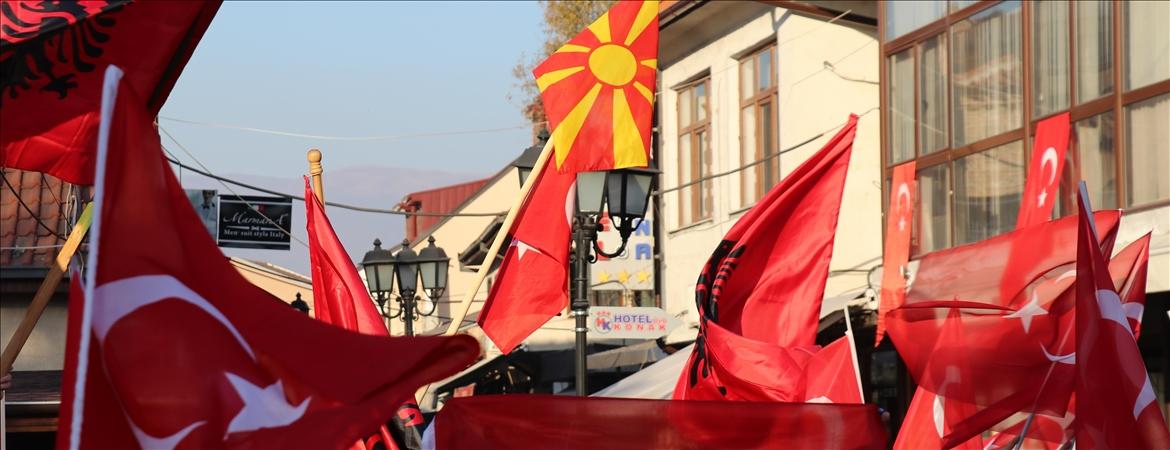
Macedonian Turks’ Language Day (TRT News)
The recognition of this day as an official holiday resulted from political initiatives within the Assembly of North Macedonia. The proposal to designate December 21 as an official and national holiday was submitted by Dr. Kenan Hasip, President of the Democratic Party of Turks and Member of Parliament, and MP Hadi Nezir. In February 2007, amendments to the Holidays Law formally recognized December 21 as the national holiday of the Turks of North Macedonia and declared it an official public holiday.【5】
However, political representatives of the Turkish community in North Macedonia highlight the ongoing challenges despite the achievement of the right to Turkish-language education. MP Salih Murat has stated that the Turkish population has long been subjected to assimilation policies targeting language and identity, and that Turks have been excluded from services and opportunities provided by the government. Murat has asserted that governments have kept the Turkish community outside the system through unlawful and unconstitutional means, citing the pretext that they are “not sufficiently integrated.”【6】
The achievement of the right to Turkish-language education has laid the foundation for the cultural and academic development of the Turks of Macedonia. Today, Turkish-language instruction is officially conducted in 134 primary schools and 11 state secondary schools. Higher education and Turkology research are concentrated in four state faculties and other institutions.
Currently, Turkish-language instruction continues officially in 134 primary schools and 11 state secondary schools. Turkology studies are carried out primarily at three major state universities: the Department of Turkish Language and Literature at the Faculty of Philology of Ss. Cyril and Methodius University in Skopje, the Department of Turkish Language and Literature at the Faculty of Philology of Goce Delčev University in Štip, and the Department of Oriental Studies at the State University of Tetovo. Additional Turkology activities are also present at the Faculty of Pedagogy of Ss. Cyril and Methodius University, named after St. Kliment Ohridski, and at the private International Balkan University. Institutions supporting this academic structure, such as the Marko Čepenkov Institute of Folklore and the National Institute of History, conduct research on Turkish folklore and history.【7】
Turkish literature in Macedonia is represented by the following authors: Hüseyin Süleyman, Abdülfettah Rauf, Enver Tuzcu, Şükrü Ramo, Mustafa Karahasan, Hümaşah Vardar, Lütfi Seyfullah, Necati Zekeriya, Şerafettin Nebi, Mahmut Kıratlı, Fahri Kaya, İlhami Emin, Recep Murat Bugariç, Esad Bayram, Cavit Saraç, Avni Engüllü, Fahri Ali, Sebahattin Sezair, Halise Hasan Özgün, Avni Abdullah, Mustafa Yaşar, Alaettin Tahir, Yusuf Edip, Melahat Engüllü, Suat Engüllü, İrfan Bellur, Enver İlyaz, Enver Ahmet, Halise Hasan Özgün, Nusret Dişo Ülkü, Sabit Yusuf, Biba İsmail, Semra Samet, Tülay İbrahim, Oktay Ahmed, Meral Kayın, Rıfat Emin, Leyla Hüseyin, Bennu Musli, Arzu Abdullah, Mehmed Arif, Gülden Ruşit, Bekir Abdi, Derya Ruşan, Zeynep Hüseyin, Rabie Ruşid, Sezen Seyfullah, Zeynep Arifi, Sema Ali Erol.【8】
Happy 21 December Turkish Language Education Day for the Macedonian Turks | Balkan Lullaby Episode 23 (TRT 1)
The Turkish Language Education Day of the Turks of North Macedonia is enthusiastically celebrated across various regions of the country through a wide range of events. The central ceremonies are typically held in the capital Skopje, with participation from the highest levels of government, including the President and Prime Minister of the country.
Celebration programs include concerts, seminars, panels, and various cultural activities. Balkan folk dances reflecting the region’s cultural heritage are performed and feasts are organized. Official delegations from Türkiye, including delegations at the level of the Speaker of the Grand National Assembly of Türkiye, participate as guests. Additionally, concerts by popular artists form part of the celebration program.
The Macedonian Turkish Civil Society Organizations Union (MATÜSİTEB), an umbrella organization for nearly 60 Turkish civil society organizations operating in North Macedonia, plays an active role in organizing these celebrations and frequently receives support from TİKA (Turkish Cooperation and Coordination Agency). This national holiday is also commemorated and celebrated in cities in Türkiye with significant Balkan Turkish migrant populations, such as Edirne.【9】
Altay, Enes, and Ahmet Akkaya. “Kuzey Makedonya’da Türkçe Eğitimi.” *ÇÜTAD Çukurova Üniversitesi Türkoloji Araştırmaları Dergisi* 7, no. 1 (2022): 147–167. Accessed November 28, 2025.https://dergipark.org.tr/tr/pub/cutad/issue/70298/1098063
Anadolu Ajansı. "Kuzey Makedonya'daki Türkler, asimilasyon ve ayrımcılığın son bulmasını istiyor." Accessed November 28, 2025.https://www.aa.com.tr/tr/ayrimcilikhatti/ayrimcilik/%20kuzey-makedonyadaki-turkler-asimilasyon-ve-ayrim%20ciligin-son-bulmasini-istiyor/1820735
Anadolu Ajansı. "Makedonya'da Türkçe Eğitim Bayramı." Accessed November 28, 2025.https://www.aa.com.tr/tr/turkiye/makedonyada-turkce-egitim-bayrami/1345547
Hoca, Fadıl, and Abdülmecit Nuredin. *Makedonya’da Türkçe Eğitim: Tarihsel ve Sosyo-Kültürel Gelişmeler*. International Vision University, Institute of Social Sciences Publications, no. 1.https://vizyonuniversitekayit.com/21749312/controller/pdf_gallery/1914-2024-makedonya-da-turkce-egitim-tarihsel-ve-sosyo-kulturel-gelismeler/1914-2024%20MAKEDONYA%E2%80%99DA%20T%C3%9CRK%C3%87E%20E%C4%9E%C4%B0T%C4%B0M%20TAR%C4%B0HSEL%20VE%20SOSYO-K%C3%9CLT%C3%9CREL%20GEL%C4%B0%C5%9EMELER.pdf
Keskiner, Nihal. "Makedonya Türklerinin Dil Bayramı." TRT Haber. Accessed November 28, 2025.https://www.trthaber.com/haber/dunya/makedonya-turklerinin-dil-bayrami-732208.html#:~:text=%C3%9Csk%C3%BCp'te%2078%20y%C4%B1l%20%C3%B6nce,Dil%20Bayram%C4%B1%20g%C3%BCn%C3%BC%20olarak%20kutlan%C4%B1yor.
Leontik, Marija. “Kuzey Makedonya’da Türkoloji / Turkology in North Macedonia.” In *Dünya’da Türkoloji*, Türkoloji Akademisi & Continent Publications, 245-396. Ankara, 2024. Accessed November 28, 2025.https://eprints.ugd.edu.mk/35694/
T.C.Trakya ÜniversitesiBalkan Araştırma Institute. "21 December, Northern Macedonia Turks' Official and National Holiday." Accessed November 28, 2025.https://bae.trakya.edu.tr/news/21-aralik-kuzey-makedonya-turklerinin-resm--ve-mill--bayrami
TRT 1. "Makedonya Türklerinin 21 Aralık Türkçe Eğitim Bayramı Kutlu Olsun | Balkan Ninnisi 23. Bölüm." Date Published December 22, 2022. Accessed November 28, 2025.https://www.youtube.com/watch?v=n5XGSP75Sdo
TRT Avaz. "Makedonya Türklerinin Dil Bayramı." Accessed November 28, 2025.https://www.trtavaz.com.tr/haber/tur/turkistandan/makedonya-turklerinin-dil-bayrami/63a2c07101a30a12201c0850
TRT Haber. "Makedonya Türklerinin Dil Bayramı." TRT Haber. Date Published December 22, 2022. Accessed November 28, 2025.https://www.youtube.com/watch?v=Dq9UNwoRYF0
[1]
Leontik, Marija. “Kuzey Makedonya’da Türkoloji / Turkology in North Macedonia.” In Dünya’da Türkoloji, Türkoloji Akademisi & Continent Publications, 245-396. Ankara, 2024, sayfa 10, erişim Tarihi: 28 Kasım 2025. https://eprints.ugd.edu.mk/35694/
[2]
Hoca, Fadıl, ve Abdülmecit Nuredin. Makedonya’da Türkçe Eğitim: Tarihsel ve Sosyo-Kültürel Gelişmeler. Uluslararası Vizyon Üniversitesi, Sosyal Bilimler Enstitüsü Yayınları, No. 1. sayfa 8, https://vizyonuniversitekayit.com/21749312/controller/pdf_gallery/1914-2024-makedonya-da-turkce-egitim-tarihsel-ve-sosyo-kulturel-gelismeler/1914-2024%20MAKEDONYA%E2%80%99DA%20T%C3%9CRK%C3%87E%20E%C4%9E%C4%B0T%C4%B0M%20TAR%C4%B0HSEL%20VE%20SOSYO-K%C3%9CLT%C3%9CREL%20GEL%C4%B0%C5%9EMELER.pdf
[3]
Hoca, Fadıl, ve Abdülmecit Nuredin. Makedonya’da Türkçe Eğitim: Tarihsel ve Sosyo-Kültürel Gelişmeler. Uluslararası Vizyon Üniversitesi, Sosyal Bilimler Enstitüsü Yayınları, No. 1. sayfa 8, https://vizyonuniversitekayit.com/21749312/controller/pdf_gallery/1914-2024-makedonya-da-turkce-egitim-tarihsel-ve-sosyo-kulturel-gelismeler/1914-2024%20MAKEDONYA%E2%80%99DA%20T%C3%9CRK%C3%87E%20E%C4%9E%C4%B0T%C4%B0M%20TAR%C4%B0HSEL%20VE%20SOSYO-K%C3%9CLT%C3%9CREL%20GEL%C4%B0%C5%9EMELER.pdf
[4]
Leontik, Marija. “Kuzey Makedonya’da Türkoloji / Turkology in North Macedonia.” In Dünya’da Türkoloji, Türkoloji Akademisi & Continent Publications, 245-396. Ankara, 2024, sayfa 16, erişim Tarihi: 28 Kasım 2025. https://eprints.ugd.edu.mk/35694/
[5]
Anadolu Ajansı, "Kuzey Makedonya'daki Türkler, asimilasyon ve ayrımcılığın son bulmasını istiyor," Anadolu Ajansı, erişim tarihi: 28 Kasım 2025, https://www.aa.com.tr/tr/ayrimcilikhatti/ayrimcilik/%20kuzey-makedonyadaki-turkler-asimilasyon-ve-ayrim%20ciligin-son-bulmasini-istiyor/1820735
[6]
Anadolu Ajansı, "Kuzey Makedonya'daki Türkler, asimilasyon ve ayrımcılığın son bulmasını istiyor," Anadolu Ajansı, erişim tarihi: 28 Kasım 2025, https://www.aa.com.tr/tr/ayrimcilikhatti/ayrimcilik/%20kuzey-makedonyadaki-turkler-asimilasyon-ve-ayrim%20ciligin-son-bulmasini-istiyor/1820735
[7]
Leontik, Marija. “Kuzey Makedonya’da Türkoloji / Turkology in North Macedonia.” In Dünya’da Türkoloji, Türkoloji Akademisi & Continent Publications, 245-396. Ankara, 2024, sayfa 5, erişim Tarihi: 28 Kasım 2025. https://eprints.ugd.edu.mk/35694/
[8]
Leontik, Marija. “Kuzey Makedonya’da Türkoloji / Turkology in North Macedonia.” In Dünya’da Türkoloji, Türkoloji Akademisi & Continent Publications, 245-396. Ankara, 2024, sayfa 16, erişim Tarihi: 28 Kasım 2025. https://eprints.ugd.edu.mk/35694/
[9]
Keskiner, Nihal, "Makedonya Türklerinin Dil Bayramı," TRT Haber, erişim tarihi: 28 Kasım 2025, https://www.trthaber.com/haber/dunya/makedonya-turklerinin-dil-bayrami-732208.html#:~:text=%C3%9Csk%C3%BCp'te%2078%20y%C4%B1l%20%C3%B6nce,Dil%20Bayram%C4%B1%20g%C3%BCn%C3%BC%20olarak%20kutlan%C4%B1yor.
Celebration Date | 21 December | ||||||||
|---|---|---|---|---|---|---|---|---|---|
Country Celebrated In | Republic of North Macedonia | ||||||||
Official Holiday Adoption Year | 2007 | ||||||||
Holiday Status | Official and National Holiday | ||||||||
Symbolic Beginning | 21 December 1944 | ||||||||
Important Supporting Organizations | MATÜSİTEB (Macedonian Turkish Civil Society Organizations Union), TİKA (Turkish Cooperation and Coordination Agency) | ||||||||
Proposers of Officialization | Dr. Kenan Hasip, Hadi Nezir | ||||||||
No Discussion Added Yet
Start discussion for "Turkish Education Day of the Turks of North Macedonia" article
Historical Development and Achievement
Official Status and Political Dimension
Structure of Turkish Language Education and Turkology Institutions
Celebration Activities