

This article was automatically translated from the original Turkish version.
+1 More
Definition(s) | It is the official state flag of Türkiye | ||||||||
|---|---|---|---|---|---|---|---|---|---|
Legal Basis | Turkish Flag Law No. 2893 | ||||||||
Symbol | Crescent and five-pointed star | ||||||||
Ratio | 2:3 | ||||||||
Shape | Rectangle | ||||||||
Color | White crescent and star on a red background | ||||||||
Türk flag is the official state flag representing the sovereignty, legal existence, and national identity of the Türkiye Republic. The flag is a state emblem whose shape, colors, proportions, manufacturing principles, and usage rules are defined by law and possesses not only symbolic but also legal status. In the Türkiye Republic, the fundamental principles regarding the Turkish flag are regulated by the Turkish Flag Law dated 22 September 1983 and numbered 2893, along with the Turkish Flag Regulation issued under this law and related circulars. The aforementioned law defines the Turkish flag as a “red flag with a white crescent and star.” This definition expresses not only the flag’s symbolic elements but also its color composition and distinctive character. The term “red flag” is a concept rooted in historical and traditional usage, indicating a flag with a red background. This expression is a linguistic element reflecting the historical continuity from the Ottoman State to the Türkiye Republic.
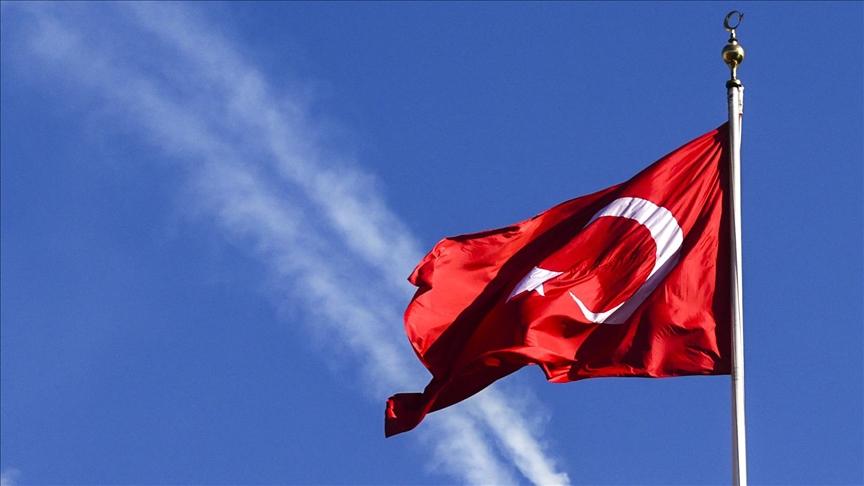
The Highest Flag of Türkiye Located at Istanbul Ulus Campus (TRT Corporate)
In addition to being the official emblem of the state, the Turkish flag is regarded as a concrete manifestation of the nation-state concept. In this sense, the flag is not merely a symbol used in public institutions; it is a fundamental element representing state authority, independence, and national unity. This characteristic necessitates detailed regulation of its usage rules. Indeed, the Turkish flag is used to represent the Türkiye Republic in official offices, military units, diplomatic missions, and international platforms. Legally, the Turkish flag is a protected state symbol. Its definition, dimensions, and modes of use are not left to discretion; they are clearly delimited by law, regulation, and circulars. These regulations aim to preserve the flag’s dignity and integrity. Disrespect, insult, or non-compliant use of the flag is not only a matter of social sensitivity but is also treated as a legal offense subject to sanctions.
An important feature of the Turkish flag is that it is the sole and unchanging official flag. Within the borders of the Türkiye Republic and in all areas where the state is represented, only the flag defined by law is valid. Flags bearing different colors, proportions, or symbols are not recognized as Turkish flags. This is significant for standardizing national symbols and clearly representing state identity. In the social sphere, the Turkish flag is directly linked to historical memory. The flag has acquired meaning through wars, the process of state foundation, the struggle for independence, and collective experiences; over time, it has evolved from being merely an official emblem into a symbol of social belonging and shared identity. However, this symbolic meaning does not override its legal definition; on the contrary, the legal framework ensures the preservation of this meaning and prevents its misuse.
The physical characteristics of the Turkish flag—its color, shape, proportions, measurements, and the positioning of its symbols—are strictly and unchangeably defined. These features are detailed to prevent arbitrary production or interpretation of the flag, ensuring that it maintains the same visual identity under all conditions. The Turkish Flag Law, the Turkish Flag Regulation, and circulars issued by the Ministry of Interior complement these standards.
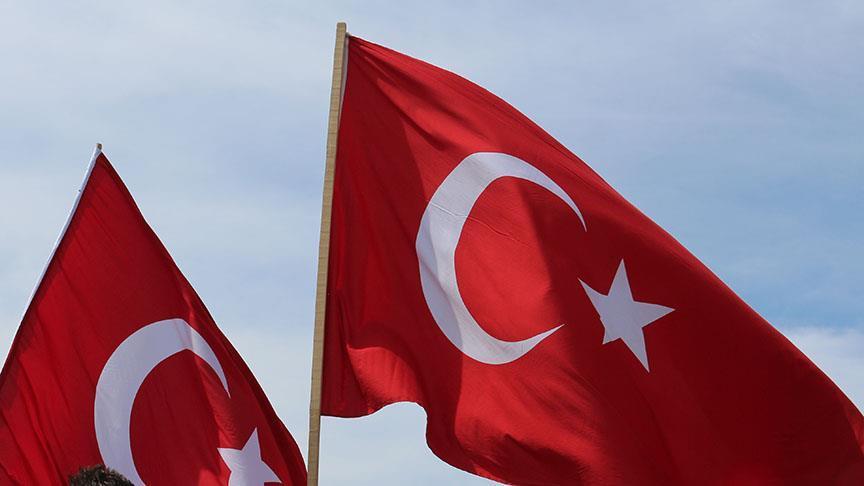
Turkish Flag (Anadolu Agency)
The Turkish flag consists of two colors: a red field and a white crescent and star. In the legal text, the red color is referred to as “al.” The color “al” has a long historical tradition in the traditional Turkish flag concept and has been used since the Ottoman period as the fundamental color of the state flag. This color is one of the distinctive and enduring elements of the Turkish flag.
The white color is used for the crescent and star symbols. The choice of white creates a strong visual contrast with the background color and ensures that the symbols are clearly visible from a distance and under varying lighting conditions. The tones of the colors are also strictly standardized; production in pale, dark, or other shades is prohibited.
The Turkish flag is rectangular. This shape is consistent with international flag conventions and is explicitly specified in the official definition of the Turkish flag. Horizontal display is the standard; the orientation and placement of the crescent and star are determined according to this horizontal plane.
The symbols on the flag are not randomly placed. The crescent is positioned with its open end facing right. The five-pointed star is located on the open side of the crescent at a specific distance. This arrangement ensures both aesthetic balance and clear distinguishability of the symbols.
The crescent on the Turkish flag is not a complete circle but a shape formed by two circular arcs. This technical definition specifies precisely how the crescent is to be constructed geometrically. The diameters and centers of the inner and outer arcs of the crescent are shown in the table attached to the law. This ensures that the shape of the crescent remains unchanged regardless of the manufacturer.
The position of the crescent on the flag is not merely an aesthetic preference but a standardized requirement. The center point of the crescent is placed according to measurements determined by the flag’s length and height. This arrangement ensures visual integrity even when the flag is produced in different sizes.
The star on the Turkish flag is five-pointed. The number of points and the shape of the star have been clearly defined through historical development and are now fixed in the modern Turkish flag. Each point of the star is of equal length and forms a regular pentagon.
The star is positioned on the open side of the crescent and maintains a specific visual relationship with it. The size of the star is proportional to the dimensions of the crescent; it is neither large enough to overshadow the crescent nor small enough to make it difficult to perceive. These proportions ensure a balanced appearance at any scale.
One of the most distinctive physical features of the Turkish flag is the precise definition of its measurements and proportions. The ratio between the flag’s width and length is shown in the technical drawing attached to the law. Similarly, the diameters of the crescent and star, their center points, and their distances from the flag’s edges are detailed in this drawing.

Turkish Flag Proportions (Turkish Historical Society)
G Width
A Distance from outer crescent center to flag edge 1/2 G
B Outer crescent diameter 1/2 G
C Distance between inner and outer crescent centers 0.0625 G
D Inner crescent diameter 0.4 G
E Distance from inner crescent to star circle 1/3 G
F Star circle diameter 1/4 G
L Length 1 1/2 G
M Flag fringe width 1/30 G
Note: The proportions remain unchanged regardless of the flag’s width (G).
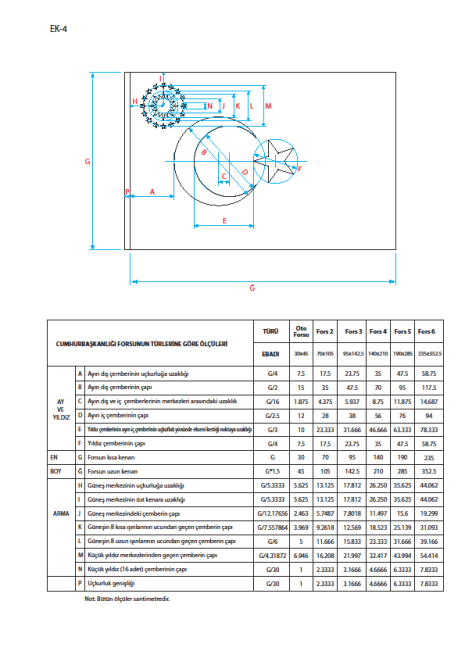
Measurements and Proportions on the Turkish Flag (Presidency of the Republic of Türkiye Legislative Information System)
Thanks to these technical standards, the Turkish flag maintains the same proportions whether it is a small desk flag or a large ceremonial flag. The shape remains unchanged regardless of scale; only the size increases or decreases.
The physical characteristics of the Turkish flag are not limited to shape and measurements. The fabric used, the printing or weaving method, and durability are also subject to specific standards. The colors must not fade, the symbols must not deteriorate, and wear during use must not render the symbols unrecognizable. In particular, flags used in official institutions and ceremonies must be standard-compliant and clean. The use of torn, faded, or dimensionally distorted flags is considered a violation of the regulations, as it compromises the flag’s physical integrity.
The detailed regulation of the Turkish flag’s physical characteristics stems from its role not as a mere visual element but as a symbol representing the state’s official identity. Standardization preserves the flag’s dignity and prevents incorrect, incomplete, or careless production. In this context, the Turkish flag is not merely an aesthetic object in terms of its physical qualities; it is a state symbol with legal, technical, and symbolic dimensions. The physical characteristics form the foundational basis for the flag’s historical and symbolic meanings.
The history of the Turkish flag is directly linked to the Turkish tradition of statehood, symbolic understanding, and political organization. In Turkish history, the flag has not merely been a sign or distinguishing feature; it has emerged as a symbol of sovereignty, authority, and legitimacy and has undergone formal changes over time to reach its current form. This process encompasses a long historical development from pre-Islamic Turkish communities through the Seljuk, Ottoman, and Türkiye Republic periods.
Among pre-Islamic Turkish communities, the flag served more as a political and military indicator than as a fixed national symbol in the modern sense. During this period, the terms “tuğ” and “sancak” were used more frequently than “flag.” Tuğ was typically made from horsehair and regarded as a symbol of rulership. The number of tuğs indicated the authority and status of the ruler or commander.
In early Turkish states, colors and animal figures carried significant symbolic meanings. Red was associated with power and authority; celestial elements such as the sky, sun, and moon were linked to concepts of cosmic order and sanctity. These symbols were indirectly reflected in later flag designs.
During the Seljuk State period, flags continued to be used as indicators of state authority and military unity. Although Seljuk sancaks featured different colors and symbols, a unified flag concept representing the entire empire had not yet emerged. Each beylik or military unit typically carried its own sancak.
It is known that crescent and star motifs appeared in architecture and decorative elements during this period. However, these symbols had not yet become central elements of the state flag. The Seljuk flag tradition laid the foundation for the sancak-centered flag culture later adopted by the Ottoman State.

Flag from the Ottoman Period (Anadolu Agency)
From the foundation of the Ottoman State, flags and sancaks held an important place in the military and administrative structure. In early periods, the Ottomans used sancaks of various colors and symbols, typically representing the sultan, the army, or specific military units. Over time, red became the official color of the Ottoman state flag. The use of red-background sancaks became widespread, especially in naval and military contexts.
The crescent symbol became increasingly prominent on Ottoman flags due to its association with Islam; the star was later introduced alongside the crescent. From the late 18th century onward, the Ottoman State moved toward standardization in flag design. Under reforms during the reign of Sultan Selim III, the flag featuring a white crescent and star on a red background was officially recognized as the state flag. This development is regarded as the stage at which the formal foundations of the modern Turkish flag were laid.
The First Turkish Flag in the Parliament (TRT News)
The Tanzimat Period was a time when the Ottoman State introduced reforms not only in administrative and legal fields but also regarding the flag. During this period, the red flag with crescent and star became more clearly established as the official emblem of the state. The number of star points and its relationship to the crescent were clarified over time, and the flag began to be used internationally as a symbol representing the Ottoman State.
During this period, the flag ceased to be merely a military emblem and acquired the broader status of a general symbol representing the state. The crescent-star flag began to be used in embassies, official ceremonies, and international relations.
With the foundation of the Republic of Türkiye, the red flag with crescent and star inherited from the Ottoman State was adopted as the new state’s flag. The republican administration undertook legal measures to clarify the flag’s form and usage. Accordingly, the shape, proportions, and usage principles of the Turkish flag were detailed in laws and regulations.
During the Republic period, the Turkish flag was recognized not only as the state’s emblem but also as the common symbol of the nation. The flag became associated with the concepts of national sovereignty, independence, and state continuity, thereby becoming one of the fundamental visual elements of modern Turkish identity.
The crescent and star on the Turkish flag are elements carrying layered historical and symbolic meanings. These symbols are not unique to the Republic of Türkiye period but must be understood as products of older cultural and historical traditions. The origin of the crescent and star evolved over a long process extending from Central Asian Turkic beliefs through the Ottoman state tradition to modern nation-state symbolism.
In pre-Islamic Turkic belief systems, the sky and celestial bodies held significant importance. Within the framework of the Sky God belief, the heavens were regarded as sacred and ordering elements. The sun, moon, and stars were viewed as symbols of cosmic order, continuity, and authority. In this context, although the moon and star were not directly used as flag symbols in early Turkic culture, they were integral components of the symbolic worldview.
Archaeological findings, rock paintings, and decorative art containing celestial motifs demonstrate that the moon and star were not foreign or later additions to Turkic culture. These elements formed a symbolic foundation that could later be transferred to state symbols.
The crescent gradually became an important symbol in the Islamic world. However, it is known that the crescent was not used as an official religious symbol in the early periods of Islam. Its widespread adoption in the Islamic world occurred largely through Turkic-Islamic states. During this process, the crescent acquired both religious and political meanings.
The Ottoman State’s dominance over vast territories and its long-standing position as the most powerful political authority in the Islamic world led to the crescent becoming identified with the Ottomans. Thus, over time, the crescent came to be perceived not only as a symbol of Islam but also as a representation of the Ottoman State’s political power and authority.
The star symbol has been used with various meanings across many cultures throughout history. The star on the Turkish flag stands out due to its five-pointed shape. Although various interpretations exist regarding the meaning of the five-pointed star, these interpretations are generally framed within symbolic and cultural contexts.
During the Ottoman period, the star was initially depicted with varying numbers of points. Over time, the five-pointed star became dominant and was definitively fixed in the modern Turkish flag. When used together with the crescent, the star serves as a balancing and complementary element on the flag.
The combined use of the crescent and star is the most distinctive feature of the Turkish flag. This combination developed over historical processes due to aesthetic, symbolic, and political reasons. The placement of the moon and star side by side signifies the representation of celestial elements together and reflects the state’s legitimacy as connected to cosmic order.
In the late Ottoman period, the crescent-star flag was officially recognized as the state emblem; this symbolic structure was continued by the Republic of Türkiye. During the Republic period, the crescent and star were reinterpreted within the ideological framework of the new state, yet historical continuity was preserved.
There are several popular legends and traditions regarding the origin of the crescent and star. These narratives commonly feature motifs such as the appearance of the moon and star reflected on a field covered with the blood of fallen soldiers after a battle. Such stories imbue the flag with emotional and mythological meaning, though they lack historical documentary value. From an academic perspective, these traditions are important for illustrating the flag’s place in social memory and the meanings assigned to its symbols; however, they are not regarded as historical evidence explaining the flag’s origin.
The Turkish flag is not merely a historical and symbolic element but also a state emblem protected by legal norms. In the Republic of Türkiye, provisions defining the flag’s identity, form, use, and protection are detailed in legislation under the constitutional framework of the state. These regulations aim to prevent arbitrary applications and ensure respect for the state’s official symbol.
The primary legal basis of the Turkish flag is the Turkish Flag Law dated 22 September 1983 and numbered 2893. This law defines the Turkish flag as a “white crescent and star on a red flag” and legally binds its shape, dimensions, and essential characteristics. The technical drawings and tables attached to the law detail the flag’s geometric structure, thereby legally fixing its visual identity.
The law explicitly emphasizes that the Turkish flag is the official state flag and establishes it as the sole flag representing the Republic of Türkiye. This prevents the use of alternative designs or interpretations under the name “Turkish flag.”
The Turkish Flag Regulation was issued to ensure the implementation of the Turkish Flag Law and contains detailed provisions regarding the flag’s usage. The regulation specifies under what circumstances, in which institutions, and how the flag should be used. It clarifies matters such as locations where the flag must be raised, its position during ceremonies, conditions for lowering it, and duration of display. The regulation aims to establish uniformity in practice by placing not only the flag’s form but also its functional use within a legal framework.
To ensure uniform implementation of Turkish flag practices nationwide, various circulars have been issued by relevant institutions, primarily the Ministry of Interior. These circulars address practical issues concerning flag usage in public institutions and clarify the application of legal and regulatory provisions.
The circulars emphasize the sensitivity required for protecting the flag and remind public officials of their responsibilities in this regard. Thus, the theoretical provisions of the legislation are supported by administrative practices.
The fundamental purpose of legal protections for the Turkish flag is its role as a symbol representing the honor and sovereignty of the state. Therefore, disrespect, mistreatment, or non-compliant use of the flag is not merely an ethical issue but is also considered a legal violation.
The use of torn, dirty, or non-compliant flags is explicitly prohibited under legal regulations. This approach aims to preserve the flag’s physical integrity and prevent the degradation of the values it represents.
The legal regulations concerning the Turkish flag are oriented toward preserving state order and official representation rather than sanctifying the symbol. The flag is treated as a state emblem defined and delimited within the framework of a rule-of-law state. In this context, the Turkish flag is not only a continuation of historical heritage but also a national symbol defined and protected within the modern legal order. Legal foundations are among the essential elements ensuring the flag’s continuity and immutability.
The rules governing the use of the Turkish flag are detailed to preserve its legal and symbolic value. These rules aim to ensure uniformity in practice by specifying when, where, and how the flag should be used. The Turkish Flag Law, the Turkish Flag Regulation, and related circulars together form the normative framework for its usage.
The Turkish flag must be used in all official institutions and organizations representing the Republic of Türkiye. Government offices, governorates, district governorships, municipalities, courts, military units, and diplomatic missions are obligated to maintain and use the flag in accordance with regulations.
In official institutions, the flag is flown on the front facade of the building or another suitable location. The flag must be clean, intact, and compliant with standards. Use of faded, discolored, or dimensionally non-compliant flags is not acceptable.
The use of the Turkish flag on national holidays, official ceremonies, and commemorative days is subject to special rules. On such occasions, the flag serves as a central element representing the shared values of the state and the nation. The flag’s position at ceremonies takes precedence over all other symbols.
At ceremonies, the Turkish flag must not be placed behind or below any other flag or symbol. When used alongside foreign state flags, arrangements must conform to protocol rules, taking into account the sovereignty rights represented by the Turkish flag.
Lowering the Turkish flag to half-mast is a practice reserved for periods of mourning and commemoration. This practice is carried out only upon the decision of authorized authorities and under specified circumstances. When lowering the flag, it is first fully raised to the top of the pole and then lowered to half-mast according to procedure.
The half-mast practice is an expression of respect for the flag and must not be performed arbitrarily. The days and circumstances under which the flag is lowered are specified in regulations and related circulars.

Turkish Military Units with the Turkish Flag (Anadolu Agency)
The Turkish flag holds special significance in military units and military ceremonies. The sancak is a fundamental element representing the honor and existence of military units. Military flags are formally presented and carefully preserved. The carrying, safeguarding, and positioning of the flag during military ceremonies are subject to strict disciplinary rules. The flag touching the ground, being damaged, or subjected to disrespect are considered unacceptable.
The Turkish flag may also be used by citizens on national holidays, commemorative days, and socially significant events. However, even in civilian use, the dignity and physical integrity of the flag must be respected.
Using the flag as a tablecloth, clothing, advertising element, or decorative item is considered non-compliant and inappropriate usage. Such uses are incompatible with the flag’s nature as a state symbol.
It is strictly prohibited to lay the Turkish flag on the ground, write on it, cut it, or damage its symbols. Covering or draping any object with the flag is also considered non-compliant. Furthermore, the flag may not be used for commercial or political purposes. These prohibitions aim to preserve the flag’s character as a neutral symbol representing the entire society.
Respect for the Turkish flag is not merely an individual attitude or traditional behavior; it is an institutionalized concept with legal, social, and cultural dimensions. Because the flag symbolizes the sovereignty and representative authority of the Republic of Türkiye, attitudes and behaviors toward it are bound by specific norms. In this context, respect for the flag is a value both codified in legislation and embedded in social memory.
Turkish Flags Hung in Villages Have Not Been Lowered Since 2006 (TRT News)
The respect owed to the Turkish flag is explicitly defined within the framework of the Turkish Flag Law and related legislation. Damaging, soiling, allowing the flag to fall to the ground, or using it in a non-compliant manner is considered legally disrespectful. Such acts are interpreted as undermining the state authority represented by the flag.
Insulting or demeaning behavior toward the flag is not merely an administrative violation but constitutes an act that may incur criminal liability. This approach is a natural consequence of recognizing the flag not as an ordinary object but as the official emblem of the state.
Respect for the Turkish flag during official ceremonies is concretized through specific protocol rules. The flag’s position at ceremonies is arranged to be in front of or at the center of all other symbols. When the flag is lowered or raised during ceremonies, participants are expected to adopt a specific posture. In military ceremonies, respect for the flag is governed by stricter rules. The carrying, safeguarding, and preservation of the sancak are inseparable parts of military discipline. These ceremonies are significant for demonstrating how the values represented by the flag are institutionally upheld.
Respect for the Turkish flag is not limited to official settings; it is also expressed through specific behaviors in daily life. When displayed in homes, workplaces, or public areas, the flag must be clean and properly maintained; worn-out flags must not be used.
Disposing of flags that have reached the end of their service life or whose physical integrity has been compromised is considered inappropriate. Such flags should be preserved or destroyed in accordance with regulations and traditions as part of the respect shown to the flag.
Respect for the Turkish flag is a component of social consciousness shaped by historical experiences. Wars, the struggle for independence, and the foundation of the state have enhanced the flag’s value in the public mind. Therefore, the flag is perceived not merely as a symbol but as a carrier of shared history and collective memory. This perception has led to attitudes toward the flag being viewed not as individual preferences but as social responsibilities.
Respect for the flag has thus become a value transmitted from generation to generation. The continuity of respect for the Turkish flag is ensured not only by individual sensitivity but also by institutional mechanisms. Flag ceremonies in educational institutions, commemorative programs on official days, and practices in public institutions help sustain this awareness.
One of the most common traditions associated with the Turkish flag is the narrative of the “blood lake”. According to this narrative, after a great battle, the shape of the current flag emerged when the moon and stars in the night sky reflected on a field covered with the blood of martyrs. This story aims to explain the historical origins of the flag’s red color and the crescent-star motif.
From an academic perspective, this tradition is not accepted as direct historical evidence of an event. However, it is noteworthy for illustrating how the flag is associated in public consciousness with the concepts of sacrifice, struggle, and cost.
Some traditions describe the crescent and star as being perceived together after reflecting on a water pool or lake surface, inspiring the flag’s design. These narratives do not emphasize blood but instead highlight a natural observation.
These narratives rely on the explanation that the symbols emerged from a random natural phenomenon. However, historical documents show that the form of the Turkish flag was shaped not by sudden or isolated events but through a long historical and symbolic process.
Legends and traditions typically emerge when written historical sources are limited or when complex processes are simplified for narrative purposes. The legends surrounding the Turkish flag are products of the need to present its origin in an understandable and emotionally resonant framework. These narratives, primarily spread through oral culture, have developed various versions over time. Each version highlights a different aspect of the flag, expanding the symbolic meaning of the emblem.
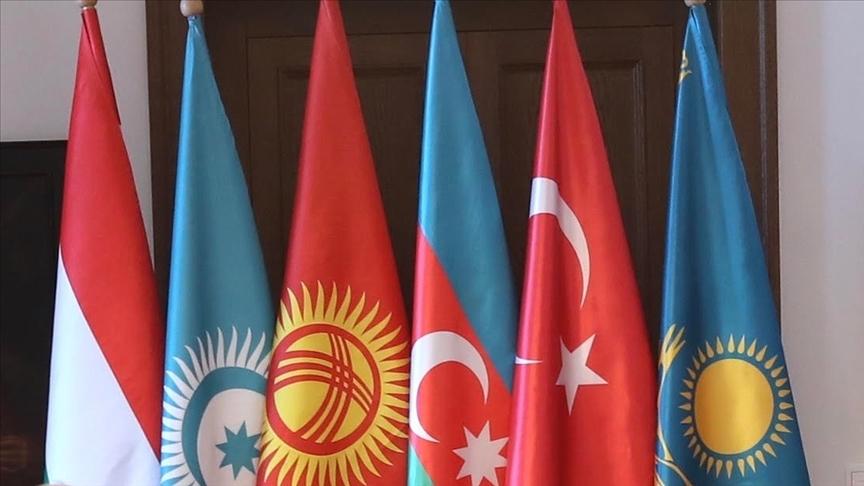
Turkish Flag at the Turkic Council (Anadolu Agency)
The Turkish flag is the official symbol representing the international presence and sovereignty of the Republic of Türkiye. In international relations, the flag is recognized as one of the primary indicators of a country’s visibility, legal personality, and diplomatic status. In this context, the Turkish flag is a state emblem governed by international law and diplomatic protocols.
The Turkish flag is officially used in Türkiye’s embassies, consulates, and permanent missions abroad. In these locations, the flag symbolically and legally signifies that the premises belong to the Republic of Türkiye. The use of the flag in diplomatic missions is conducted in accordance with international customs and the practices of the host country.
As part of diplomatic representation, the flag gains visibility during official ceremonies, protocol events, and meetings between heads of state. This usage reflects Türkiye’s international position based on the principle of sovereign equality.
Under international law, the flag is one of the indicators of state recognition. The Turkish flag symbolizes the Republic of Türkiye’s place in the international community as an independent state. The use of the flag on ships, aircraft, and official vehicles indicates the state’s legal jurisdiction and national affiliation.
Especially in maritime contexts, the flag indicates the state to which a vessel is subject. A ship flying the Turkish flag is recognized as under the sovereignty and protection of the Republic of Türkiye in international waters. This demonstrates that the flag is not merely symbolic but carries legal consequences.
The Republic of Türkiye is represented by the Turkish flag in international organizations and multilateral platforms. In the United Nations, NATO, and similar international bodies, the Turkish flag is one of the primary symbols indicating Türkiye’s status as a member state.
In international sports events, cultural activities, and official ceremonies, the use of the Turkish flag visibly asserts the state’s identity and representative authority. The use of the flag in such events is conducted in accordance with international protocol rules.
When used alongside foreign state flags, the Turkish flag follows the principles of equality and reciprocity. In international protocol, no national flag may be positioned to assert superiority over another. This principle underscores the sovereign equality of states.
Within the borders of the Republic of Türkiye or at international events abroad, the display of the Turkish flag alongside other flags is carried out in accordance with established protocol rules. These arrangements aim to maintain respect and balance in international relations.
Historically, the Turkish flag became identified with the Ottoman State and later evolved into the symbol of the modern nation-state identity of the Republic of Türkiye. This transformation has influenced its international perception. The crescent and star are now among the symbols directly associated with Türkiye in the global public consciousness. This perception enables the flag to simultaneously represent both its historical legacy and its contemporary state identity. In this sense, the Turkish flag is a symbol that maintains its historical continuity while occupying a place within the modern system of nation-states.
Akarsu, Veli. "Türk Bayrağı ve Altın Oran İlişkisi." *Erciyes Üniversitesi Fen Bilimleri Enstitüsü Dergisi* 25, no. 1-2 (2009): 437-448. https://dergipark.org.tr/tr/download/article-file/236312.
Anadolu Ajansı. "15 Temmuz Kahramanı Şehit Olana Kadar Türk Bayrağını Elinden Bırakmadı." Accessed February 1, 2026. https://www.aa.com.tr/tr/15-temmuz-darbe-girisimi/sehit-olana-kadar-turk-bayragini-elinden-birakmadi/1123885.
Anadolu Ajansı. "Osmanlı Bayrağı Türkiye’ye İade Edildi." Accessed February 1, 2026. https://www.aa.com.tr/tr/pg/foto-galeri/osmanli-bayragi-turkiyeye-iade-edildi.
Anadolu Ajansı. "Süleyman Şah’ın Naaşının Nakledileceği Bölgeye Türk Bayrağı Çekildi." Accessed February 1, 2026. https://www.aa.com.tr/tr/turkiye/suleyman-sahin-naasinin-nakledilecegi-bolgeye-turk-bayragi-cekildi/72919.
Anadolu Ajansı. "Türk Konseyi: Bir Millet Altı Devlete Doğru." Accessed February 1, 2026. https://www.aa.com.tr/tr/analiz/turk-konseyi-bir-millet-alti-devlete-dogru/2193734.
Dokuz Eylül University Bayrak Science and Ethnography Museum. "Ay Yıldızın Hikayesi." Accessed February 1, 2026. https://bayrakmuzesi.deu.edu.tr/ay-yildizin-hikayesi/.
Kurtuluş Savaşı Müzesi. "Türk Bayrağı Kanunu ve Tarihçesi." Türk Tarih Kurumu. Accessed February 1, 2026. https://ttk.gov.tr/turk-bayragi-kanunu/.
Kırkarlar, Osman. "Türk Bayrağı ve Modernleşme." Master's thesis,Kocaeli Üniversitesi, 2021. Accessed February 1, 2026. https://tez.yok.gov.tr/UlusalTezMerkezi/TezGoster?key=cbOXH84ZayrLjc0tI-QXKtZNxrtChPc_UyVHd1sDuuNF_xvHAVQLqakv4uGwPIlS.
Ministry of Interior of the Republic of Turkey. "Turkish Flag Circular." General Directorate of Provincial Administration. Accessed February 1, 2026. https://www.icisleri.gov.tr/kurumlar/icisleri.gov.tr/IcSite/illeridaresi/Mevzuat/Genelgeler/T%C3%BCrk%20Bayra%C4%9F%C4%B1%20Genelgesi.pdf.
Rawpixel. "Turkish Flag." Accessed February 1, 2026. https://www.rawpixel.com/image/6016962/photo-image-public-domain-banner-star.
Savaş, Mevhibe. "Bayrak, Tuğra ve Sancak." Çukurova Üniversitesi Türkoloji Araştırmaları Merkezi. Accessed February 1, 2026. https://turkoloji.cu.edu.tr/GENEL/mevhibe_savas_bayrak_tugra_sancak.pdf.
Sevinç, Murat. "Türkiye’de Bayrağa Saygısızlık Konusu." *Ankara Üniversitesi SBF Dergisi* 58, no. 1 (2003): 215-236. https://dergipark.org.tr/en/download/article-file/36061.
T.C. Legislative Information System. "Law No. 2893 on the Turkish Flag." Accessed February 1, 2026. https://www.mevzuat.gov.tr/MevzuatMetin/1.5.2893.pdf.
T.C. Legislative Information System. "Turkish Flag Regulation." Decision No.: 85/9034. Accessed February 1, 2026. https://www.mevzuat.gov.tr/mevzuat?MevzuatNo=859034&MevzuatTur=2&MevzuatTertip=5.
TRT Haber. "1. Meclis'teki İlk Türk Bayrağı." YouTube. Accessed February 1, 2026. https://www.youtube.com/watch?v=zYzpq8f1IKA.
TRT Haber. "Köye Asılan Türk Bayrakları 2006'dan Bu Yana Hiç İndirilmedi." YouTube. Accessed February 1, 2026. https://www.youtube.com/watch?v=E4EUl2bwOlQ.
TRT Kurumsal. "Türkiye'nin En Yüksek Bayrağı İstanbul Ulus Yerleşkesinde!" YouTube. Accessed February 1, 2026. https://www.youtube.com/watch?v=XnWefX1NRd0.
Çetin, Elif. "Osmanlı Bayraklarında Ay ve Ay Yıldız." *Sanat Tarihi Dergisi* 30, no. 1 (2021): 277-302. https://dergipark.org.tr/en/download/article-file/1816707.


Definition(s) | It is the official state flag of Türkiye | ||||||||
|---|---|---|---|---|---|---|---|---|---|
Legal Basis | Turkish Flag Law No. 2893 | ||||||||
Symbol | Crescent and five-pointed star | ||||||||
Ratio | 2:3 | ||||||||
Shape | Rectangle | ||||||||
Color | White crescent and star on a red background | ||||||||
Physical Characteristics of the Turkish Flag
Color Characteristics
Shape and Form
Crescent Element
Star Element
Measurements and Proportions
Manufacturing and Material Standards
Importance of Standardizing Physical Characteristics
History
Flag and Symbolism Among Pre-Islamic Turks
Flags in the Seljuk Period
Flag Usage in the Ottoman State
Tanzimat Period and Beyond
Turkish Flag in the Republic of Türkiye Period
Origin of the Crescent and Star
Celestial Symbols and Early Turkic Culture
Islamic Culture and the Crescent Symbol
Meaning and Use of the Star Motif
Combined Use of Crescent and Star
Legends and Traditions
Legal Basis of the Turkish Flag
Turkish Flag Law
Turkish Flag Regulation
Circulars and Administrative Regulations
Protection and Dignity of the Flag
Importance of the Legal Framework
Usage Rules of the Turkish Flag
Use in Official Institutions and Organizations
Use in Ceremonies and Official Days
Half-Mast Procedure
Military Use
Use in Civilian Areas and on Special Days
Prohibited Uses
Respect for the Turkish Flag
Legal Concept of Respect
Respect in Ceremonies and Protocol
Respect for the Flag in Daily Life
Social Memory and Concept of Respect
The Blood Lake Tradition
Natural Reflection Narratives of the Crescent and Star
Reasons for the Emergence of Legends
The International Standing of the Turkish Flag
Diplomatic Representation and the Flag
Flag in International Law
International Organizations and Events
Relationship with Other National Flags
International Perception of the Flag