


This article was automatically translated from the original Turkish version.
+2 More
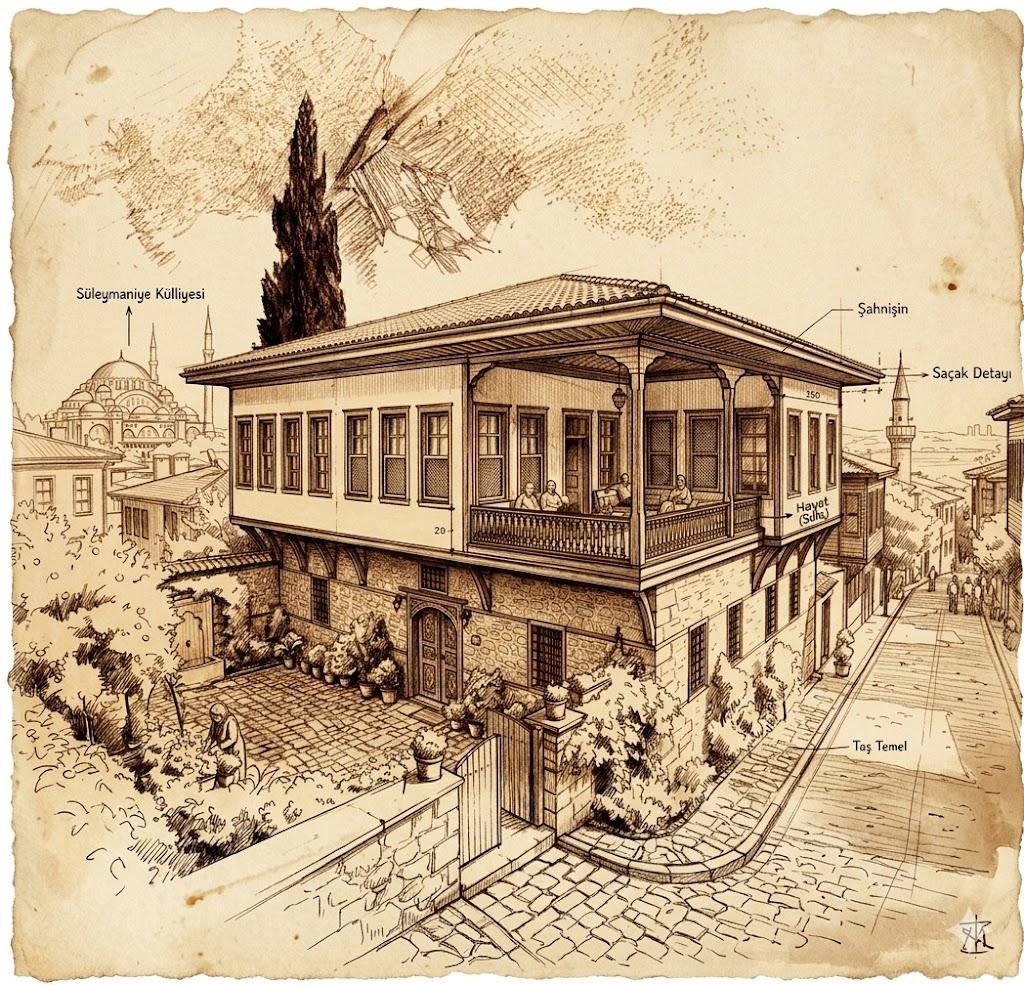
(Yapay Zeka ile Oluşturulmuştur)
The Turkish house is a concept used in the historiography of Turkish architecture, particularly to describe traditional residential architecture that developed in Anatolia and Rumelia during the Ottoman period. This term does not refer to a single architectural type but rather to a historical residential tradition shaped by shared spatial understanding, planning principles, modes of life, and cultural practices.【1】 The concept has often been employed to explain examples of Ottoman civil architecture at the residential scale and has been evaluated alongside traditional residential fabric, plan typologies, spatial organization, and daily life practices.【2】
There is no consensus in the literature regarding the scope and boundaries of the concept of the Turkish house. While some researchers treat the term within the broader framework of Ottoman residential tradition, others define it through specific planning features, spatial arrangements, and cultural lifestyles. Consequently, the Turkish house is not merely an architectural definition but also a conceptual framework shaped within historiography.【3】
Traditional housing is not merely a physical structure fulfilling the function of shelter; it is also a spatial organization that reflects a society’s way of life, cultural values, and daily practices. Therefore, housing must be evaluated not only by its formal characteristics but also in relation to the social and cultural context in which it developed. Indeed, the main factors influencing the formation of residential architecture are considered to be physical, cultural, and socio-economic elements. Physical factors include topography, climate, landscape, soil structure, and vegetation; cultural factors encompass worldview, value systems, social structure, religious beliefs, notions of privacy, traditions, and family relationships; socio-economic factors cover means of subsistence, production relations, and economic opportunities.【4】
According to Ayda Arel, drawing on Amos Rapoport’s approach, the primary determinants of a house’s formal and spatial formation are social and cultural factors; physical elements such as climate, materials, construction methods, and technology play a more modifying role. In this sense, the traditional house is not a structure formed by chance but a residential type resulting from shared experiences, knowledge, and patterns of living transmitted across generations.【5】
Within this framework, traditional housing represents a historical residential tradition shaped by a specific society’s production and consumption relations, lifestyle habits, and adaptation to its environment. ICOMOS’s 1999 charter defines traditional structures as those possessing a shared building tradition, regional identity adapted to the environment, anonymous transmission of design and craftsmanship, and representation of traditional construction systems and techniques.【6】
Studies on Ottoman and Anatolian residential architecture have demonstrated that traditional housing cannot be unified under a single form but can be understood through shared spatial principles and patterns of daily life. Ayda Arel has interpreted this diversity as “the rich content emerging from the manifestation of a multifaceted cultural accumulation in the Ottoman house into the space of living.” Therefore, the concept of traditional housing must be examined not only in terms of physical form but also in conjunction with cultural content and modes of living.【7】
The concept of the Turkish house is not a neutral term introduced merely to describe traditional housing; it is a conceptualization formed within the national identity quests, Turkist/Pan-Turkist ideologies, and national architecture debates spanning from the Second Constitutional Era to the early years of the Republic. During this period, a major debate emerged over which elements of Ottoman architectural heritage should define the “national”: whether monumental structures or everyday civil architecture. With the growing influence of national architecture thought on traditional civil architectural examples, the concept of the “Turkish house” gained a central position in architectural historiography.【8】

Celal Esat Arseven (İslam Ansiklopedisi)
One of the earliest and most decisive figures in this process is "Celal Esad Arseven". Arseven opposed the general classification of Turkish artistic and architectural products under the umbrella term "Islamic Art" and instead emphasized the notion of "Turkish Art", thereby becoming one of the pioneering figures in the effort to establish a national nomenclature and classification in architectural historiography. Indeed, his 1909 work is recognized as one of the first texts to treat the Ottoman house as a historical and artistic subject of research. In his later work titled "Türk San’atı", he continued this approach, analyzing traditional housing under headings such as Anatolian houses, Edirne houses, and Istanbul houses, thereby establishing the early typological framework of the Turkish house concept.【9】
Unlike many researchers who followed him, Arseven’s approach focused primarily on the physical and formal characteristics of buildings. This approach, which sought to define traditional houses by their plan, floor arrangement, projections, roofs, windows, doors, and facades, later evolved into a systematic typology alongside Sedad Hakkı Eldem. However, from the perspective of conceptual foundations, Celal Esad’s role before Eldem was crucial. Therefore, the origin of the “Turkish house” concept in historiography cannot be attributed solely to Eldem; Celal Esad played a prominent pioneering role in its early establishment within nationalist and national architecture discourse.【10】
In the subsequent period, Sedad Hakkı Eldem systematized this concept through surveys, classifications, and plan typologies, providing it with a more distinct theoretical framework. Nevertheless, Eldem’s conception of the “Turkish house” was not entirely independent of the historical accumulation that preceded him. As Tuztaşı has shown, the idea of the “Turkish house” did not begin with Eldem; it developed gradually between 1909 and 1930 through texts, visual documents, and national culture debates. Therefore, the concept must be understood as part of both architectural historiography and the construction of national identity.【11】
Research on the Turkish house has demonstrated that traditional residential architecture cannot be explained by a single criterion. Architectural historians and researchers have approached the subject through plan typologies, materials and construction techniques, cultural lifestyles, and historical development. Consequently, the literature on the Turkish house, while centered around a common concept, exhibits diversity in approach. Ayda Arel has interpreted this diversity as the rich content emerging from the manifestation of a multifaceted cultural accumulation in the Ottoman house into the space of living.【12】

Celal Esat Arseven - Islahat-ı Mimariye kitabında yer alan geleneksel ev betimlemesi (Mazlum,2005)
Within this literature, Celal Esad Arseven is one of the key early figures to address the Turkish house. Arseven’s approach focuses primarily on the physical and formal characteristics of buildings. He emphasizes features such as floor arrangement, projections, roof forms, windows, doors, and facade character, attempting to define the Turkish house through its architectural attributes. In this respect, Arseven’s work laid an early foundation for the typological research that would follow.【13】

Sedad Hakkı Eldem (İslam Ansiklopedisi)
Sedad Hakkı Eldem is widely regarded as one of the most influential figures in Turkish house research. Eldem’s contribution went beyond mere description of traditional Ottoman-Turkish housing; he systematically surveyed, classified, and evaluated it through plan types. According to Eldem, the Turkish house is a distinctive residential type that developed over a long period in Anatolia and Rumelia, possessing unique and enduring qualities. In his work, the plan schema and especially the sofa arrangement became the defining features of the Turkish house. The placement of the main living level on the upper floor and the arrangement of rooms around the sofa formed the basis of Eldem’s typological approach.【14】
Doğan Kuban expanded Eldem’s plan-centered analysis by more strongly addressing factors such as materials, construction techniques, cultural environment, and historical geography. Kuban criticizes most of his predecessors for treating materials as secondary; he argues that the relationship between building material and form directly influenced vernacular architecture. For him, the Turkish house is a cultural rather than an ethnic term; thus, it differs from the “Ottoman house” and refers to the residential tradition of a specific cultural region. In Kuban’s approach, housing is evaluated not only by its plan features but also in conjunction with regional construction techniques, material preferences, and daily life practices.【15】
Metin Sözen is also among the researchers who emphasize cultural continuity, environmental adaptation, and historical accumulation in Turkish house debates. Sözen argues that houses developed in Anatolia reflect a long-standing cultural continuity; he notes that this housing tradition evolved through interaction with local cultural elements. Sözen also opposes the view that Turks were entirely nomadic before settling in Anatolia; he considers traces of settled life in Central Asia and housing examples outside Anatolia to situate the origins of the Turkish house within a broader historical framework. This approach is significant because it evaluates the Turkish house not only through plan typologies but also through cultural continuity and the experience of settled life.【16】
Ayda Arel draws attention to the difficulty of explaining traditional Ottoman housing within a single typological schema. Arel’s approach is distinguished by its simultaneous consideration of historical issues and spatial organization. According to her, formal and typological classifications alone are insufficient in traditional housing research; these data must be examined in their historical context. Moreover, Arel identifies the relationships between the sofa, eyvan, courtyard, and rooms as the primary determinants of spatial organization, explaining the diversity of traditional Anatolian housing through varying uses of these elements.【17】
Other significant figures in the Turkish house literature include Önder Küçükerman. Küçükerman explained the Turkish house through the relationship between rooms and the sofa, using common plan arrangements as a fundamental tool to understand the evolution of housing and regional variations. Thus, Turkish house research did not remain confined to defining a single historical residential type; it transformed into a multidimensional field of inquiry centered on origins, typology, culture, region, and lifestyle.【18】
The spatial organization of the Turkish house was shaped according to the requirements of daily life, family structure, notions of privacy, and usage habits. The fundamental units of this organization are spaces such as the room, sofa, eyvan, and courtyard. The house’s plan arrangement is determined by the relationships among these elements; particularly, the functional distinction between the ground floor and upper floor constitutes one of the defining characteristics of traditional housing layouts.【19】
According to Ayda Arel, in the living level located above the ground floor—whose use varies regionally—the number of rooms and the position and form of the sofa or eyvan are the primary determinants of plan organization. The varied use of the sofa and eyvan has enabled both diverse arrangements within the same plan type and the emergence of different plan types through similar spatial elements. Thus, the diversity of traditional Anatolian housing stems from the different combinations of a limited number of fundamental spatial elements.【20】
The sofa is one of the principal elements of the Turkish house plan schema. Arel notes that the sofa initially emerged to facilitate circulation between rooms but gradually assumed functions of rest, sitting, gathering, and communal living, becoming the central space of the plan. In contrast, the courtyard serves primarily as a regulatory space connected to service areas on the ground floor. Thus, a distinction emerges between two levels of spatial organization: the courtyard, linking service and production areas on the lower floor, and the sofa, connecting living units on the upper floor.【21】
In Sedad Hakkı Eldem’s approach, the sofa arrangement remains the decisive element of plan organization. Eldem identifies the distinctive feature of the Turkish house in the organization of rooms around a central sofa on the main living level. Consequently, plan typologies in Turkish house research have largely been constructed based on the sofa. Doğan Kuban, however, considers the life area located in front of the rooms on the first floor as the fundamental element in the formation of this tradition. While both approaches acknowledge the decisive role of communal living space in the house plan, they differ in their emphasis on the definition and origin of the spatial center.【22】
The number of floors also significantly affects spatial organization. According to Aksoy, the two essential spaces constituting Anatolian housing are the sofa and the courtyard; however, the number of floors directly influences their relationship and the overall plan arrangement. The development of independent living spaces on the upper floor enabled the emergence of an internal organization centered around the sofa. Although this arrangement takes different forms depending on climate, environment, materials, and local traditions, most researchers in Turkish house literature accept the existence of a common plan understanding.【23】
Within this framework, the spatial organization of the Turkish house is not merely a matter of room arrangement; it must be understood in relation to the relationship between lower and upper floors, the distinction between communal and private areas, circulation patterns, and the organization of daily life. The relationship between the room, sofa, eyvan, and courtyard is fundamental to understanding Turkish house plan types.【24】
In Turkish house research, plan typologies are among the most frequently used methods for classifying housing. Sedad Hakkı Eldem notably identified the plan type as the primary unifying element connecting traditional housing examples across a vast geography; he grouped houses from Anatolia and Rumelia according to the position of the sofa within the structure. According to Eldem, these types are not rigid, mutually exclusive schemas but rather arrangements that developed historically and occasionally coexisted.【25】

Eldem'in Ortaya Koyduğu Türk Evi Plan Tipleri (Eldem,1954 - alınan planlar yazar tarafından düzenlenmiştir)
This classification highlights four main plan types: sofa-less plan, external-sofa plan, internal-sofa plan, and central-sofa plan. The sofa-less plan, considered the most primitive type in the literature, connects rooms through open circulation areas such as courtyard, life space, sidewalk, or balcony; there is no direct internal connection between rooms. Consequently, this plan type was predominantly applied in hot climates, particularly widespread in southern Anatolia.【26】
The external-sofa plan is regarded as the second stage in the development of the Turkish house plan. In this type, the sofa first appears as a distinct space connecting rooms. Most rooms open onto the external sofa; the plan is more advanced than the sofa-less type but exhibits a free rather than symmetrical arrangement. The addition of an eyvan and the placement of new rooms at the end of the sofa can produce L- or U-shaped layouts. Row-room, corner-sofa, and three-sided-room arrangements fall within this group.【27】
The internal-sofa plan is defined as a more enclosed and centralized version of the external-sofa plan. In this arrangement, the sofa is no longer a semi-open space opening to the exterior but is drawn into the building’s interior, with rooms arranged around this internal space. This provides better protection against climatic conditions and makes the inward-looking nature of family life more pronounced. The central-sofa plan is considered a more advanced schema in which the sofa is located at the center of the building, with rooms arranged around this core. In Turkish house literature, this type is regarded as one of the mature forms of plan organization.【28】
Önder Küçükerman also emphasizes the plan schema, but he explains classification not solely by the sofa’s position but by the relationship between rooms and communal areas. For him, the Turkish house is a spatial language formed by the convergence of independent living units—rooms—around the communal living area, the sofa. Thus, plan typologies reflect not only formal differences but also the underlying logic of house formation and regional variations.【29】
Doğan Kuban accepts plan typologies but emphasizes that they are insufficient on their own. For Kuban, while plan arrangement is an important distinguishing feature, materials, construction techniques, climate, and cultural environment are also decisive in understanding typological differences. Therefore, Turkish house plan typologies acquire explanatory power only when considered together with spatial organization and regional and cultural context.【30】
In Turkish house research, construction systems and material use have been regarded as equally decisive areas of study as plan typologies. Doğan Kuban criticized most of his predecessors for focusing primarily on plan schemas and assigned particular importance to the role of materials in shaping traditional housing. For him, material is not merely a technical element but a fundamental factor influencing a building’s form, scale, and regional character. Consequently, different residential styles developed according to the geographical and historical conditions of regions; the spread of these styles often paralleled the spread of building materials.
In Kuban’s analysis, traditional residential architecture in Anatolia is divided into regions based on materials and construction techniques. In Southeastern Anatolia, courtyard houses built of stone predominate; in Central Anatolia, houses combine stone and adobe; in Eastern Black Sea regions, timber-framed structures are characteristic; and in transitional zones, houses use stone and hımış construction systems. This situation demonstrates that the Turkish house cannot be explained by a single material or structural system; rather, despite varying material repertoires across regions, a shared residential tradition persists.【31】
Formally, the most notable features in traditional houses include projections, eaves, window arrangements, door placements, and roof forms. From the 16th and 17th centuries onward, the increasing use of wood led to the emergence of classical forms; projections gradually became a prominent architectural element. According to Kuban, this period saw a transition from cubic and single-facade structures to more open and outward-projecting forms, with the classical form of the life-centered house emerging by the 18th century.【32】
In facade organization, recurring elements include the upper floor projecting outward, the use of broken roofs, wooden joinery, guillotine or casement windows, iron railings, and decorative elements beneath eaves. Studies on Akşehir houses reveal the combined use of stone, adobe, wood, and iron; heavier masonry systems were preferred on lower floors, while lighter materials and projecting facades were favored on upper floors. In these examples, wooden doors, stone-arched entrances, projecting bay rooms, and broken roofs emerge as concrete elements defining the formal repertoire of traditional housing.【33】
However, researchers emphasize that the construction system and formal features of the Turkish house cannot be reduced to its external appearance alone. As Ayda Arel notes, the typology of the Ottoman house is not composed of individual functional, structural, or symbolic elements but of the specific relationships among them. Therefore, materials, structure, and facade characteristics acquire explanatory power only when examined in conjunction with plan organization, usage patterns, and cultural context.【34】
The Turkish house is not understood as a single, unchanging housing type specific to one region but as a residential tradition that spread across the Ottoman domain, particularly in Anatolia and Rumelia, adapting to local climate, topography, materials, and lifestyle practices. Sedad Hakkı Eldem noted that this housing type produced various subtypes across the vast geography of the Ottoman Empire under differing natural and cultural conditions while preserving its fundamental principles.【35】
Within this spread, Istanbul, Edirne, and Anatolian cities are frequently treated as distinct areas in the literature. Celal Esad Arseven’s classification of the Turkish house into Anatolian houses, Edirne houses, and Istanbul houses demonstrates that these regional differences were recognized from an early period. Arseven noted that while some distinctions exist in plan arrangements among these groups, they should not be regarded as entirely disconnected architectural styles.【36】
Doğan Kuban interprets the regional variations in traditional residential architecture primarily through materials and construction techniques. In Southeastern Anatolia, stone courtyard houses predominate; in Central Anatolia, stone and adobe structures are common; in the Black Sea region, timber becomes the dominant material. This variation reflects not only technical diversity but also the architectural expression of geographical environment and local lifestyles. For Kuban, the significance of the Turkish house tradition lies in its maintenance of a shared cultural understanding of housing despite differing construction systems across regions.【37】
Ayda Arel also avoids evaluating traditional housing within a single schema, instead considering its variations according to regional and historical conditions. According to her, fundamental spatial elements such as the sofa, eyvan, room, and courtyard were used differently in various regions; this enabled both variations within the same plan type and the emergence of different plan types. Thus, the Turkish house can be defined as a residential tradition possessing shared spatial principles but reinterpreted according to local conditions.【38】
Within this framework, the concept of the Turkish house refers not to a homogeneous cluster of structures across geography but to a residential heritage shaped within a broad cultural area extending from Anatolia to the Balkans, marked by both shared features and pronounced local differences. Regional classifications in the literature further demonstrate that the Turkish house is not a single model but a historical tradition that evolved in response to diverse environmental conditions.
Aksoy, Erdem. "Ortamekan: Türk Sivil Mimarisinde Temel Kuruluş Prensibi." Mimarlık ve Sanat, no. 8 (1983): 39–92.
Akyüz, E. "Geleneksel Konut Mimarisine İlişkin Kavramlar." Ege Mimarlık Dergisi, Volume 3, no. 17 (1995): 39.
Arel, Ayda. Osmanlı Konut Geleneğinde Tarihsel Sorunlar. İzmir: Ege Üniversitesi Güzel Sanatlar Fakültesi Yayınları, 1982.
Arseven, Celal Esad. Türk Sanatı. İstanbul: Türk Ocakları Merkez Neşriyatı, 1928.
Demirci, Ayşegül and Önder Aydın. “Osmanlı Sivil Mimarisine Bir Örnek: Akşehir Evleri.” In *Dünden Bugüne Türk Mimarlığı*, Ankara, 2023. Accessed April 16, 2026. https://webupload.gazi.edu.tr/upload/1102/2023/7/24/e8af6333-2d68-4043-927c-a878e8ebfdc9-dunden-bugune-turk-mimarligi-turkdam.pdf
Demirci, Ayşegül. “Batılılaşma Dönemi Osmanlı Sivil Mimarisine Bir Örnek: Geleneksel Akşehir Evleri.” Master's thesis, Gazi Üniversitesi, 2024. Accessed April 16, 2026. https://avesis.gazi.edu.tr/yonetilen-tez/12426b93-41a1-42c3-a5e1-55847c9075c9/batililasma-donemi-osmanli-sivil-mimarisine-bir-ornek-geleneksel-aksehir-evleri
Eldem, Sedad Hakkı. Türk Evi Plan Tipleri. İstanbul: İTÜ Mimarlık Fakültesi Yayınları, 1954.
Eldem, Sedad Hakkı. Türk Evi: Osmanlı Dönemi. Volume 2. İstanbul: Türkiye Anıt Çevre Turizm Değerlerini Koruma Vakfı, 1986.
Eyice, Semavi. "Arseven, Celal Esad." *TDV İslâm Ansiklopedisi.* Accessed April 16, 2026. https://islamansiklopedisi.org.tr/arseven-celal-esat
Eyice, Semavi. "Eldem, Sedat Hakkı." TDV İslâm Ansiklopedisi. Accessed April 16, 2026. https://islamansiklopedisi.org.tr/eldem-sedat-hakki
Kocabıçak, Evren. “Ayvacık’a Bağlı Köylerde Yöresel Konut Analizi.” PhD thesis, Yıldız Teknik Üniversitesi, 2017. Accessed April 16, 2026. https://tez.yok.gov.tr/UlusalTezMerkezi/tezDetay.jsp?id=GlBbxjDbGVKXUGRq1JQwCQ&no=1VpbN3OoL_CwH8v0BQvw9w
Kuban, Doğan. "Türk Ev Geleneği Üzerine Gözlemler." In Sanat Tarihimizin Sorunları, 192–211. İstanbul: Çağdaş Yayınları, 1975.
Kuban, Doğan. "Türkiye'de Malzeme Koşullarına Bağlı Geleneksel Konut Mimarisi Üzerine Bazı Gözlemler." Mimarlık Dergisi, Volume 4, no. 10 (1966): 15-20.
Kuban, Doğan. Türk Hayatlı Evi. İstanbul: MSR Vakfı Yayınları, 1995.
Küçükerman, Önder. Anadolu’daki Geleneksel Türk Evinde Mekân Organizasyonu Açısından Odalar. İstanbul: Türkiye Turing ve Otomobil Kurumu Yayınları, 1973.
Küçükerman, Önder. Kendi Mekânının Arayışı İçinde Türk Evi. İstanbul: Promat Basım Yayın San. ve Tic. A.Ş., 1996.
Mazlum, Deniz. “Öncü Bir Mimarlık Sözlüğü: Celâl Esad Arseven’in Istılahat-ı Mimariye’si.” *Sanat Tarihi Defterleri*, no. 9 (2005): 9–32. Accessed April 16, 2026. https://www.academia.edu/36877589/%C3%96nc%C3%BC_Bir_Mimarl%C4%B1k_S%C3%B6zl%C3%BC%C4%9F%C3%BC_Celal_Esad_Arseven_in_Ist%C4%B1lahat%C4%B1_Mimariye_si_
Sözen, Metin. Türklerde Ev Kültürü. İstanbul: Doğan Kitapçılık A.Ş., 2001.
Tuztaşı, Uğur. “İdealleş[tiril]miş ‘Türk Evi’ Fikrinin Historiyografik Çözümlenmesi.” *International Journal of Architecture and Planning*, Volume 1, no. 1 (2013): 66–91. Accessed April 16, 2026. https://gcris.ktun.edu.tr/server/api/core/bitstreams/1e199ee5-798a-4d5e-ab5b-2fda62e03c42/content
İncedemir, Şerife, and Kemal Reha Kavas. “Türk Evi Kavramının Tarih Yazımı Üzerine Bir İnceleme.” *Akdeniz Üniversitesi Sosyal Bilimler Enstitüsü Dergisi (AKSOS)*, no. 10 (2021): 74–86. Accessed April 16, 2026. https://dergipark.org.tr/en/pub/aksos/article/1010191
Şahlan, Kevser Çeltik. “19. ve 20. YY. Osmanlı Toplumunda Konut İçi Dokumacılık Üretiminin Mekâna Yansıması: Geleneksel Isparta Konutları.” PhD thesis, Gazi Üniversitesi, 2018. Accessed April 16, 2026. https://tez.yok.gov.tr/UlusalTezMerkezi/tezDetay.jsp?id=a3PGEHWflMnxo5ws5GAeIA&no=U5uGmZSbLCPeb15ws01hHQ
[1]
Ayda Arel, Osmanlı Konut Geleneğinde Tarihsel Sorunlar (İzmir: Ege Üniversitesi Güzel Sanatlar Fakültesi Yayınları, 1982), 4-5.
[2]
Şerife İncedemir ve Kemal Reha Kavas, “Türk Evi Kavramının Tarih Yazımı Üzerine Bir İnceleme”, Akdeniz Üniversitesi Sosyal Bilimler Enstitüsü Dergisi (AKSOS), sy. 10 (2021): 79-80.
[3]
Uğur Tuztaşı, “İdealleş[tiril]miş ‘Türk Evi’ Fikrinin Historiyografik Çözümlenmesi”, International Journal of Architecture and Planning, c. 1, sy. 1 (2013): 66-67.
[4]
Evser Çeltik Şahlan, “19. ve 20. Yy. Osmanlı Toplumunda Konut İçi Dokumacılık Üretiminin Mekâna Yansıması: Geleneksel Isparta Konutları” (Doktora Tezi, Gazi Üniversitesi, 2018), 9-11.
[5]
Arel, Osmanlı Konut Geleneğinde Tarihsel Sorunlar, 5.
[6]
Şahlan, Konut İçi Dokumacılık Üretiminin Mekâna Yansıması, 16.
[7]
Arel, Osmanlı Konut Geleneğinde Tarihsel Sorunlar, 5.
[8]
Tuztaşı, “İdealleş[tiril]miş ‘Türk Evi’ Fikrinin Historiyografik Çözümlenmesi”, 71-72.
[9]
Evren Kocabıçak, “Ayvacık’a Bağlı Köylerde Yöresel Konut Analizi” (Doktora Tezi, Yıldız Teknik Üniversitesi, 2017), 1.
[10]
İncedemir ve Kavas, “Türk Evi Kavramının Tarih Yazımı”, 80.;Celal Esad Arseven, Türk Sanatı (İstanbul: Türk Ocakları Merkez Neşriyatı, 1928), 45.
[11]
Tuztaşı, “İdealleş[tiril]miş ‘Türk Evi’ Fikrinin Historiyografik Çözümlenmesi”, 71-72.
[12]
Arel, Osmanlı Konut Geleneğinde Tarihsel Sorunlar, 5.;İncedemir ve Kavas, “Türk Evi Kavramının Tarih Yazımı”, 80-81.
[13]
Kocabıçak, “Ayvacık’a Bağlı Köylerde Yöresel Konut Analizi”, 3; Arseven, Türk Sanatı, 12.
[14]
Ayşegül Demirci, “Batılılaşma Dönemi Osmanlı Sivil Mimarisine Bir Örnek: Geleneksel Akşehir Evleri” (Yüksek Lisans Tezi, Gazi Üniversitesi, 2024), 196-197.
[15]
Doğan Kuban, Türk Hayatlı Evi (İstanbul: MSR Vakfı Yayınları, 1995), 4.
[16]
Kocabıçak, “Ayvacık’a Bağlı Köylerde Yöresel Konut Analizi”, 6.
[17]
Arel, Osmanlı Konut Geleneğinde Tarihsel Sorunlar, 4-5, 14.
[18]
İncedemir ve Kavas, “Türk Evi Kavramının Tarih Yazımı”, 81-82.
[19]
Arel, Osmanlı Konut Geleneğinde Tarihsel Sorunlar, 14.
[20]
Arel, Osmanlı Konut Geleneğinde Tarihsel Sorunlar, 14.
[21]
Arel, Osmanlı Konut Geleneğinde Tarihsel Sorunlar, 14.
[22]
Demirci, “Batılılaşma Dönemi Osmanlı Sivil Mimarisine Bir Örnek: Geleneksel Akşehir Evleri”, 196-197.
[23]
Kocabıçak, “Ayvacık’a Bağlı Köylerde Yöresel Konut Analizi”, 3;Demirci, “Batılılaşma Dönemi Osmanlı Sivil Mimarisine Bir Örnek: Geleneksel Akşehir Evleri”, 196-197.
[24]
İncedemir ve Kavas, “Türk Evi Kavramının Tarih Yazımı”, 81-82.;Demirci, “Batılılaşma Dönemi Osmanlı Sivil Mimarisine Bir Örnek: Geleneksel Akşehir Evleri”, 196-197.
[25]
İncedemir ve Kavas, “Türk Evi Kavramının Tarih Yazımı”, 81-82.
[26]
Sedad Hakkı Eldem, Türk Evi Plan Tipleri (İstanbul: İstanbul Teknik Üniversitesi Mimarlık Fakültesi, 1954), 17-19; aktaran Ayşegül Demirci, “Batılılaşma Dönemi Osmanlı Sivil Mimarisine Bir Örnek: Geleneksel Akşehir Evleri” (Yüksek Lisans Tezi, Gazi Üniversitesi, 2024), 14-15.
[27]
Demirci, “Batılılaşma Dönemi Osmanlı Sivil Mimarisine Bir Örnek: Geleneksel Akşehir Evleri”, 15; ayrıca bkz. Sedad Hakkı Eldem, Türk Evi Plan Tipleri (1954) ve Metin Sözen, Türk Sanatı (2001) aktarımları.
[28]
İncedemir ve Kavas, “Türk Evi Kavramının Tarih Yazımı”, 81; Demirci, “Batılılaşma Dönemi Osmanlı Sivil Mimarisine Bir Örnek: Geleneksel Akşehir Evleri”, 16.
[29]
İncedemir ve Kavas, “Türk Evi Kavramının Tarih Yazımı”, 81-82;Arel, Osmanlı Konut Geleneğinde Tarihsel Sorunlar, 26.
[30]
Arel, Osmanlı Konut Geleneğinde Tarihsel Sorunlar, 26-27; ayrıca bkz. Doğan Kuban, Türk Hayatlı Evi (İstanbul: MSR Vakfı Yayınları, 1995), 3-4.
[31]
Doğan Kuban, Türk Hayatlı Evi (İstanbul: MSR Vakfı Yayınları, 1995), 4.
[32]
İncedemir ve Kavas, “Türk Evi Kavramının Tarih Yazımı Üzerine Bir İnceleme”, 80; ayrıca bkz. Kuban, Türk Hayatlı Evi, 5.
[33]
Demirci, “Batılılaşma Dönemi Osmanlı Sivil Mimarisine Bir Örnek: Geleneksel Akşehir Evleri”, 97, 130.
[34]
Arel, Osmanlı Konut Geleneğinde Tarihsel Sorunlar, 33.
[35]
Eldem, Türk Evi Plan Tipleri, 196 (aktaran Demirci, 14-15).
[36]
Kocabıçak, “Ayvacık’a Bağlı Köylerde Yöresel Konut Analizi”, 1.
[37]
Kuban, Türk Hayatlı Evi, 4.
[38]
Arel, Osmanlı Konut Geleneğinde Tarihsel Sorunlar, 14.

(Yapay Zeka ile Oluşturulmuştur)
The Concept of Traditional Housing
Origins and Historiography of the Turkish House Concept
Major Researchers and Approaches
Spatial Organization and Plan Features
Plan Typologies
Construction System, Materials, and Formal Features
Geographical Spread and Regional Variations