


This article was automatically translated from the original Turkish version.
+1 More
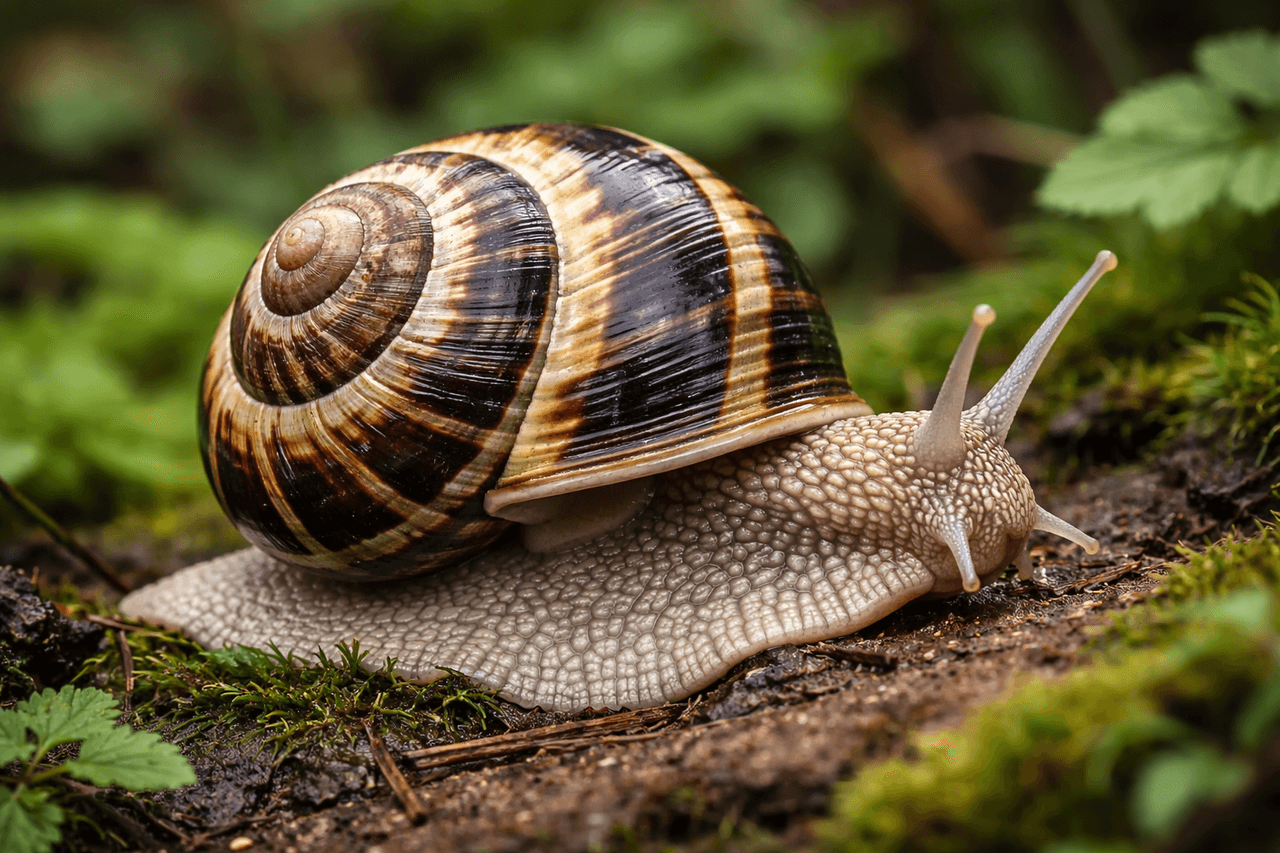
Turkish Snail
(Generated with Artificial Intelligence)
Turkish Snail (Helix lucorum)
Team(s) | Stylommatophora | ||||||||
|---|---|---|---|---|---|---|---|---|---|
Family | Helicidae | ||||||||
Body Color | Grayish brown | ||||||||
Shell Color | Dark black spiral bands on a brown background | ||||||||
Shell Diameter | 30-60 mm | ||||||||
Class | Gastropoda | ||||||||
Turkish Snail (Helix lucorum), a large land snail species belonging to the family Helicidae, is widely distributed in Türkiye and the Balkans. It is one of the most dominant native snail species in Türkiye’s fauna and forms extensive populations particularly in the Black Sea, Central Anatolia, Aegean, and Marmara regions. Due to historical consumption as food and commercial trade, human activities have introduced this species to various other geographic areas.
H. lucorum typically possesses a broad, spherical shell measuring 30–60 mm in diameter. The shell surface features prominent spiral bands on a dark brown or yellowish background. Individuals have a body weight of approximately 20–25 grams and are among the largest land snail species in Türkiye.

Turkish Snail (Helix lucorum)
(Generated by Artificial Intelligence)
Shell structure is sensitive to environmental conditions. In soils with high calcium content, the shell develops more robustly and thickly.
H. lucorum has a wide distribution extending across the entire Balkans, Anatolia, and into the Caucasus. In Türkiye, it is naturally common in the Black Sea, Marmara, and Aegean regions. Its primary habitats include shaded, moist forest understories, shrublands, and garden areas. These habitats provide calcium-rich soils that are favorable for shell development.
This species primarily inhabits the following areas:
It exhibits active behavior when humidity levels range between 70–90 percent.
H. lucorum lays eggs in the soil, producing approximately 40–60 eggs per clutch, which typically hatch within 2–4 weeks. Juveniles mature within their first year, and adults reproduce during spring and autumn.
During hot and dry periods, the snail enters estivation (summer dormancy), reducing its metabolic rate to minimize water loss. Shell color may influence estivation behavior: individuals with darker shells tend to burrow into the soil, while lighter-colored individuals remain closer to the surface, with survival rates as high as 98 percent observed in the light-colored group. In winter, hibernation occurs, during which the shell aperture is sealed with mucus and metabolic activity drops to minimal levels. This behavior is an adaptation to fluctuations in humidity and temperature.
Helix lucorum serves as an intermediate host in the life cycles of various Dicrocoeliidae (Trematoda: Digenea) parasite species. Studies conducted in Türkiye have detected sporocysts and cercariae, larval stages of trematodes, in 22 percent of 100 snails collected from the Van region. Parasite prevalence is higher in May, a finding of significance for livestock and human health.【1】 Similarly, another study in the Kastamonu region reported the presence of Dicrocoeliidae larval stages in H. lucorum.【2】
Although consumption in Türkiye is limited, H. lucorum is exported fresh or processed by seafood processing facilities to the European Union, the United States, and countries in the Far East. However, current regulations include only limited hunting bans covering the June–July period. More comprehensive conservation measures are recommended to ensure sustainable harvesting and population management of the species.
Warning: The content presented here is intended solely for general encyclopedic information. The information provided should not be used for diagnosis, treatment, or medical advice. Always consult a physician or qualified healthcare professional before making decisions related to health. The author and KÜRE Encyclopedia assume no responsibility for any consequences arising from the use of this information for diagnostic or therapeutic purposes.
Alkaya, Ahmet, Hülya Şereflişan, and Önder Duysak. “Kara Salyangozu Yetiştiricilik Sistemlerine Genel Bir Bakış.” ResearchGate. Accessed February 2, 2026. https://www.researchgate.net/publication/328555182_Kara_Salyangozu_Yetistiricilik_Sistemlerine_Genel_Bir_Bakis
Baki, Birol. “Ülkemiz Kara Salyangozlarından Helix lucorum (L., 1758) Biyolojisi, Ekonomisi, Avcılık ve İhracata Yönelik Yasal Mevzuatı.” Uludağ Üniversitesi Ziraat Fakültesi Dergisi 24, no. 1 (April 1, 2010): 109–114. Accessed February 2, 2026. https://dergipark.org.tr/tr/pub/ziraatuludag/article/174197?
Duman, Mehmet Bedrettin, and M. Yeşim Çelik. “Cornu aspersum (Müller 1774) ve Helix lucorum (Linnaeus 1758) Türü Kara Salyangozlarının Biyokimyasal Kompozisyonu.” Gaziosmanpaşa Bilimsel Araştırma Dergisi 8, no. 3 (December 2019): 44–49. Accessed February 2, 2026. https://dergipark.org.tr/en/pub/gbad/article/558908
Ünlü, Ahmet Hakan, Hüseyin Bilgin Bilgiç, Hasan Eren, and Tülin Karagenç. “Prevalence of Larval-Stage Dicrocoeliidae (Digenea) Trematodes in Helix lucorum (Mollusca: Pulmonata) in Van Province.” Turkey Parazitoloji Dergisi 41, no. 4 (2017): 204–207. Accessed February 2, 2026. https://turkiyeparazitolderg.org/pdf/c1dc3a38-51db-436b-af33-1bc7522029b3/articles/tpd.2017.5444/TPD-41-204.pdf
Şereflişan, Hülya. “The Effect of Different Shell Colors on Helix lucorum (Gastropoda: Helicidae) in Estivation Period.” Journal of Advances in VetBio Science and Techniques 6, no. 1 (April 30, 2021): 1–8. Accessed February 2, 2026. https://www.researchgate.net/publication/351231963_The_effect_of_different_shell_colors_on_helix_lucorum_Gastropoda_Helicidae_in_estivation_period
[1]
Ahmet Hakan Ünlü, Hüseyin Bilgin Bilgiç, Hasan Eren ve Tülin Karagenç, “Prevalence of Larval-Stage Dicrocoeliidae (Digenea) Trematodes in Helix lucorum (Mollusca: Pulmonata) in Van Province,” Türkiye Parazitoloji Dergisi 41 (2017): 204–207, accessed 2 February 2026, https://turkiyeparazitolderg.org./pdf/c1dc3a38-51db-436b-af33-1bc7522029b3/articles/tpd.2017.5444/TPD-41-204.pdf
[2]
Gözde Gürelli, Mehtap Alay ve Sevilay Koymalı, “Kastamonu Civarında Dağılış Gösteren Helix lucorum Linnaeus, 1758 (Mollusca: Pulmonata)’da Dicrocoeliid (Trematoda: Digenea) Larval Safhalarının Yaygınlığı,” Türkiye Parazitoloji Dergisi 38, no. 1 (2014): 37–40, accessed 2 February 2026, https://doi.org/10.5152/tpd.2014.3346

Turkish Snail
(Generated with Artificial Intelligence)
Turkish Snail (Helix lucorum)
Team(s) | Stylommatophora | ||||||||
|---|---|---|---|---|---|---|---|---|---|
Family | Helicidae | ||||||||
Body Color | Grayish brown | ||||||||
Shell Color | Dark black spiral bands on a brown background | ||||||||
Shell Diameter | 30-60 mm | ||||||||
Class | Gastropoda | ||||||||
No Discussion Added Yet
Start discussion for "Turkish Snail (Helix lucorum)" article
Morphology
Shell Structure
Body Characteristics
Distribution and Habitat
Geographic Distribution
Habitat Preferences
Biology and Life Cycle
Reproduction and Development
Estivation and Hibernation
Parasitology
Economic and Legal Dimensions