This article was automatically translated from the original Turkish version.
+1 More
Type(s) | Jet trainer and light attack aircraft | ||||||||
|---|---|---|---|---|---|---|---|---|---|
Country of Origin | Türkiye | ||||||||
Manufacturer(s) | TUSAŞ | ||||||||
Designer | TUSAŞ | ||||||||
First Flight(s) | 25 April 2023 | ||||||||
Introduction into Service | 2027 (planned) | ||||||||
Status | In testing phase | ||||||||
Production Quantity | 2 (prototypes) | ||||||||
Cost | 600 million $ | ||||||||
Crew | 2 | ||||||||
Unit Cost | 25 million $ | ||||||||
Length(s) | ~13.0–13.6 m | ||||||||
Wingspan | ~9.5–9.8 m | ||||||||
Height(s) | ~4.2–5.1 m | ||||||||
Engine(s) | 1 × turbofan GE F404 series | ||||||||
Maximum Speed | Mach 1.2–1.4 | ||||||||
Service Ceiling | ≈13.700 m | ||||||||
Range / Ferry Range | ≈2.200–2.600 km | ||||||||
Payload / Weapon Capacity | ≈2.5–2.7 ton | ||||||||
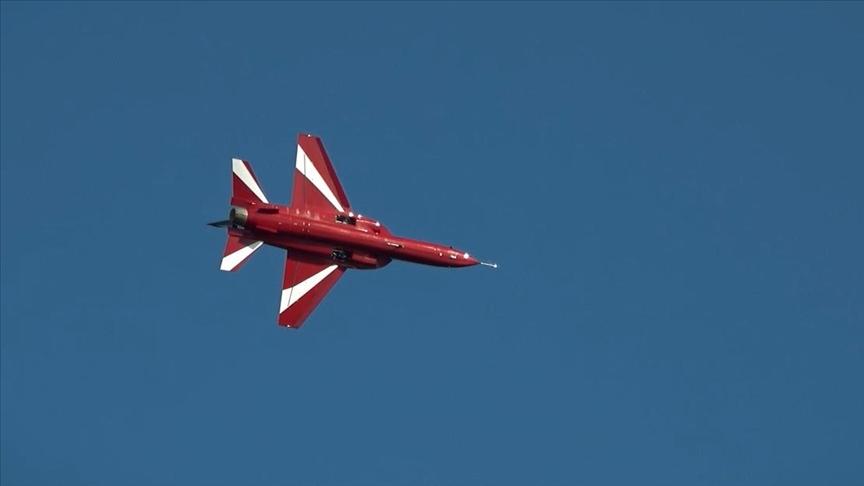
HÜRJET (Hürjet Jet Training and Close Air Support Aircraft), a single-engine tandem cockpit jet trainer and light attack aircraft currently under development by Turkish Aerospace Industries Inc. (TUSAŞ). It is designed for both advanced pilot training and light attack/close air support (CAS) missions and is positioned as an original platform developed by TUSAŞ with modern avionics and weapons carriage capability.

HÜRJET Conducting Joint Flight with ANKA III (Anadolu Ajansı)
HÜRJET is a national initiative launched around 2017 within TUSAŞ (Turkish Aerospace Industries Inc.) to develop a domestic jet trainer and light attack aircraft. The objective is to meet Türkiye’s advanced jet training needs with indigenous resources while enabling flexible use of the same platform for light attack/close air support (CAS) missions. The project has undergone conceptual design preliminary design and systems engineering phases under the supervision of the Presidency of Defence Industries (SSB). TUSAŞ is responsible for airframe structural assembly and integration. Within this framework HÜRJET has been planned as a platform focused on the dual role of “training and operational light attack”.
Between 2019 and 2022 design validation composite and metallic structure development landing gear and subsystem testing were completed. By the end of 2022 prototype assembly had reached its final stages. In early 2023 engine run and ground taxi tests were conducted. The first recorded taxi tests took place in March 2023 followed by field reports and photographic news coverage confirming HÜRJET’s first flight on 25 April 2023. The first flight report indicated that flight duration altitude and speed parameters were within expected limits and that “all systems were functioning”. One prototype is allocated for flight testing the other for structural strength and load testing. The flight test program includes low-altitude maneuvers speed profiles climb and descent tests G-limit validations and system-integrated function tests.
According to TUSAŞ’s official schedule after prototype validation intermediate deliveries and the establishment of a serial production line are planned. First serial deliveries are targeted for 2026–2027. As the flight test phase progresses weapons integration tests (pylon and payload tests targeting pod firing simulations) and certification processes (TSO/national type certification NATO compliance tests) will proceed in parallel. Media sources report that the planned monthly production rate for HÜRJET in the initial phase is two aircraft per month. The final production rate will depend on demand and export contracts. Reports of a proposed order of 45 aircraft from Spain demonstrate the program’s export potential although the official timeline remains subject to government and corporate approvals.
HÜRJET is a single-engine tandem cockpit design targeting light to medium mission profiles. The design aims to achieve low operating costs high training efficiency flexible munition carriage capacity and ease of maintenance. A hybrid metal-composite material structure has been adopted with aluminum-lithium alloys used in critical load-bearing elements and carbon-composite reinforcements in high-temperature zones. The aircraft’s maneuverability envelope (+8 / −3 g) is suited for advanced tactical training and aerobatic missions. The engine selection favors GE F404-class turbofan engines to achieve high thrust response acceptable maintenance costs and a broad spare parts ecosystem.
The following table is a compilation based on publicly reported figures and may be revised as the program progresses.

HÜRJET Technical Specifications Visual (Anadolu Ajansı)
The platform is designed to integrate targeting pods (laser designator/FLIR) G-buoy/EO sensor pods laser designation and electronic support measures (ESM). Additionally the integrated mission computer and avionics architecture support digital tactical data links (similar to Link-16) and compatibility with ground and flight command networks. HUMS (Health & Usage Monitoring System) and digital maintenance support software have been designed to optimize flight safety and maintenance intervals.
TUSAŞ is conducting integration work with national munition manufacturers such as Roketsan and TÜBİTAK SAGE. Integration of foreign systems such as AIM-9X is also possible to meet NATO and customer requirements. The final integration list will depend on customer contracts and certification requirements.
Sources list various proposed variants for HÜRJET including a pure training configuration a two-seat advanced training/operational configuration an aerobatic display aircraft a light attack configuration and modifications for carrier-based operations. These variants are expected to be realized through changes in avionics packages weapons load landing gear reinforcement and fuel capacity.
HÜRJET is designed with a modern “glass cockpit” display suite Head-Up Display (HUD) helmet-mounted display (HMDS) compatibility integrated mission computer digital mapping simulator integration and support for live-virtual-constructive (LVC) ground-to-air real-time training. The fly-by-wire (FBW) flight control architecture provides flight envelope protection modes that enhance training safety. The aircraft is also compatible with night vision goggles (NVG) and data-link capabilities.
HÜRJET has three primary military applications.

HÜRJET (Anadolu Ajansı)
The successful taxi tests of the first prototype and its first flight on 25 April 2023 are key milestones for the program. Initial flight reports confirmed that flight dynamics system integration and basic performance parameters remained within design limits.
As HÜRJET remains in the testing and certification phase operational deployment in active combat zones has not yet been reported. However TUSAŞ’s objectives include integration into training fleets and operational deployment in export markets.
The successful completion of prototype assembly and ground tests on schedule and the successful completion of the first flight with visual and telemetry data are regarded as indicators of the program’s technical competence.

HÜRJET Completing Its 100th Test Flight (Anadolu Ajansı)
On 28 October 2025 the Spanish Council of Ministers approved during its weekly ordinary meeting a contract to procure 45 HÜRJET aircraft from Türkiye. The decision states that the “Integrated Training System (ITS-C)” will be acquired to modernize expand and renew the capabilities of the Air and Space Force’s fighter and attack pilot training. The contract is valid until 30 November 2035 with no provision for extension.
Deliveries are scheduled to begin in 2028 with the first aircraft to be used in training courses by 2029/2030 and HÜRJETs expected to remain in service for at least 30 years. The Spanish Ministry of Industry has planned to provide a credit of 1.04 billion euros over five years for the project.
In statements made by the President of the Presidency of Defence Industries Haluk Görgün on 29 December 2025 it was announced that the Spanish Air and Space Force has officially selected HÜRJET in a 30-aircraft export package. This selection has been described as a historic export success for Türkiye’s defense industry.
Görgün emphasized that the agreement encompasses not only aircraft sales but an integrated training architecture covering advanced combat pilot education. This architecture includes ground-based simulation systems training infrastructure maintenance and sustainment elements and long-term operational support components. It was stated that the HÜRJET program plays a vital role in transforming Türkiye into a high-technology producer and exporter of aerospace platforms and that this development enhances Türkiye’s competitiveness in the global market.
The 2.6 billion euro export agreement constitutes a high-value multidimensional defense industry export package. This structure which includes integrated training systems maintenance infrastructure and long-term support components presents an industrial model beyond conventional platform exports.
HÜRJET can be compared with similar-class platforms such as Italy’s M-346 South Korea’s T-50 Golden Eagle and U.S. light attack aircraft. In such comparisons HÜRJET’s advantages include indigenous production flexibility in weapons integration and potential low operating costs. Its weaknesses lie in the program’s relative youth and limited international certification experience. Detailed performance comparisons vary by variant and configuration.
The signing ceremony for the export of the HÜRJET aircraft developed by Turkish Aerospace Industries was held on 28 April 2026 at Airbus facilities in Getafe Madrid. Attendees included defense industry officials from Türkiye and Spain senior military representatives and diplomatic delegations.
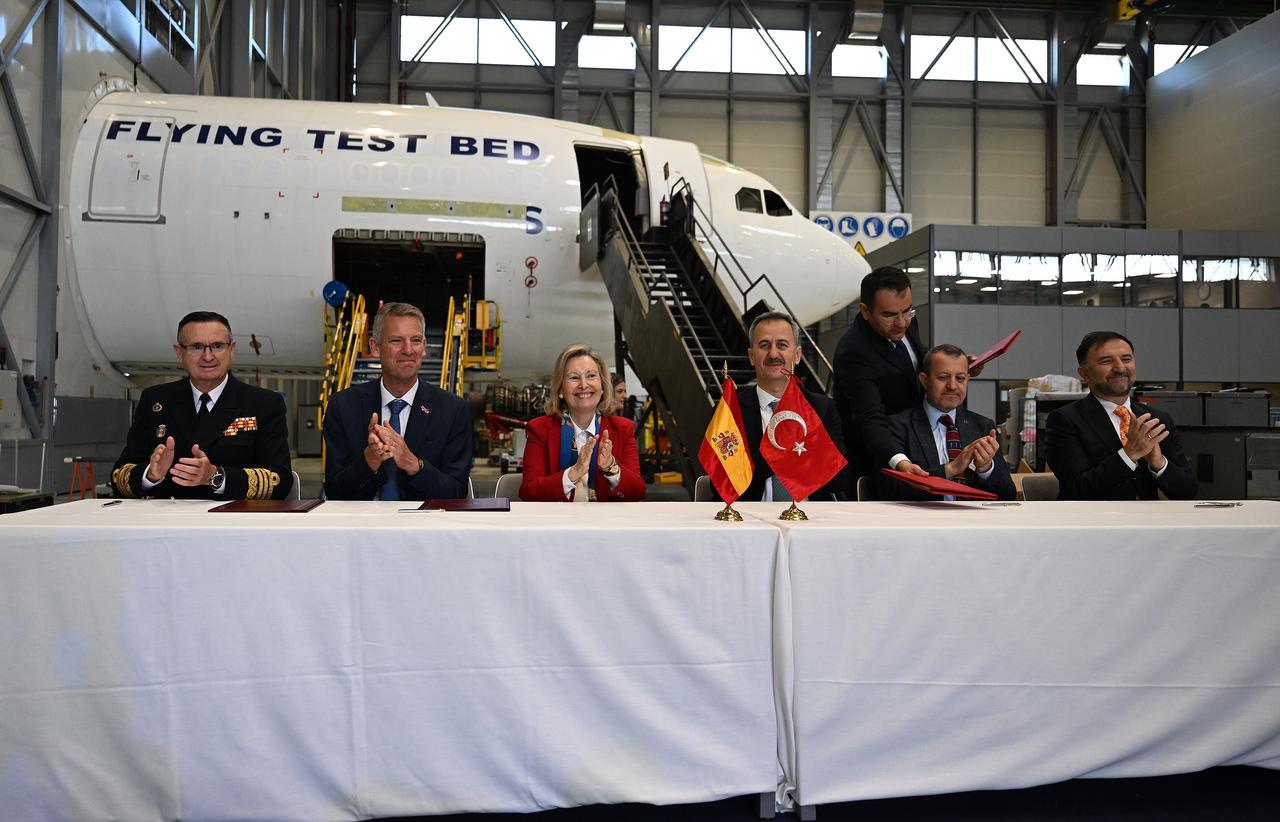
Signing ceremony for HÜRJET export to Spain Madrid 28 April 2026 - (Anadolu Ajansı)
The agreement was signed by Haluk Görgün President of the Presidency of Defence Industries of the Republic of Türkiye Amiral Aniceto Rosique Director General of Armaments and Equipment at the Spanish Ministry of Defense Jean Brice Dumont Head of Air Power at Airbus Defense and Space Gökhan Uçar Deputy President of the Presidency of Defence Industries and Mehmet Demiroğlu General Manager of TUSAŞ.
Under the signed program part of the HÜRJET platform will be produced in Türkiye and delivered to Spain while another portion will be manufactured in Spain with contributions from local producers. This model is defined as a program based on joint production and industrial cooperation between the two countries.
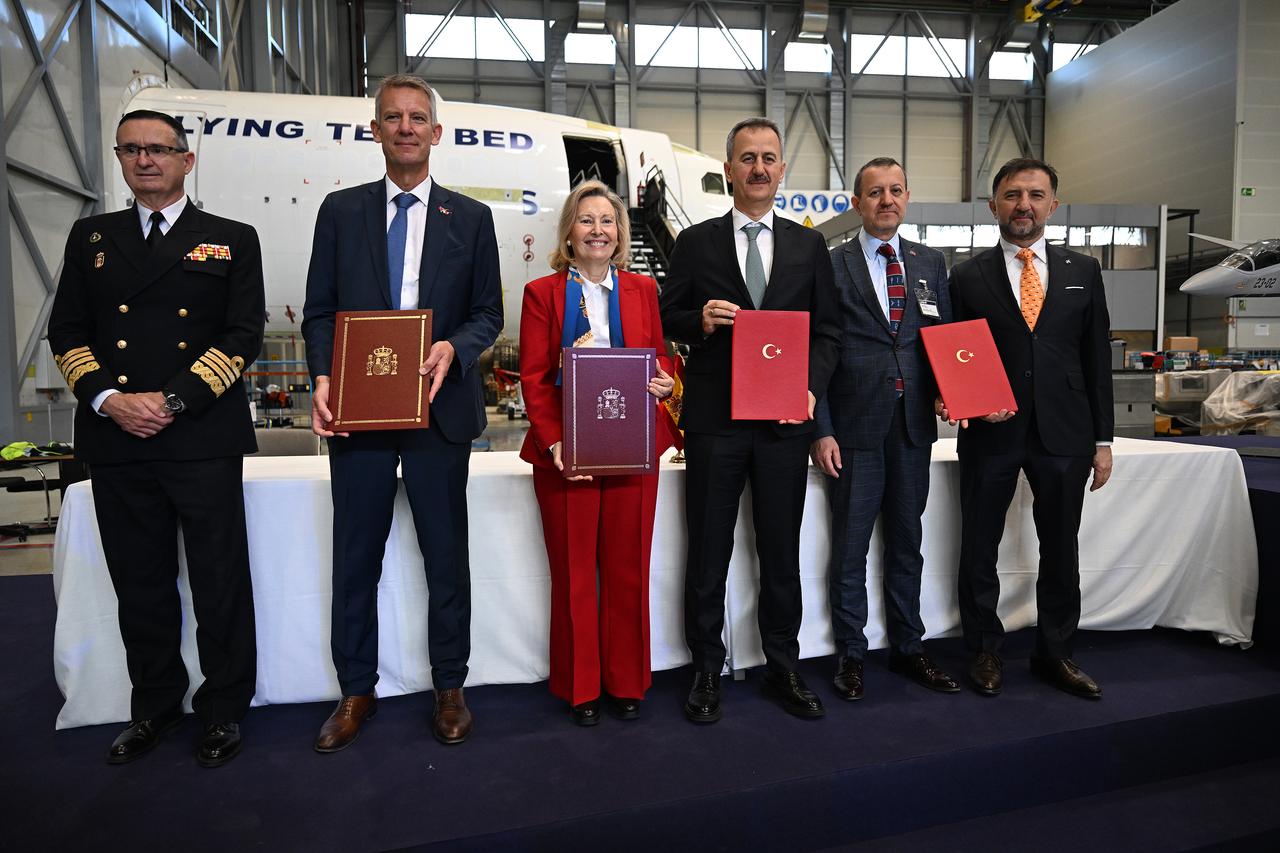
Signing ceremony for HÜRJET export to Spain Madrid 28 April 2026 - (Anadolu Ajansı)
The program is intended to meet the jet trainer requirement for fighter pilot training. The Spanish side has clarified that the project is planned as a system to replace its current F-5 training aircraft.
Airbus officials stated that deliveries of HÜRJET aircraft are scheduled to begin in 2028 with active use in training activities planned for 2029–2030 and a target of 30 aircraft entering service between 2030 and 2035.
It was stated that Turkish and Spanish defense industry entities will collaborate on the project with local Spanish industrial organizations integrated into the production process and that the program is expected to generate approximately 2500 jobs. Official statements at the ceremony emphasized that the agreement aims to strengthen defense industry cooperation between the two countries and is regarded as a model of joint production among NATO allies.
Akarsu, Ozan. “Hafif Taarruz Uçağı HÜRJET’in Teknik Özellikleri.” SavunmaTR. Accessed October 30, 2025. https://www.savunmatr.com/hafif-taarruz-ucagi-hurjetin-teknik-ozellikleri/. Bigpara. “3,1 Milyar Euroluk İmza: İspanya 45 Adet HÜRJET Alımını Resmen Onayladı.” Bigpara. Accessed October 30, 2025. https://bigpara.hurriyet.com.tr/haberler/genel-haberler/3-1-milyar-euroluk-imza-ispanya-45-adet-hurjet-alimini-resmen-onayladi_ID1619878/. Dünya Gazetesi. “TUSAŞ HÜRJET Avrupa Yolcusu: İspanya, Türkiye’den 45 HÜRJET Alımını Onayladı.” Dünya. Accessed October 30, 2025. https://www.dunya.com/ekonomi/tusas-hurjet-avrupa-yolcusu-ispanya-turkiyeden-45-hurjet-alimini-onayladi-haberi-800704/. Milli Savunma. “HÜRJET Jet Eğitim ve Yakın Hava Destek Uçağı.” Millî Savunma. Accessed October 30, 2025. https://www.millisavunma.com/hurjet-jet-egitim-ve-yakin-hava-destek-ucagi/. TUSAŞ (Türk Havacılık ve Uzay Sanayii A.Ş). “HÜRJET Ürün Sayfası.” TUSAŞ Resmî Web Sitesi. Accessed October 30, 2025. https://www.tusas.com/urunler/ucak/ozgun-gelistirme/hurjet. Uylaş, Hülya Ömür. “HÜRJET 100. test uçuşunu başarıyla gerçekleştirdi.” Anadolu Ajansı. Accessed October 30, 2025. https://www.aa.com.tr/tr/savunma-sanayisi/hurjet-100-test-ucusunu-basariyla-gerceklestirdi/3305752. Yıldırım, Göksel. “'Türk Yıldızı' HÜRJET ilk kez yuvasından ayrıldı.” Anadolu Ajansı. Accessed October 30, 2025. https://www.aa.com.tr/tr/savunma-sanayisi/turk-yildizi-hurjet-ilk-kez-yuvasindan-ayrildi/3222199. Yıldırım, Göksel. “Hürjet uçmak için gün sayıyor.” Anadolu Ajansı. Accessed October 30, 2025. https://www.aa.com.tr/tr/teknofest/hurjet-ucmak-icin-gun-sayiyor/2604643. Yanık, Tolga. “ANKA III, HÜRJET ile kol uçuşu yaptı.” Anadolu Ajansı. Accessed October 30, 2025. https://www.aa.com.tr/tr/savunma-sanayisi/anka-iii-hurjet-ile-kol-ucusu-yapti/3241393.
Anadolu Ajansı. "HÜRJET'ten 2,6 milyar avroluk ihracat başarısı." Accessed December 30, 2025. https://www.aa.com.tr/tr/savunma-sanayisi/hurjetten-2-6-milyar-avroluk-ihracat-basarisi/3784288.
Anadolu Ajansı. “HÜRJET’in İspanya’ya İhracına İlişkin Madrid’de İmza Töreni Düzenlendi.” Accessed April 28, 2026. https://www.aa.com.tr/tr/bilim-teknoloji/hurjetin-ispanyaya-ihracina-iliskin-madridde-imza-toreni-duzenlendi/3920310
[1]
Various sources provide differing data; the official value provided by TUSAŞ is taken as reference.


Type(s) | Jet trainer and light attack aircraft | ||||||||
|---|---|---|---|---|---|---|---|---|---|
Country of Origin | Türkiye | ||||||||
Manufacturer(s) | TUSAŞ | ||||||||
Designer | TUSAŞ | ||||||||
First Flight(s) | 25 April 2023 | ||||||||
Introduction into Service | 2027 (planned) | ||||||||
Status | In testing phase | ||||||||
Production Quantity | 2 (prototypes) | ||||||||
Cost | 600 million $ | ||||||||
Crew | 2 | ||||||||
Unit Cost | 25 million $ | ||||||||
Length(s) | ~13.0–13.6 m | ||||||||
Wingspan | ~9.5–9.8 m | ||||||||
Height(s) | ~4.2–5.1 m | ||||||||
Engine(s) | 1 × turbofan GE F404 series | ||||||||
Maximum Speed | Mach 1.2–1.4 | ||||||||
Service Ceiling | ≈13.700 m | ||||||||
Range / Ferry Range | ≈2.200–2.600 km | ||||||||
Payload / Weapon Capacity | ≈2.5–2.7 ton | ||||||||
Development Process
Project Initiation and Background
Prototype Phases and Testing Processes
Transition to Series Production and Developments
Technical Specifications and Variants
General Technical Assessment
Technical Specifications Table
Munitions and Capabilities
Electronic Warfare and Reconnaissance Systems
Domestic and Foreign Weapons Integration
Current and Planned Variants
Avionics and System Components
Purpose and Missions
Military Applications
Civilian and Humanitarian Missions
Future Potential Applications
Operational History and Achievements
Completed Missions
Operational Experience
Initial Successes and Critical Milestones
Spanish Government Approval for HÜRJET Procurement
Official Statements by the Turkish Government
International Counterparts
Export Agreement with Spain and Madrid Signing Ceremony (2026)