


This article was automatically translated from the original Turkish version.
+2 More
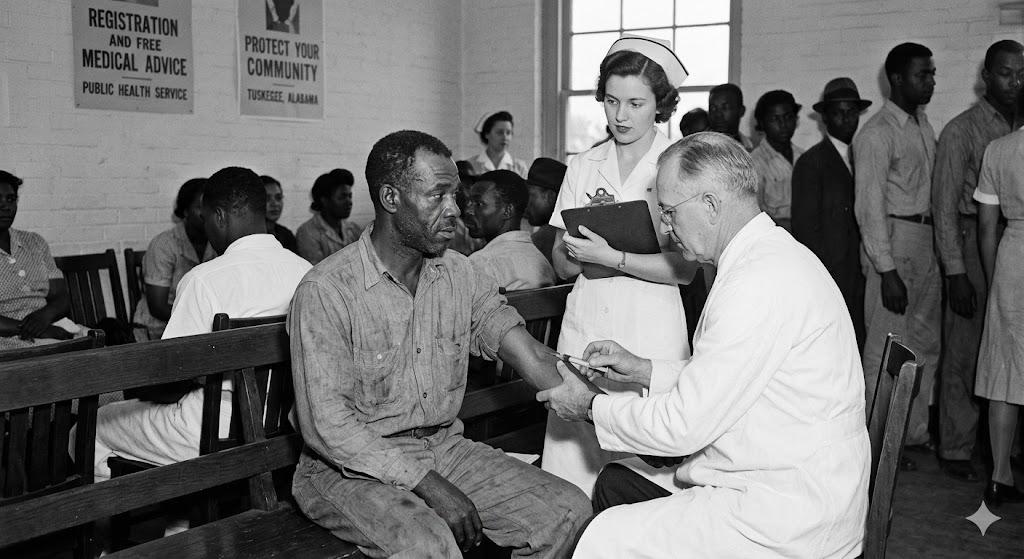
(Yapay zeka ile oluşturulmuştur)
In the 20th century, the Tuskegee and Guatemala studies conducted under the auspices of the United States Public Health Service (USPHS) are among the practices in the history of clinical research in which ethical principles were systematically violated and which have been examined within the context of scientific racism debates. These studies involved the administration of experimental procedures without informed consent on economically and socially vulnerable groups, the failure to adequately inform participants about medical procedures, and in some cases, the deliberate restriction of available treatments.
Between 1946 and 1948 in Guatemala, deliberate infection methods were applied on prisoners, soldiers, psychiatric patients, and other vulnerable populations to investigate the effectiveness of penicillin in preventing venereal diseases; in the Tuskegee study, access to treatment for African American participants was systematically denied for decades in order to observe the natural progression of syphilis.【1】
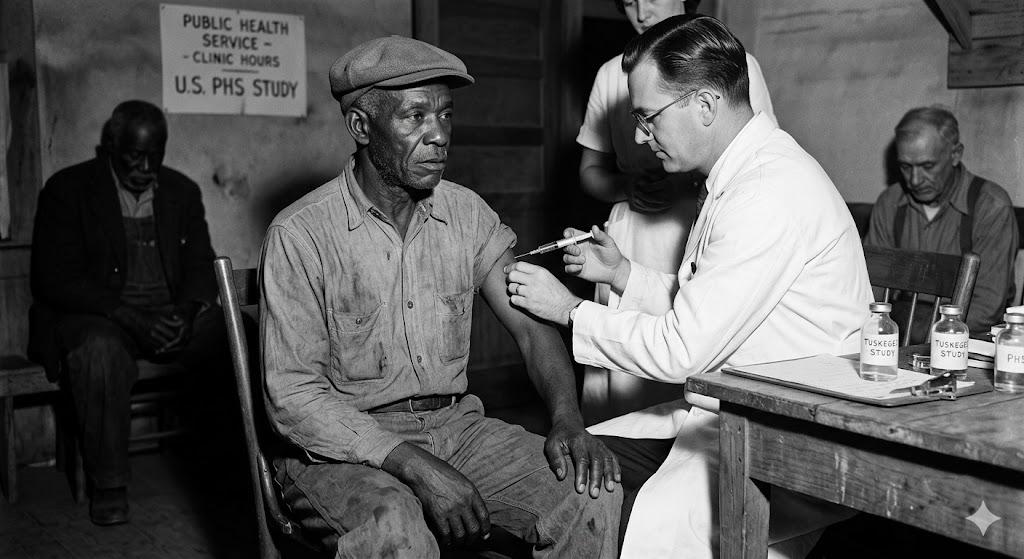
Visual representing the Tuskegee and Guatemala studies (generated by artificial intelligence)
The Tuskegee study was grounded in scientific racism and social Darwinism, prevalent in the medical community of the 19th and early 20th centuries, which classified African Americans as physically and mentally distinct, more tolerant of pain, and morally inferior. During this period, false scientific beliefs dominated the medical world, asserting that Black individuals possessed excessive sexuality, were highly susceptible to sexually transmitted diseases, and would not seek treatment regardless of their educational background.
The scientific inspiration for the study came from a 1928 investigation conducted by Bruusgard in Oslo, Norway, which examined the natural progression of syphilis in hundreds of white men. American researchers decided to replicate this study within the United States to test claims that syphilis affected the nervous system more in whites and the cardiovascular system more in Black individuals. The research site was chosen as Macon County, Alabama, where syphilis prevalence reached 35 to 40 percent.【2】
Originally planned by Dr. Taliaferro Clark as a six- to eight-month observational phase followed by a treatment phase, the study was later transformed into a continuous observational experiment with treatment completely withheld.
The 600 extremely poor and uneducated African American men enrolled in the study were told they were receiving treatment for “bad blood.”【3】To ensure participants remained in the study, they were provided with meals, a health worker was assigned to transport them to appointments, and funeral expense assistance was promised in exchange for permission to perform autopsies. Researchers even marketed lumbar punctures, performed to collect cerebrospinal fluid, as free special medical treatments.
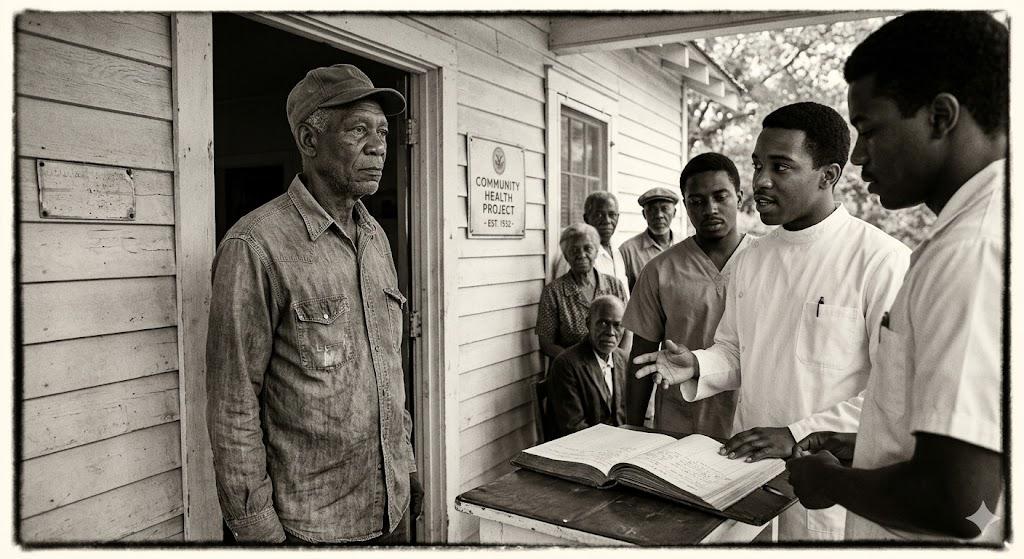
Visual representing the Tuskegee and Guatemala studies (generated by artificial intelligence)
Throughout the duration of the experiment, participants were systematically and deliberately denied access to actual treatment. In 1934, local physicians were provided with lists of participants and instructed not to treat them. In 1941, participants who were drafted into military service were deliberately removed from the armed forces to prevent them from receiving treatment. Even after penicillin became the standard treatment for syphilis in 1947, participants were not given the drug and were denied access to it. Officials justified this neglect by claiming that participants were too resilient to seek medical care or that their disease had progressed too far for penicillin to be effective. Despite international ethical agreements, the study continued until it was exposed to the press in 1972, and no official was ever held accountable.
During World War II, venereal diseases were seen as a threat to military health, prompting USPHS doctors to seek new settings where they could deliberately infect healthy individuals to test penicillin’s protective effects. Knowing that the public would not tolerate such research on American soil, the experiments were planned in collaboration with the Guatemalan government and the Pan American Health Organization outside U.S. borders.【4】
In the initial phase of the experiments, infected sex workers were used to transmit the disease to soldiers and prisoners, but this method was deemed too slow, prompting a shift in focus. Researchers targeted psychiatric patients in state mental health institutions, whose mental conditions rendered them unable to resist. Due to the difficulty of natural transmission, participants were directly inoculated with syphilis via cerebrospinal fluid or subjected to physical irritation methods to increase infection risk. In all these procedures, informed consent was never obtained from participants or their families; only approval from institutional doctors and military officers was sought.
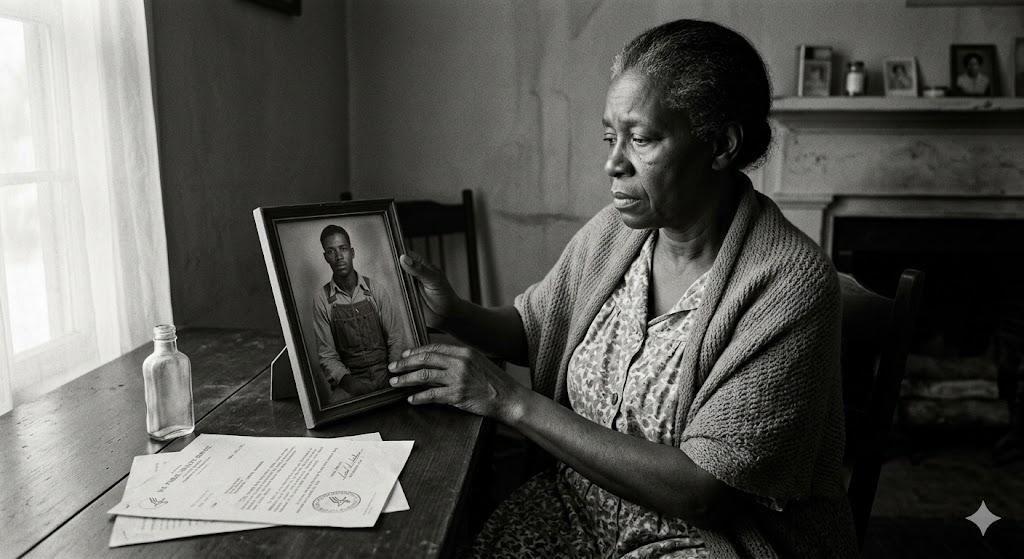
Visual representing the Tuskegee and Guatemala studies (generated by artificial intelligence)
These two studies triggered profound and lasting changes as well as enduring damage to clinical research ethics and modern public health policy. Public outrage over the Tuskegee study led to the adoption of the National Research Act in 1974, the establishment of informed consent requirements, and the creation of Institutional Review Boards. Moreover, this process paved the way for the Belmont Report, which became the foundational document for the ethics of human experimentation.
At the societal level, these experiments generated deep mistrust of government and health institutions among African American communities. The deceptive strategies used to recruit and retain participants severely undermined the effectiveness of public health programs in subsequent decades.【5】The trauma caused by the study negatively affected awareness of access to healthcare services and left a lasting imprint on public health outcomes.
Arslan, Muhammet F. “II. Dünya Savaşından Günümüze Sifiliz ve İnsan Deneyleri: Tarihi Perspektif ve Etiğe Yansımaları.” Hacettepe Ünv. Tıp Fak. Tıp Tarihi ve Etik AD. Accessed May 8, 2026. https://deontoloji.hacettepe.edu.tr/ekler/pdf/makale_sunulari/14_15/mf_arslan_2.pdf
Office for Science and Society. “40 Years of Human Experimentation in America: The Tuskegee Study.” Separating Sense from Nonsense. Accessed May 8, 2026. https://www.mcgill.ca/oss/article/history/40-years-human-experimentation-america-tuskegee-study
Stanford University. "Tuskegee Syphilis Experiment." Stanford University Libraries: Say Their Names. Accessed May 8, 2026. https://exhibits.stanford.edu/saytheirnames/feature/tuskegee-syphilis-experiment
[1]
Office for Science and Society, “40 Years of Human Experimentation in America: The Tuskegee Study,” Separating Sense from Nonsense, Access Date 8 May 2026, https://www.mcgill.ca/oss/article/history/40-years-human-experimentation-america-tuskegee-study
[2]
Office for Science and Society, “40 Years of Human Experimentation in America: The Tuskegee Study,” Separating Sense from Nonsense, Access Date 8 May 2026, https://www.mcgill.ca/oss/article/history/40-years-human-experimentation-america-tuskegee-study
[3]
Office for Science and Society, “40 Years of Human Experimentation in America: The Tuskegee Study,” Separating Sense from Nonsense, Access Date 8 May 2026, https://www.mcgill.ca/oss/article/history/40-years-human-experimentation-america-tuskegee-study
[4]
Muhammet F. Arslan, “From World War II to the Present: Syphilis and Human Experiments: Historical Perspective and Ethical Implications,” Hacettepe University Faculty of Medicine, Department of Medical History and Ethics, Access Date 8 May 2026, https://deontoloji.hacettepe.edu.tr/ekler/pdf/makale_sunulari/14_15/mf_arslan_2.pdf
[5]
Office for Science and Society, “40 Years of Human Experimentation in America: The Tuskegee Study,” Separating Sense from Nonsense, Access Date 8 May 2026, https://www.mcgill.ca/oss/article/history/40-years-human-experimentation-america-tuskegee-study


(Yapay zeka ile oluşturulmuştur)
No Discussion Added Yet
Start discussion for "Tuskegee Syphilis Study" article
Historical and Ideological Background of the Tuskegee Syphilis Study
Manipulation of Participants and Systematic Denial of Treatment
Guatemala Syphilis Experiments and Deliberate Inoculation Process
Research Ethics and Lasting Impact on Public Health