


This article was automatically translated from the original Turkish version.
+2 More
Universal Asynchronous Receiver/Transmitter (UART) is a fundamental hardware-based communication protocol used to enable serial data communication between digital devices. It is commonly integrated into microcontrollers and computers to convert data between parallel and serial formats in both directions. Due to its asynchronous structure, UART enables data exchange without requiring an external clock signal.

UART Topology (Generated by artificial intelligence.)
The UART protocol transmits data within a defined frame structure. This structure consists of:
1. Start Bit: The start bit signals the beginning of communication by pulling the communication line from a logic high level to a logic low level.
2. Data Bits: These bits represent the actual data and typically range from 5 to 8 bits in length.
3. Parity Bit (Optional): Used for error detection and can be configured as odd or even parity.
4. Stop Bit(s): These bits indicate the end of the transmission and are usually one or two bits long.
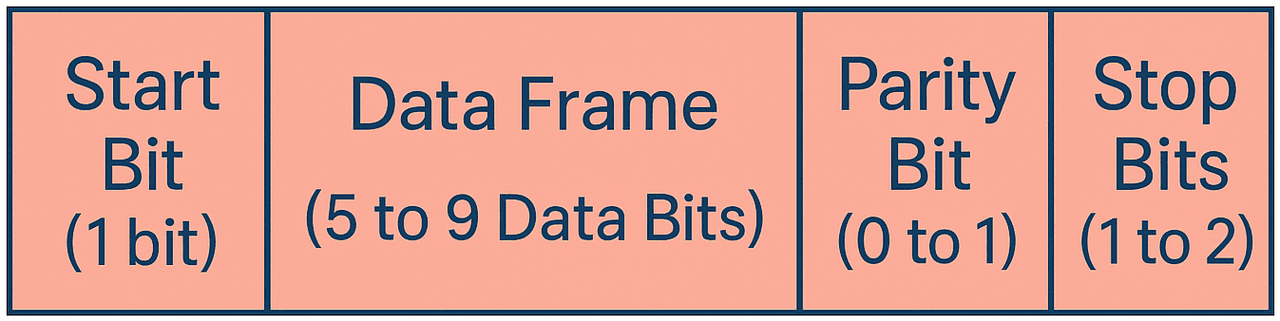
UART Data Frame (Generated by artificial intelligence.)
The baud rate specifies the number of bits transmitted per second and must be identical for both communicating devices. Due to its asynchronous nature, mismatches in baud rate can lead to timing errors and data loss.
The asynchronous operation of UART eliminates the need for a continuous clock signal. Instead, timing is synchronized based on the start bit. UART can operate in either full duplex or half duplex configurations, enabling simultaneous transmission and reception of data.
The flexibility and simplicity of UART make it suitable for a wide range of applications. It is widely used in the automotive industry for communication between sensors, control units, and infotainment systems. It also serves as a standard communication solution in consumer electronics, GPS receivers, and modems. Due to its prevalence and ease of integration, UART is commonly implemented as a default module in many microcontrollers.
Despite its specific technical limitations, UART remains a preferred protocol in many applications due to its simplicity, cost-effectiveness, and widespread availability.
Analog Devices. "UART: A Hardware Communication Protocol." Analog Dialogue. Accessed May 20, 2025. Accessed Adresi.
Bestaş Otomotiv. “UART Protokolü Nedir, Nasıl Çalışır? Otomotiv Uygulamaları.” Accessed May 20, 2025. Accessed Adresi.
Circuit Basics. "Basics of UART Communication". Accessed May 20, 2025. Accessed Adresi.
GeeksforGeeks. "Universal Asynchronous Receiver Transmitter (UART) Protocol." Accessed May 20, 2025. Accessed Adresi.
Rohde & Schwarz. "Understanding UART." Accessed May 20, 2025. Accessed Adresi.
Soldered. "What Is the UART Communication Protocol?" Accessed May 20, 2025. Accessed Adresi.

No Discussion Added Yet
Start discussion for "UART Communication Protocol" article
UART Structure and Operation
Data Frame
Baud Rate
Operating Principle
Applications and Usage
Advantages and Limitations
Advantages
Limitations