

This article was automatically translated from the original Turkish version.
Type(s) | Soup | ||||||||
|---|---|---|---|---|---|---|---|---|---|
Name(s) | Borscht (Borş) | ||||||||
UNESCO Status | List of Urgently Needed Intangible Cultural Heritage (2020) | ||||||||
Main Ingredient | Beetroot | ||||||||
Kitchen | Ukraine | ||||||||
Ukrainian Borscht is a traditional soup based on beets, containing vegetables and optionally meat. Its distinctive red color derives from beets, and the dish is one of the most recognized elements of Ukrainian culinary culture.
Borscht is prepared with varying ingredients and cooking methods across different regions, but its Ukrainian form is defined by specific ingredient preferences and culinary practices. The role of borscht in Ukrainian cuisine encompasses a wide range of uses, from everyday meals to special occasion tables. The soup has evolved within home cooking traditions and has also been documented through written sources over time.
The preparation and consumption of Ukrainian Borscht were inscribed in 2022 on UNESCO’s List of Intangible Cultural Heritage in Need of Urgent Safeguarding. UNESCO’s decision was based on the transmission of traditional cooking practices across generations among families, communities, and individuals of all ages. The soup is typically prepared in large pots or cauldrons and is commonly served with bread or garlic bread. The preparation practice encompasses numerous variations, with recipes, cooking techniques, and presentation styles differing according to context. These characteristics have led to borscht being viewed not merely as a dish but as a symbol of lifestyle and cultural identity. During its UNESCO nomination, particular emphasis was placed on the transmission of knowledge within families, the inclusion of children in the preparation process, and the role of borscht in social gatherings. Additionally, attention was drawn to its presence in folkloric narratives, wedding rituals, and regional events.【1】
The origins of borscht are linked to Eastern European culinary traditions. Beet-based soups have been widely prepared on the territory of present-day Ukraine since the Middle Ages. During this period, the significant role of beets in agricultural production contributed to the formation of borscht’s core ingredient. Over time, recipes diversified according to regional conditions, while the central role of beets was preserved. In Ukraine, borscht emerged as a dish closely tied to rural life, reflecting the culinary practice of combining vegetables produced by agrarian communities. In this context, borscht has been regarded not only as a food but also as an indicator of local production and consumption relationships.
Ukrainian Borscht has been passed down from generation to generation through family recipes. As an essential component of domestic culinary knowledge, borscht can be prepared with minor variations in different households. Nevertheless, the central use of beets and its vegetable-based composition remain common features. Borscht is also associated with communal meals in Ukrainian culture. Its presence at family tables, in hospitality practices, and in charity food events has reinforced its social significance. In this sense, Ukrainian Borscht is defined as a dish that reflects shared practices of preparation and consumption.
The main ingredient of Ukrainian Borscht is beet. Other commonly used vegetables include cabbage, potato, carrot, onion, and garlic. Some recipes include meat or meat broth, while others favor a completely vegetarian preparation. The type and quantity of ingredients vary according to regional customs and seasonal conditions. Natural acidic components are frequently used to balance the flavor of the soup. The choice of these components may differ based on individual taste preferences and local practices.

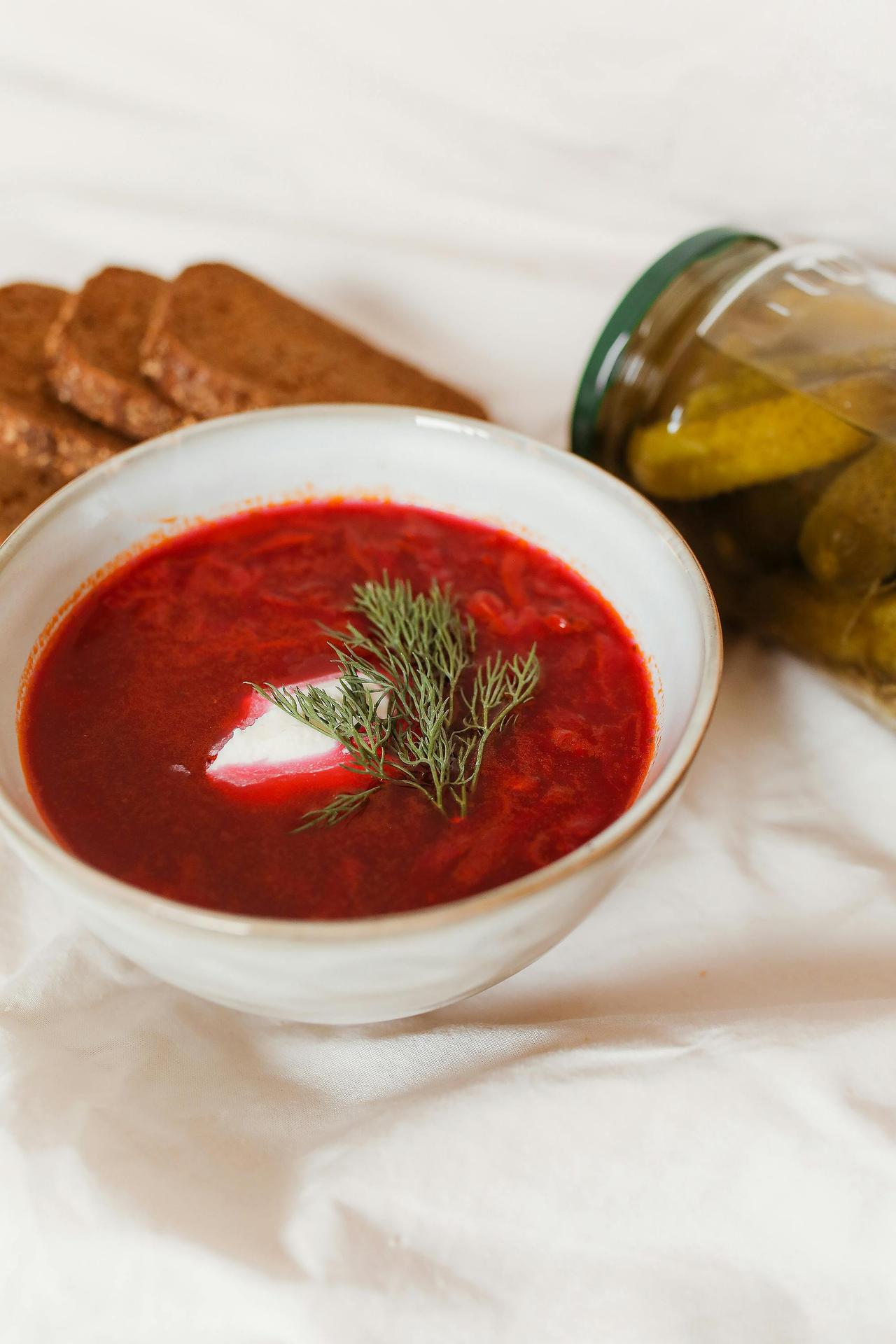
Borscht Soup (Pexels)
The preparation of Ukrainian Borscht involves specific stages. Vegetables are typically chopped or grated and cooked separately or together. Beets are added to the pot at an appropriate stage to preserve their color and aroma. Care is taken during cooking to maintain the texture of the vegetables. Preparation methods draw not only from written recipes but also from hands-on culinary knowledge. As a result, the consistency and taste of borscht may vary depending on the cook’s experience and regional traditions.
Ukrainian Borscht is typically served hot. It can be consumed as part of a main meal or as a starter. Presentation styles vary according to domestic and communal dining contexts. In some serving traditions, additional foods accompany the soup. Borscht is recognized as a soup preferred not only in daily nutrition but also in seasonal and social food events.
Ukrainian Borscht holds a prominent place among dishes representing Ukrainian cuisine. While it is known internationally in various forms, its Ukrainian version is distinguished by a specific arrangement of ingredients and preparation method. The soup continues to exist both within traditional culinary practices and in modern recipe adaptations. Ukrainian Borscht is regarded as a dish that reflects the continuity of culinary culture and serves as a bridge between historical heritage and contemporary practices.【2】
[1]
UNESCO, “Culture of Ukrainian Borscht Cooking,” UNESCO Intangible Cultural Heritage, Erişim tarihi: 28 Ocak 2026, https://ich.unesco.org/en/USL/culture-of-ukrainian-borscht-cooking-01852
[2]
UNESCO, “Culture of Ukrainian Borscht Cooking,” UNESCO Intangible Cultural Heritage, Erişim tarihi: 28 Ocak 2026, https://ich.unesco.org/en/USL/culture-of-ukrainian-borscht-cooking-01852


Type(s) | Soup | ||||||||
|---|---|---|---|---|---|---|---|---|---|
Name(s) | Borscht (Borş) | ||||||||
UNESCO Status | List of Urgently Needed Intangible Cultural Heritage (2020) | ||||||||
Main Ingredient | Beetroot | ||||||||
Kitchen | Ukraine | ||||||||
Borscht as Intangible Cultural Heritage
Historical and Geographical Context
Cultural Context
Core Ingredients
Preparation Process
Serving and Consumption
Ukrainian Borscht Today