


This article was automatically translated from the original Turkish version.
+1 More
Ukulele, a small, fretted, four-stringed string instrument. It arrived on the islands through Portuguese workers who migrated from the Madeira Islands of Portugal to Hawaii in the late 19th century. The ukulele quickly became one of the foundational instruments of Hawaiian music culture. The word “ukulele” originates from the Hawaiian language and is commonly translated as “jumping flea,” a name inspired by the rapid finger movements used when playing the instrument.
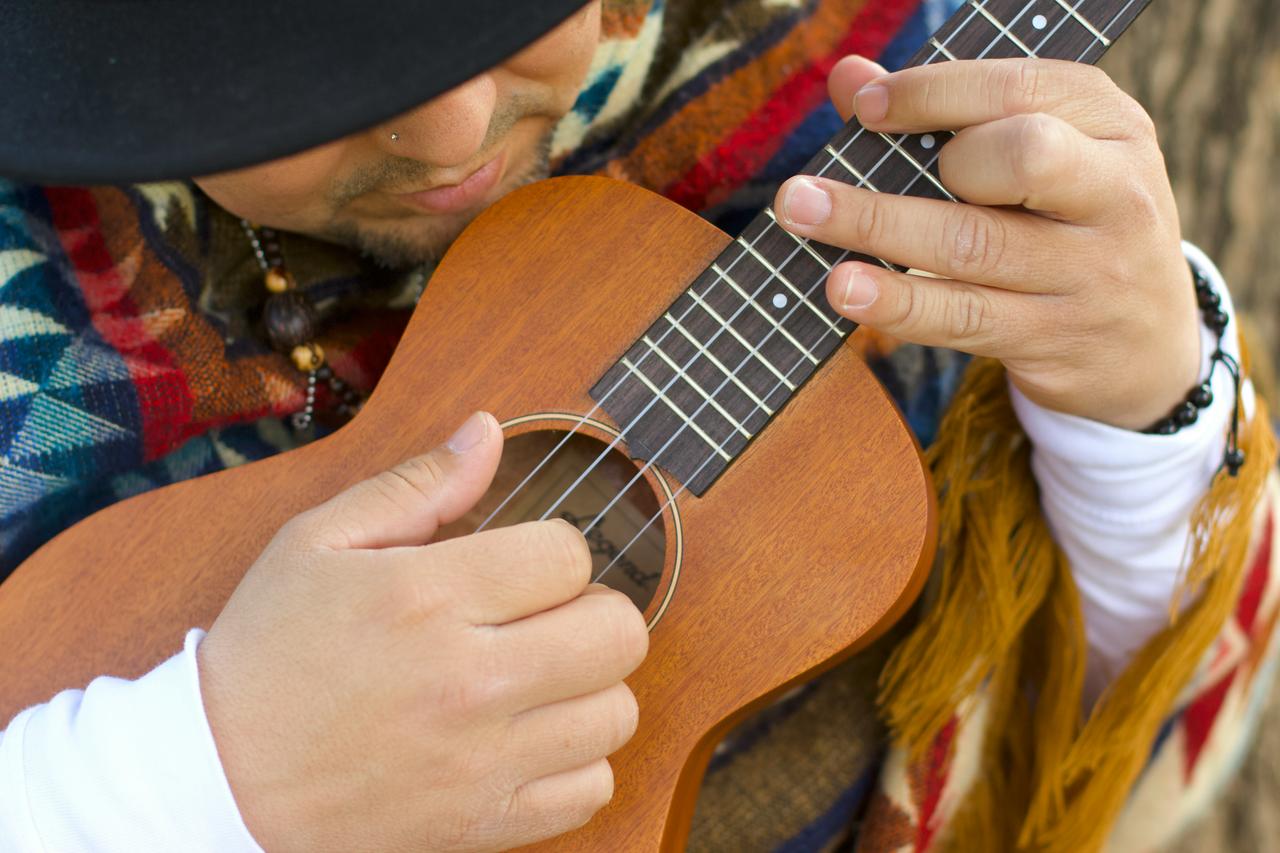
A person playing the ukulele. (
The ukulele is a Portuguese-origin instrument. In 1879, Portuguese immigrants and workers from the Madeira Islands brought with them small stringed instruments known as braguinha or machete. Over time, these instruments evolved in Hawaii into the modern ukulele.
In the early 20th century, it gained popularity in the United States and found a place in jazz and pop music. The introduction of the baritone ukulele in the 1950s and the widespread adoption of the internet in the 21st century, particularly through video sharing platforms, contributed to its global popularity.
Ukuleles are typically made from wood; woods such as koa, cedar, and mahogany are preferred, though modern models are also made from plastic or composite materials. Key components include the body, neck, fretboard, frets, bridge, and tuning pegs.
Ukuleles are divided into four main types based on size and tuning:
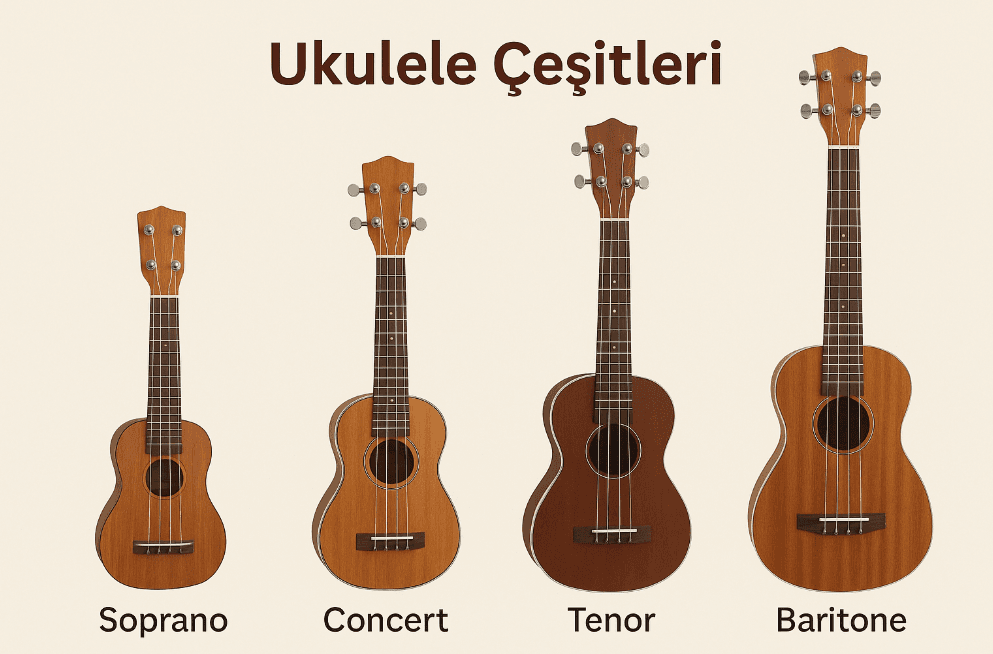
Types of ukulele. (Generated by artificial intelligence.)

A visual showing the tuning system. (Artist’s drawing.)
In recent years, the ukulele has become a widely used functional tool in music education both in Türkiye and globally. Its portability, affordability, ease of learning, and ability to produce polyphonic sounds make it popular among both students and teachers.
Used to instill a love of music in children and to teach fundamental harmony and melody, the ukulele is especially favored in group playing and song singing activities.
Bernard, Cara F., and Christopher Cayari. “Encouraging Participatory Music Making through Differentiation on the Ukulele.” *General Music Today* 34, no. 1 (2020): 29–36. Accessed April 22, 2025. Gayretli, Şerif, Hüseyin Yılmaz, and Onur Zahal. “Müzik Eğitiminde Ukulele.” *Atatürk Üniversitesi Kazım Karabekir Eğitim Fakültesi Dergisi* 42 (2021): 496–510. Accessed April 22, 2025. Giebelhausen, Robin. “So, You’re Thinking About Starting a Ukulele Program?” *General Music Today* 29, no. 3 (2016): 38–41. Accessed April 22, 2025. Greenberg, Marvin. “The Ukulele in Your Classroom.” *Music Educators Journal* 79, no. 3 (1992): 43–48. Accessed April 22, 2025. Mutlu Yıldız, Yıldız. “Müzik Eğitiminde Öğretmen Çalgısı Olarak Bir Öneri: Ukulele.” *Mehmet Akif Ersoy Üniversitesi Eğitim Fakültesi Dergisi* 58 (2021): 733–746. Accessed April 22, 2025. Tranquada, Jim, and John King. *The ‘Ukulele: A History.* Honolulu: University of Hawai‘i Press, 2012. Accessed April 22, 2025. Miller, Terry E., and Andrew Shahriari. *World Music: A Global Journey.* 5th ed. New York: Routledge, 2021. Accessed April 22, 2025. Santos, A. A., and Angelina F. Nunes. *Original Method and Self Instructor on the Ukulele.* Honolulu: Santos-Nunes Studios, 1915. Accessed April 22, 2025. Raychl, Smith, and Jacqueline Secoy. “Exploring the Music Identity Development of Elementary Education Majors Using Ukulele and YouTube.” *Journal of Music Teacher Education* 29, no. 1 (2019): 71–85. Accessed April 22, 2025. Statista. “Wholesale Sales of Ukuleles in the U.S. 2009–2021.” Accessed April 22, 2025. Unsplash. “Person Playing Brown Ukulele.” Photograph by 02Am14EPf1g. Accessed April 22, 2025.

Historical Development
Structural Features
Types of Ukulele
Tuning System
Use in Music Education