


This article was automatically translated from the original Turkish version.
+2 More
Ulukale Camii is a rural mosque from the Ottoman period located in Ulukale Village, Çemişgezek District of Tunceli Province in Eastern Anatolia, Türkiye. The structure, characterized by its architectural simplicity, stone construction, and functional design, represents a typical example of regional mosque architecture and constitutes an important element of the village’s historical identity.
Ulukale Camii is situated within the boundaries of Ulukale Village, part of Çemişgezek District in Tunceli. The building was integrated into the central settlement fabric of the village, harmoniously embedded within the neighborhood structure. Historically, Ulukale Village lies within the boundaries of the Çemişgezek Sanjak of the Ottoman administrative system, and this mosque is regarded as one of the representative examples of Islamic architecture at the rural level in the region.
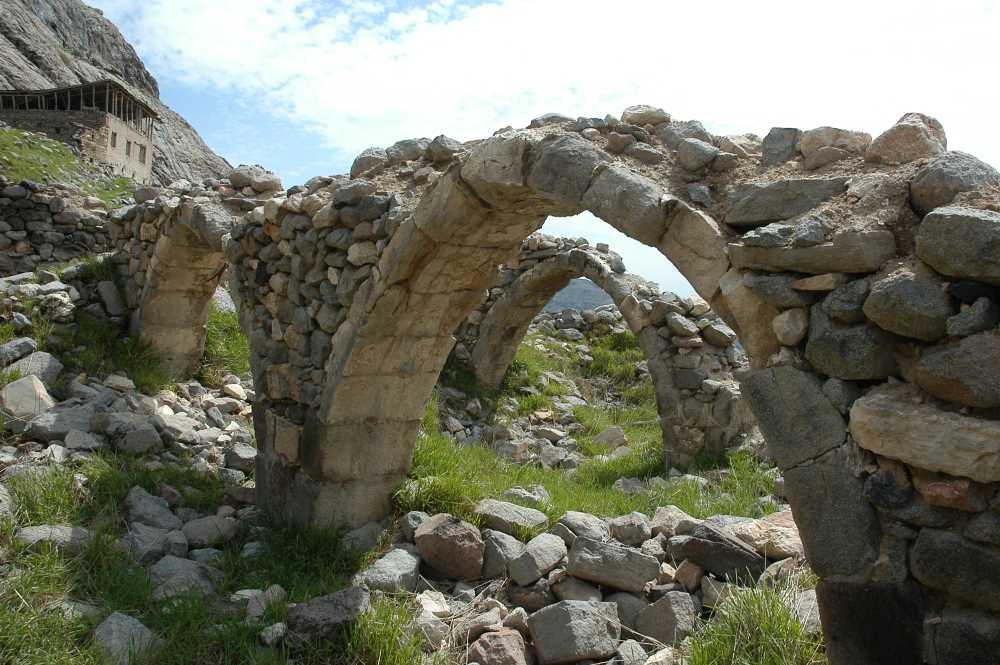
Remains of Ulukale Camii (Culture Portal)
Current sources do not provide clear information regarding the exact construction date or founder of the mosque. However, statements issued by the Republic of Türkiye Ministry of Culture and Tourism emphasize that Ulukale Camii belongs to the Ottoman period. In this context, the mosque is among the numerous local places of worship constructed as a result of Ottoman settlement policies in the region from the 16th century onward. Ulukale Village has historically been known as a settlement where Turkmen, Kurdish, and Zaza communities lived together, and in this regard, the mosque has ensured the continuity of Islamic worship within a multicultural environment.
Ulukale Camii exhibits the characteristic simplicity of rural Ottoman architecture, with a plain exterior façade and a functionally organized interior layout. The building is generally rectangular in plan and constructed entirely of stone. The walls display a combination of cut stone and rubble stone techniques. Decorative elements on the façade are extremely limited, and the structure as a whole reflects a minimalist design devoid of ornamentation.
The interior space includes traditional elements such as the mihrab, minbar, and vaaz kürsüsü. A notable feature of the interior is its wooden ceiling system. There is no mention of a minaret in any sources; therefore, it is likely that the structure was originally built without a minaret or that a removable or later-added minaret once existed. Additionally, the mosque lacks a courtyard, a feature commonly absent in rural settlements due to limited land availability.
Since its construction, Ulukale Camii has served as one of the primary religious structures for the local community’s daily worship. Although the village population is small, the mosque continues to function as an active place of worship. Its central location within the village suggests that it has fulfilled not only religious functions but also social roles such as community solidarity, local gatherings, and religious education.
Official sources do not provide clear information regarding the mosque’s restoration or conservation status. However, resources under the Tunceli Provincial Directorate of Culture and Tourism confirm that the structure remains standing and is still open for worship. This indicates that the building is embraced by the local community and preserved through grassroots awareness. Nevertheless, it must not be overlooked that the structure has deteriorated over time due to environmental factors and has suffered various damages to its architectural integrity.
Ulukale Camii is one of the original examples of rural architecture in Tunceli Province. When considered within the context of small-scale village mosques built in eastern Anatolia during the Ottoman period, the structure exemplifies the typical characteristics of Ottoman provincial architecture through its unadorned and simple design. At the same time, as a deeply embedded element of the village’s historical memory, the mosque serves as a cultural symbol of local identity and religious continuity.
Accessed November 26, 2025.
Accessed November 26, 2025.
Ministry of Culture and Tourism of the Republic of Turkey. “Cami ve Türbeler.” Tunceli İl Kültür veTurizm Müdürlüğü. Accessed July 16, 2025.
Ministry of Culture and Tourism of the Republic of Türkiye. "Ulukale Camii." *Kültür Portalı*. Accessed July 16, 2025.

Location and Settlement Context
Historical Background
Architectural Features
Function and Social Role
Conservation Status
Cultural and Architectural Value