

This article was automatically translated from the original Turkish version.
Card Types | UNO Show ‘Em No Mercy UNO Flex UNO Braille UNO Blokus Shuffle UNO Blast UNO All Wild | ||||||||
|---|---|---|---|---|---|---|---|---|---|
Deck Size | 108-112 | ||||||||
Number of Players | 2-10 players | ||||||||
Game Name | UNO | ||||||||
Release Year | 1971 | ||||||||
Publisher/Distributor | Mattel | ||||||||
Designer/Inventor | Merle Robbins | ||||||||
Game Type | Desktop card game | ||||||||
UNO is a fast-paced tabletop card game based on matching colors and numbers, featuring special action cards that introduce strategic elements and resemble the game "Crazy 8s". Recommended for individuals aged 7 and above, it is typically played by 2 to 10 players. The primary objective is to be the first player to discard all cards from their hand and to be the first to reach a total of 500 points overall.
How to play UNO (Youtube)
UNO was invented in 1971 by Merle Robbins, a barber from Reading, Ohio, United States. A disagreement with his son over the rules of "Crazy Eights" inspired him to create his own game with improved rules, laying the foundation for UNO. Since its market release, it has been widely played around the world for over 50 years. Today, the rights and distribution of the game are managed by Mattel.
A classic UNO deck consists of 108 cards. However, since new action cards were added in 2018, some modern decks contain 112 cards. The card distribution is as follows:
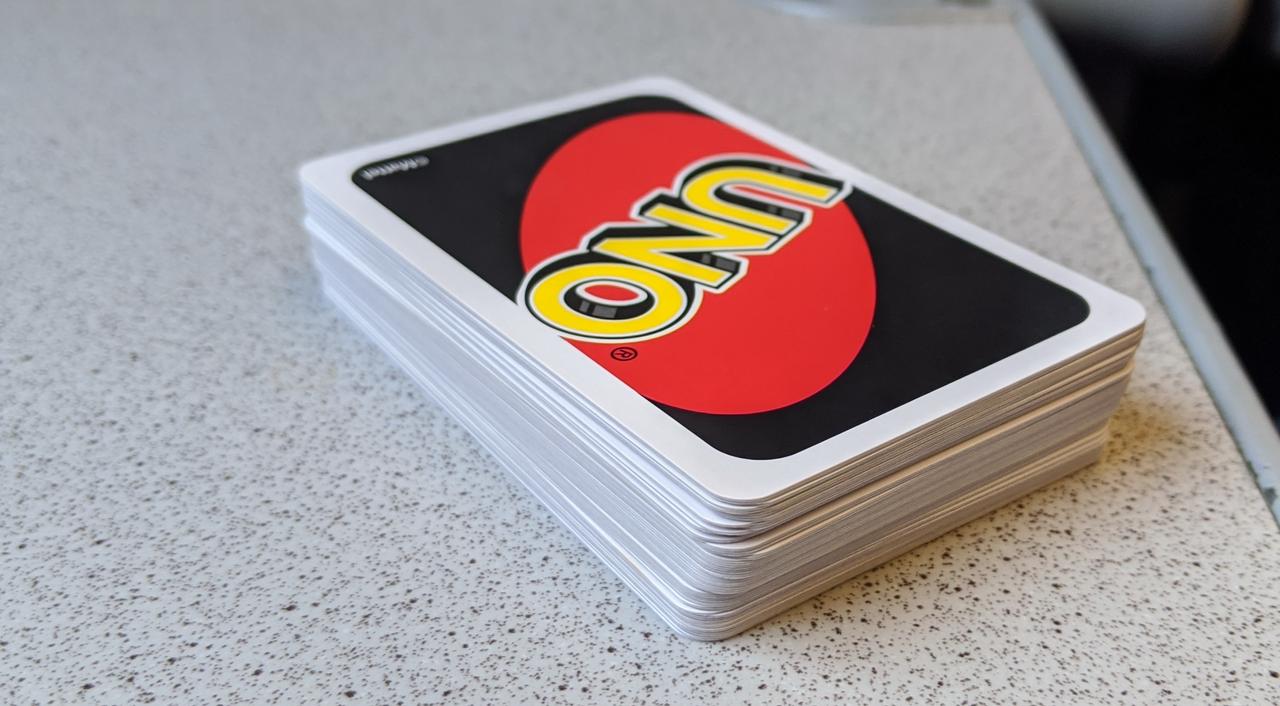
UNO (Flickr)
Before the game begins, a dealer must be determined. Each player draws one card from the deck, and the player with the highest number becomes the dealer. In this phase, symbol (action) cards are considered to have a value of zero. If there is a tie, the tied players draw again until one draws a higher number.
The dealer shuffles the deck and deals seven cards face down to each player. The remaining cards are placed face down in the center of the table to form the "Draw Pile". The top card of the Draw Pile is turned face up and placed beside it to start the "Discard Pile". If the first revealed card is an action card, its effect is immediately applied to the first player. However, if the first card is a "Wild Draw Four", it is returned to the Draw Pile and a new card is revealed.
The game typically begins with the player to the left of the dealer (or, in some versions, the youngest player) and proceeds clockwise. On their turn, a player must play a card from their hand that matches either the color, number, or symbol of the top card on the Discard Pile. For example, if the top card is a red 7, the player may play any red card or any 7 regardless of color. Alternatively, the player may choose to play any "Wild" card.
If a player has no matching card, they must draw one card from the Draw Pile. If the drawn card matches the top card of the Discard Pile, the player may choose to play it immediately during the same turn. Even if a player has a matching card, they may choose not to play it; in this case, they must still draw a card from the Draw Pile, and only the newly drawn card (if compatible) may be played during that turn.
When a player has only one card left in their hand (after playing their second-to-last card), they must announce "UNO" to alert the other players. If the player forgets to say "UNO" and another player notices and calls out "UNO" before the next player takes their turn, the player who forgot must draw two cards as a penalty (or four cards in some versions). When the Draw Pile is exhausted, the Discard Pile is shuffled, leaving only the top card face up, and becomes the new Draw Pile.
These cards directly influence the flow of the game and are tied to color or symbol. Their functions are as follows:
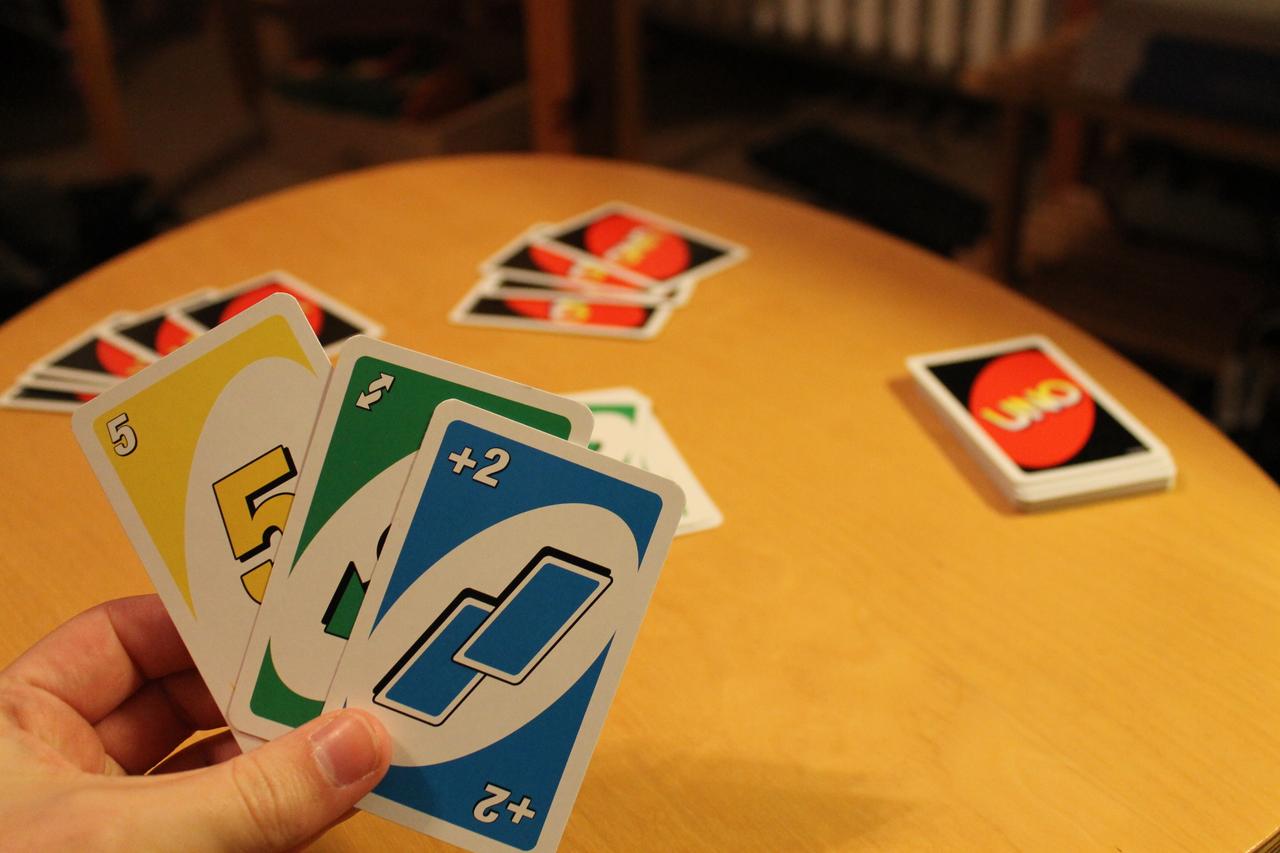
UNO (Flickr)
The player who wins a round (by discarding all their cards) scores points equal to the total value of all cards remaining in the other players’ hands. If the final card played is a "Draw Two" or "Wild Draw Four", the next player must draw the penalty cards before scoring. Rounds continue until a player reaches 500 points. Card values are calculated as follows:
In an alternative scoring system, players record the total value of cards remaining in their own hands as negative points or elimination points after each round. Any player who reaches 500 points is eliminated, and the last player remaining at the table is declared the winner.
Numerous "House Rules" and game variations have developed through informal agreement among players, often modifying the official rules:
Mattel has released numerous themed and mechanically altered versions of UNO over the years. These include mechanical variants such as UNO Attack, UNO Flip, UNO All Wild, UNO Flex, UNO Show 'Em No Mercy, UNO Spin, UNO Stacko, and UNO Blast, which retain the core gameplay while adding new mechanics, as well as themed pop culture versions such as UNO Harry Potter, UNO Minecraft, and UNO Super Mario. All these variations maintain the central rule: the first player to discard all their cards must say "UNO" to win.
Antsy Labs. "THE COMPREHENSIVE LIST OF UNO VARIATIONS" Accessed May 5, 2026. https://www.antsylabs.com/blogs/the-ant-hill/uno-challenge-2023-17-uno-variations-you-need-to-try-this-year
Flickr. "UNO" elPadawan. Accessed May 5, 2026. https://www.flickr.com/photos/elpadawan/8479303067/in/photolist-dVhDot-njAeWc-j6H5v-2hUMgLy-2oUpsyV-2m1DxyM-2hP8RzW-2iuajye-2nb6EEy-6b8GuT-3oF22X-AAtA5y-rvKKd-2iPiSz4-2ozzwoA-2ozACq4-2nkT6nw-QTm4iJ-5Lm9Q-eeX68-Q5tcjj-UQQZhu-2iv7jSQ-4VMRAQ-dZrfZJ-HjjrY-2gVQEBJ-9zDsAR-9fxU4f-2eoTfze-e9fnnU-8F9Yt1-7nwzEU-3cKftd-2ofyZRp-7X2zLS-3its65-7WEGGi-2ofAKMY-2oqaeDR-hvU1Sk-f1ngcN-2otWwTv-f17V58-2oouN8J-4NMEzB-2ou34RJ-f17ViB-7hEVW2-2ouBTWJ
Flickr. "UNO" foilman. Accessed May 5, 2026. https://www.flickr.com/photos/foilman/49914009822/in/photolist-2j3Jm9f-GnM8Z-DMXX-Jg3Z-4qiCar-2iPiXJ2-dVhDot-j6H5v-2oUpsyV-2m1DxyM-2hP8RzW-3oF22X-AAtA5y-2iPiSz4-2rhvDku-LgYZkY-tRNt4T-2oxFahe-adQqb3-sXo296-2nQyiA1-fcA2QY-QTm4iJ-5Lm9Q-eeX68-2iv7jSQ-dZrfZJ-HjjrY-a1Bixp-2gVQEBJ-9iqmbL-Hx95ir-Y7dcTK-5a9neg-wEkvHr-7nwzEU-3cKftd-2ofyZRp-2ofAKMY-2oqaeDR-hvU1Sk-2otWwTv-4NMEzB-f17ViB-7hEVW2-eNGpGp-2ouBTWJ-2ou1zSf
Mattel. "UNO Card Game Instructions." Accessed May 5, 2026. https://service.mattel.com/instruction_sheets/42001pr.pdf
Reader's Digest. "Here Are the Official Uno Rules—And the Super-Fun Unofficial Ones Too." Accessed May 5, 2026. https://www.rd.com/article/uno-rules/
The Spruce Crafts. "UNO Nasıl Oynanır?" Accessed May 5, 2026. https://www.thesprucecrafts.com/how-to-play-uno-4169919
UNO Cardgame. "Game rules." Accessed May 5, 2026. https://www.uno-cardgame.com/game-rules
Uno Rules. "Original Uno Rules." Accessed May 5, 2026. https://www.unorules.com/
Uno Rules. "Uno Versions." Accessed May 5, 2026. https://www.unorules.com/uno-versions/
YouTube. "How to play UNO" wikiHow. Accessed May 5, 2026. https://www.youtube.com/watch?v=sWoSZmHsCls&t=63s

Card Types | UNO Show ‘Em No Mercy UNO Flex UNO Braille UNO Blokus Shuffle UNO Blast UNO All Wild | ||||||||
|---|---|---|---|---|---|---|---|---|---|
Deck Size | 108-112 | ||||||||
Number of Players | 2-10 players | ||||||||
Game Name | UNO | ||||||||
Release Year | 1971 | ||||||||
Publisher/Distributor | Mattel | ||||||||
Designer/Inventor | Merle Robbins | ||||||||
Game Type | Desktop card game | ||||||||
History
Deck Structure and Contents
Game Setup
Basic Gameplay and Rules
"UNO" Rule
Special Action Cards
Scoring and Winning Conditions
Popular House Rules and Alternative Play Styles
Official Game Variations