


This article was automatically translated from the original Turkish version.
+2 More
Valla Canyon
Location | Kastamonu | ||||||||
|---|---|---|---|---|---|---|---|---|---|
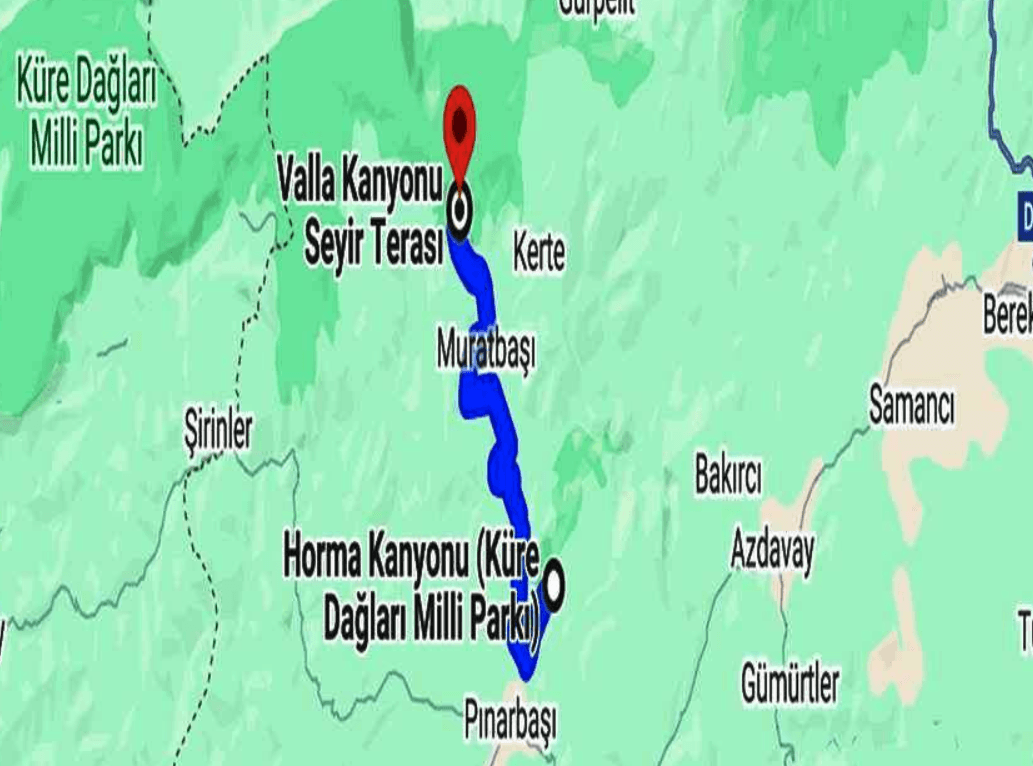
Valla Canyon is located within the boundaries of Muratbaşı Village, Pınarbaşı District, Black Sea Region in Türkiye. canyon stretches 12 kilometers from the confluence of the Devrekani Çayı and Kanlıçay rivers toward the district of Cide. The cliff walls of the canyon vary in height from 800 to 1200 meters in places. Access to the area is provided via a 1.5-kilometer-long footpath road that passes through forest.
Valla Canyon possesses a highly impressive geological structure. Noted for its depth and steep cliffs, the canyon serves as a habitat for predatory birds, particularly species of eagles, griffon vultures, goshawks, and peregrine falcons like. Additionally, the canyon hosts various wild av animals and offers rich ecosystem biodiversity. Along the canyon, numerous types of vegetation cover are found, the majority of which exhibit endemic characteristics.
Navigating Valla Canyon without equipment is extremely difficult and can only be undertaken by professional mountaineers with appropriate gear. Entry and exit to the canyon are facilitated via a forest trail connected to Valla Neighborhood in Muratbaşı Village. Visitors may undertake guided short hikes, but descending into the deeper sections of the canyon requires advanced technical skills and specialized equipment.
Valla Canyon offers two observation terraces for visitors seeking to admire its natural beauty: the Muratbaşı Burgu Observation Terrace and the Kerte Observation Terrace. These terraces provide ideal vantage points for viewing the canyon from its elevated ridges. The Work Cliff Swing, established in 2023, is located on the Kerte Observation Terrace and allows visitors to experience the canyon from a height of 600 meters opportunity.
Valla Canyon was discovered in 1994 by a group of students from Istanbul Technical University. After becoming lost inside, they emerged 14 days later in the district of Cide, an experience described as “Wild Heaven”. This event received media coverage and contributed to the canyon’s growing popularity among nature enthusiasts. Today, the canyon has attracted interest in terms of adventure tourism due to both its natural beauty and challenging terrain.
The canyon is also emerging as a key area enhancing the nature tourism potential of Pınarbaşı District. In recent years, particularly after pandemic, interest in the district has increased. Valla Canyon is recognized among the world’s most significant natural formations due to its depth and cliff structures, and visitors often describe it as “the second deepest canyon in the world”. The rising number of visitors is having positive effects on the local economy.
Anadolu Ajansı. "Valla Kanyonuna Giren, 12 Kilometre Yürümeden Çıkamıyor." Accessed February 12, 2025. https://www.aa.com.tr/tr/yasam/valla-kanyonuna-giren-12-kilometre-yurumeden-cikamiyor/2312751.
Culture Portal. "Valla Kanyonu." Accessed February 12, 2025. https://www.kulturportali.gov.tr/turkiye/kastamonu/gezilecekyer/valla-kanyonu.
Kastamonu Belediyesi. "Valla Kanyonu." Accessed February 12, 2025. https://www.kastamonu.bel.tr/valla-kanyonu/.
Kastamonu İl Kültür ve Turizm Müdürlüğü. "Doğa Turizmi." Accessed February 12, 2025. https://kastamonu.ktb.gov.tr/TR-339589/doga-turizmi.html.
Pınarbaşı Belediyesi. "Valla Kanyonu." Accessed February 12, 2025. http://www.pinarbasi.gov.tr/valla-kanyonu.

Valla Canyon
Location | Kastamonu | ||||||||
|---|---|---|---|---|---|---|---|---|---|
Access and Safety
History and Popularity
Nature Tourism and Local Impact