


This article was automatically translated from the original Turkish version.
+2 More
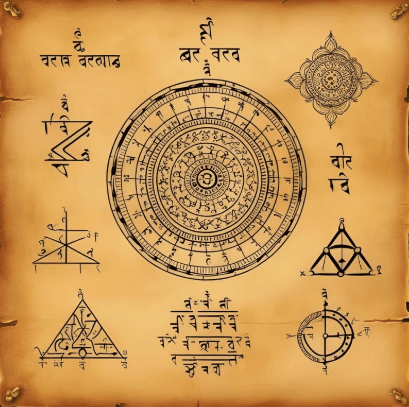
Vedic mathematics is an ancient mathematics system that exists in the world. It is stated that Vedic mathematics was first recorded in writing 500 years before Christ and is rooted in historical Indian mathematics. The root of the word “Vedic,” the term “Farewell,” means information in Sanskrit. It was restructured by Swami Bharati Krishna Tirthaji Maharaja (1884–1960) following an eight-year research effort Vedas on based on ancient Indian texts.
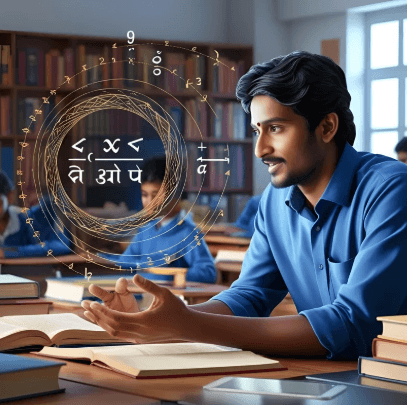
Visual related to Vedic mathematics (generated by artificial intelligence.)
Ethnomathematics can be defined as the study of the relationship between mathematics and culture and the identification of how mathematical thinking emerges in different cultures. This term was first used by Brazilian mathematician and educator Ubiratan D'Ambrosio. The earliest studies in this field examined mathematical activities carried out by communities labeled as “primitive” and illiterate. Later, areas such as number systems patterns logic probability and algebra such as were examined within the framework of ethnomathematics. (İmamoğlu 2021) D'Ambrosio more precisely defines ethnomathematics as “an internal pedagogical action with a historical and epistemology program that responds to a broader understanding of mathematics while considering cultural differences that shape human cultural evolution and the political dimensions of mathematics.”【1】 .

Visual related to Vedic mathematics (generated by artificial intelligence.)
Mathematics possesses its own universal language composed of definitions and symbols. When we examine the history of mathematics we find that the number systems operation symbols and rules used almost everywhere in the world took shape only a few centuries ago. However the foundations of many mathematical ideas emerged much earlier. Before this language was established how was mathematics used in daily life within traditional societies? When we begin to investigate this we observe that similar ideas could emerge in different forms across societies or that communities could develop distinct mathematical solutions to meet similar needs. The use of alternative and thought-provoking methods instead of conventional ones and the fact that these originate from within Indian history itself is certainly not coincidental. The large population of India and the need for students to stand out through a different perspective to develop has helped Vedic mathematics find its place among other cultures.【2】 .
Swami Bharati Krishna Tirthaji Maharaja derived 16 Sutras (aphorisms) and 13 Sub-Sutras (corollaries) from his research. He developed methods and techniques to expand the principles found in these aphorisms and their corollaries and named this system Vedic Mathematics. Regarding this Prof. RC Gupta (1994) states “The system has great educational value because the Sutras contain techniques for performing basic mathematical operations in simple ways and the results are obtained fast”.

Visual related to Vedic mathematics (generated by artificial intelligence.)
The Sutras apply to and encompass nearly every branch of mathematics and can even be applied to complex problems involving numerous mathematical operations. Applying the Sutras saves considerable time and labor. For instance in solving systems of equations finding square roots and performing divisions with irrational results they encourage students to think using unique algorithms. Computer calculations in a sense follow the underlying principles of the Sutras. The Sutras are not merely computational methods but also provide pathways for their application.【3】
The 16 Sutras are named as follows:
1. One more than the previous one
2. All from nine and the last from ten
3. Vertically and crosswise
4. Transpose and apply
5. When the sum is the same that sum is zero
6. If one is in ratio the other is zero
7. By addition and by subtraction
8. By the completion or non-completion
9. Differential calculus
10. Difference by the deficiency
11. Specific and general
12. The remainders by the last digit
13. The ultimate and twice the penultimate
14. By one less than the one before
15. The product of the sum of the coefficients in the factors
16. The whole product
In addition the 13 Sub-Sutras are as follows:
1. Proportionally
2. Remainder remains constant
3. First by the first and last by the last
4. For 7 the multiplier is 143
5. By osculation
6. Lessen by the deficiency
7. Whatever the deficiency lessen by that amount and set up the square of the deficiency
8. The last and twice the penultimate when the last digit is 10 and the previous part is entirely the same
9. Only the last terms
10. The sum of the coefficients in the product
11. By alternate elimination and retention
12. Observation by the completion
13. The product of the sum of the coefficients in the factors equals the sum of the coefficients in the product.

Table containing examples of Sutras (created using Microsoft Word.)

Table containing examples of Sutras (created using Microsoft Word.)
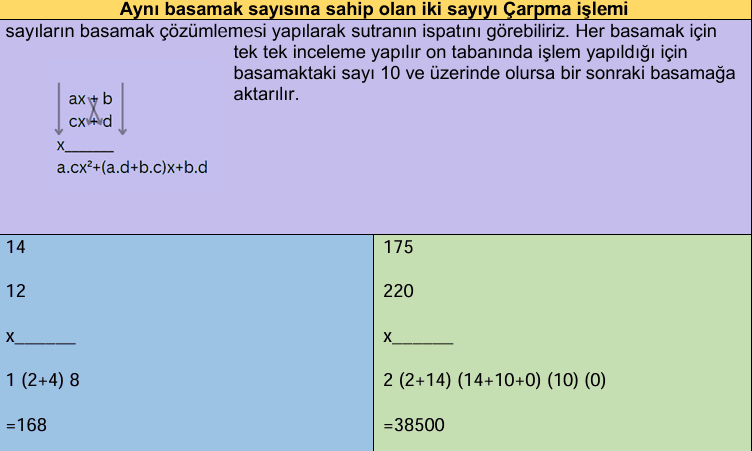
Table containing examples of Sutras (created using Microsoft Word.)
[1]
Jason Johnson, Linda Smail, Darryl Çekirdek, Adeeb Jarrah, "Ethnomathematics in Mathematics Education", Scholarly Community Encyclopedia. Last accessed: 6 April 2025, The provided content is a URL, not a Turkish text to translate. The URL https://encyclopedia.pub/entry/23576 points to an entry on the Encyclopedia.pub platform but contains no translatable content.If you have the Turkish text from that entry, please provide it, and I will translate it according to the encyclopedic translation guidelines. .
[2]
ÇEZİKTÜRK, Özlem. “THE EFFECT OF VEDIC MATHEMATICS SUCCESS ON PROBLEM-SOLVING ATTITUDES.” electronic journal of social sciences, 2019: 124.
[3]
Sri V.S. Sri Ram Ghanapati, "Why Vedic Mathematics?", Sri Sathya Sai Veda Pratisthan, Last Access: 6 April 2024, http://www.vedamu.org/PageViewerToC.aspx?ID=148370&DivisionId=1795

Relationship with Ethnomathematics
Content
Example Sutras