This article was automatically translated from the original Turkish version.
+1 More
Location | Istanbul Zeytinburnu | ||||||||
|---|---|---|---|---|---|---|---|---|---|
Establishment | 1912-1913 | ||||||||
Past Use | Recreational area in the 18th century | ||||||||
Land Area | 596 dunams | ||||||||
Runways | 1720m sand training track 1870m synthetic track 2020m grass track | ||||||||
Facilities | Administrative buildings, Racehorse Hospital, Apranti Education Center, Museum and exhibition hall, Picnic area and children's park | ||||||||
Operation | Turkish Jockey Club | ||||||||
Located at the boundary between Zeytinburnu and Bakırköy in Istanbul, the Veliefendi Hipodromu has been used since the Ottoman period as a vast grassland and became the primary venue for modern horse racing in the early 20th century. Today it functions as Türkiye’s oldest and largest hippodrome, having served as a significant focal point throughout its long history for both leisure culture and racing tradition.

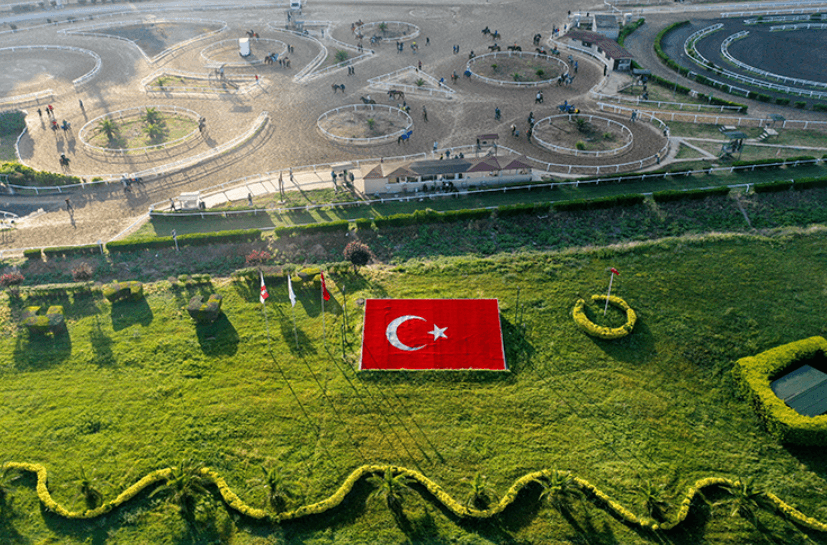
Veliefendi Hipodromu (Flickr)
The name Veliefendi derives from Şeyhülislam Veliyüddin Efendi. The site included the coastal portion of Çırpıcı Çayırı, a meadow granted by Sultan III. Mustafa to Veliyüddin Efendi as an apology after unsubstantiated accusations were made against him. Veliyüddin Efendi endowed this land as a public leisure area, assumed responsibility for its maintenance, and commissioned the construction of fountains and small structures.
In Ottoman Istanbul, leisure areas were characterized by meadows, streams, and open expanses where strolling, picnicking, carriage rides, games, and sporting activities took place. Veliefendi Çayırı served as an important leisure site with these characteristics. It is recorded that the mosque, farm, and fountains built by the Şeyhülislam contributed to the area’s established identity as a structured leisure destination.
The transformation of Veliefendi Çayırı into a racing venue dates to 1911. Under the leadership of Mahmud Şevket Paşa, the Islah-ı Nesl-i Feres (Improvement of the Horse Breed) Cemiyeti selected Veliefendi Çayırı as the site for modern-style horse racing in Istanbul. Wooden grandstands were constructed on the meadow, and the first regular races were held in August 1911.
Another source indicates that Enver Paşa requested the German delegation to identify a suitable area in Istanbul for hosting races. After evaluation, Veliefendi Çayırı was deemed appropriate, and two tracks with wooden grandstands were rapidly constructed.
The first modern structures of the hippodrome were built between 1912 and 1913 by German experts. This period marked the beginning of Veliefendi’s identity as a dedicated racing facility.
Following the Second Constitutional Era, racing activities revived, and Veliefendi Çayırı became a major racing venue. Despite the Balkan Wars, a six-race program was organized in 1913, attended by prominent figures of the time. It is recorded that Prince Yusuf İzzeddin Efendi and state officials participated in the races.

Servet-i Fünûn Dergisi: Spectators flocking to horse races (National Library)
Racing activities continued into the early years of the Republic and were formally institutionalized in 1924 with the reactivation of equestrian organizations, leading to a regular racing program at Veliefendi.

Servet-i Fünûn Dergisi: Enthusiastic spectators at Veliefendi horse races (National Library)
In 1950, the land was leased by the Ministry of Agriculture to the Turkish Jockey Club, thereby establishing a regular institutional framework for the operation of the hippodrome.

Servet-i Fünûn Dergisi: Horses and jockeys participating in the fourth race at the start of the race (National Library)
From the 1950s onward, the hippodrome expanded rapidly: first a sand track, then a turf track were constructed; a 500-seat grandstand was added in 1968 and another new grandstand in 1987. Additionally, paddock areas, jockey rooms, stables, parking lots, restaurants, and other service facilities were built.
In 2008, with the completion of the lighting system, night races were introduced.
Veliefendi Hipodromu is built on a total area of 596 dunams. The current track configurations are as follows:
These figures are also recorded in the official records of the TJK.
The structures and service units at the hippodrome include:

Veliefendi Hipodromu (AA)
Veliefendi Hipodromu hosts numerous important races, including Turkey’s most prestigious race, the Gazi Koşusu. As the longest continuously operating venue for horse racing in Turkey, it has become one of the foundational elements of the nation’s racing culture.
Veliefendi stands out among Turkish hippodromes in terms of location, capacity, and historical continuity. With its turf and synthetic tracks, training facilities, stable capacity, and social areas, it ranks among the most advanced racing facilities in the country.

99th Gazi Koşusu (AA)
Veliefendi Hipodromu has served as the physical space for a long transformation process from Ottoman leisure culture to modern Turkish racing. Evolving from a meadow endowed in the 18th century into a modern hippodrome in the 20th century, it today stands as Türkiye’s most comprehensive facility in terms of historical continuity and racing practice. Its structural developments, track features, race programs, and urban location have established Veliefendi Hipodromu as one of Istanbul’s key cultural and sporting venues.
Anadolu Ajansı. "99. Gazi Koşusu'nu jokeyliğini Ahmet Çelik'in yaptığı 'Cutha' kazandı." Anadolu Ajansı, June 29, 2025. Accessed November 21, 2025. https://www.aa.com.tr/tr/spor/99-gazi-kosusunu-jokeyligini-ahmet-celikin-yaptigi-cutha-kazandi/3616937
Anadolu Ajansı. "Veliefendi Hipodromu'nda operasyon." Anadolu Ajansı, August 7, 2017. Accessed November 21, 2025. https://www.aa.com.tr/tr/gunun-basliklari/veliefendi-hipodromunda-operasyon/877696
Anadolu Ajansı. "Veliefendi Hipodromu'nu 96. Gazi Koşusu heyecanı sardı." Anadolu Ajansı, June 21, 2022. Accessed November 21, 2025. https://www.aa.com.tr/tr/spor/veliefendi-hipodromunu-96-gazi-kosusu-heyecani-sardi/2618708
Baki, Gülizar. "Şeyhülislam Veliyüddin Efendi At Yarışı Sever miydi?" Accessed November 21, 2025. https://www.gulizarbaki.com/?p=428
Istanbul Tarihi. "The Sporting History and Locations of Istanbul." Accessed November 21, 2025. https://istanbultarihi.ist/504-the-sporting-history-and-locations-of-istanbul
LiderForm. "Veliefendi Hipodromu kaçıncı yüzyılda nasıl yapıldı." Accessed November 21, 2025. http://liderform.com.tr/haberler/2392-veliefendi-hipodromu-kacinci-yuzyilda-nasil-yapildi.html
List.Istanbul. "Veliefendi Racecourse." February 12, 2019. Accessed November 21, 2025. https://list.istanbul/en/tourism-in-turkey/guide-to-tourist-places/gardens-and-parks/veliefendi-racecourse
National Library Digital Library. "Servet-i Fünun 63. Cilt Sayı 1653 (1956 SB 501)." Accessed November 21, 2025. https://dijital-kutuphane.mkutup.gov.tr/tr/Periodicals/Catalog/Issue/?IssueId=7909
Türkiye Jokey Kulübü. "Hipodromlar: İstanbul Veliefendi Hipodromu." Accessed November 21, 2025. https://www.tjk.org/TR/Kurumsal/Static/Page/Hipodromlar
Uğuryol, Drahşan. "Kentin Köklü Tanıklarına Hayat Vermek: Geçmişten Günümüze Veliefendi Çeşmesi." Mimarlık, no. 419 (Mayıs-Haziran 2021). Accessed November 21, 2025. http://www.mimarlikdergisi.com/index.cfm?sayfa=mimarlik&DergiSayi=434&RecID=5309

Location | Istanbul Zeytinburnu | ||||||||
|---|---|---|---|---|---|---|---|---|---|
Establishment | 1912-1913 | ||||||||
Past Use | Recreational area in the 18th century | ||||||||
Land Area | 596 dunams | ||||||||
Runways | 1720m sand training track 1870m synthetic track 2020m grass track | ||||||||
Facilities | Administrative buildings, Racehorse Hospital, Apranti Education Center, Museum and exhibition hall, Picnic area and children's park | ||||||||
Operation | Turkish Jockey Club | ||||||||
No Discussion Added Yet
Start discussion for "Veliefendi Hippodrome" article
Historical Background and Initial Uses of the Site
Veliyüddin Efendi’s Endowment and Leisure Ground
The Beginning of Modern Horse Racing (1911–1913)
Islah-ı Nesl-i Feres Cemiyeti and the First Races
Construction Period 1912–1913
Development Between 1920 and 1950
Structural Developments After 1950
Grandstands, Tracks, and Facility Expansions
Current Structure of Veliefendi Hipodromu
Land and Track Features
Hipodrome Facilities
Veliefendi’s Position in Racing History
Gazi Koşusu and Other Major Races