Doğum tarihi | 1928-07-23 | ||||||||
|---|---|---|---|---|---|---|---|---|---|
Eş | Robert Joshua Rubin (b. 1948–2008) | ||||||||
Ölüm tarihi | 2016-12-25 | ||||||||
Award(s) | Bruce Medal National Medal of Science Gold Medal of the Royal Astronomical Society Dickson Prize in Science | ||||||||
Çocuk | Allan Rubin Judith Young David Rubin Karl Rubin | ||||||||
Vera Cooper Rubin was born on 23 July 1928 in Philadelphia, Pennsylvania, United States of America. Her interest in science emerged at an early age, particularly in the fields of astronomy and natural sciences. During her high school years, she demonstrated strong performance in physics and mathematics, laying the foundation for her academic career. She completed her undergraduate education in 1948 at Cornell University, where she studied physics and acquired foundational knowledge in astronomy. Rubin continued her postgraduate studies at Georgetown University, earning a master’s degree in astronomy.

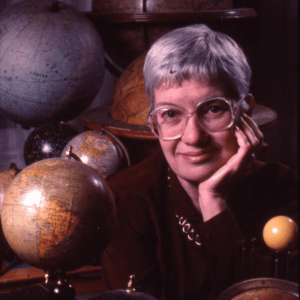
Vera Rubin. (NoirLab)
Vera Rubin completed her doctoral studies at Georgetown University in 1954. In her dissertation, she investigated the structure and motion of galaxies. After graduation, she continued her research at Harvard University and Princeton University, conducting empirical studies on galactic dynamics and observable motions. A notable aspect of Rubin’s academic career was the limitations she encountered as a woman in astronomy, yet she persisted in her research despite these barriers.
One of Vera Rubin’s most significant contributions was her observational work on galaxy rotation curves. In the 1970s, while conducting observations with Kent Ford, she discovered that the outer regions of galaxies rotated at speeds faster than predicted by Newton’s laws. This finding pointed to the existence of unseen mass—dark matter—as a major component of the universe. Rubin’s research became a fundamental reference point in galactic dynamics and cosmology.
Rubin’s work played a critical role in the acceptance of the dark matter theory within the astronomical community. Her method of calculating and comparing galactic rotation speeds provided a new approach to understanding cosmic mass distribution. Rubin also conducted various studies on the classification of galaxy shapes and structures, the analysis of motions within galaxy clusters, and galaxy evolution.
Vera Rubin served as a researcher for many years at Georgetown University and later at the Department of Terrestrial Magnetism of the Carnegie Institution. Throughout her academic career, she served as a peer reviewer for numerous scientific journals and presented at international astronomical congresses. Her work has been frequently cited in scientific publications and is regarded as a foundational reference in astronomical literature.
Vera Rubin received numerous awards and academic honors in recognition of her scientific contributions. However, her work was never directly recognized with a Nobel Prize during her lifetime. Nevertheless, she was regarded as a pivotal figure who enhanced the visibility of women in astronomy and supported the careers of female scientists.
Vera Rubin maintained her scientific curiosity throughout her personal life and continued her research. She passed away on 25 December 2016 at the age of 88. Following her death, her research continued to be regarded as a fundamental reference for proving the existence of dark matter in galaxies and for advancing cosmological studies. Rubin’s scientific legacy is recognized as one of the cornerstone contributions to observational astronomy and our understanding of the structure of the universe.
American Museum of Natural History. "Vera Rubin on Dark Matter: A Factor of Ten." Accessed August 16, 2025. https://www.amnh.org/learn-teach/curriculum-collections/cosmic-horizons-book/vera-rubin-dark-matter.
Astronomy Magazine. "Vera Rubin: Found a Lifetime of Wonder in the Dark Skies." Accessed August 16, 2025. https://www.astronomy.com/science/vera-rubin-found-a-lifetime-of-wonder-in-the-dark-skies/.
Carnegie Science. "Vera Rubin: Opening Doors to Dark Matter and Women in STEM." Accessed August 16, 2025. https://carnegiescience.edu/news/vera-rubin-opening-doors-dark-matter-and-women-stem.
NOIRLab. "Vera Rubin: A Lifetime of Discovery." Accessed August 16, 2025. https://noirlab.edu/public/news/noirlab2003/.
National Women's History Museum. "Vera Rubin." Accessed August 16, 2025. https://www.womenshistory.org/education-resources/biographies/vera-rubin.
Rubin Observatory. "Vera Rubin." Accessed August 16, 2025. https://rubinobservatory.org/about/vera-rubin.

Doğum tarihi | 1928-07-23 | ||||||||
|---|---|---|---|---|---|---|---|---|---|
Eş | Robert Joshua Rubin (b. 1948–2008) | ||||||||
Ölüm tarihi | 2016-12-25 | ||||||||
Award(s) | Bruce Medal National Medal of Science Gold Medal of the Royal Astronomical Society Dickson Prize in Science | ||||||||
Çocuk | Allan Rubin Judith Young David Rubin Karl Rubin | ||||||||
Doctoral Studies and the Beginning of an Academic Career
Research Areas and Contributions
Academic Positions and Professional Contributions
Awards and Recognition
Personal Life and Legacy