
This article was automatically translated from the original Turkish version.
Official Name(s) | Vevčani Carnival | ||||||||
|---|---|---|---|---|---|---|---|---|---|
Location | Vevčani Municipality North Macedonia | ||||||||
Date Range | January 11–14 (Main events: January 13–14) | ||||||||
Origin(s) | Pagan rituals and pre-Christian traditions | ||||||||
Key Characteristics | Groom and Bride, Ahmak August (Stupid August), Musicians | ||||||||
Key Rituals | House visits, Charity collection, Vasilitsa dance, Burning of masks | ||||||||
Theme(s) | Socio-political satire Freedom to turn the world upside down Social criticism | ||||||||
International Membership | Federation of European Carnival Cities (FECC) | ||||||||
Cultural Status | North Macedonia's oldest and most original cultural heritage | ||||||||
Vevčani Carnival is a traditional carnival that combines pagan rituals with modern celebratory elements, held in the Vevčani Municipality in southwestern North Macedonia to commemorate the arrival of the New Year (Vasilitsa) according to the old Julian calendar.
The known history of the Vevčani Carnival is believed to extend approximately 1400 years into the past. Recent field research suggests that the carnival tradition may be even older, with its origins dating back around 800 years【1】. The carnival is rooted in pagan beliefs and rituals in which people used masks to cleanse themselves of evil and dark thoughts.
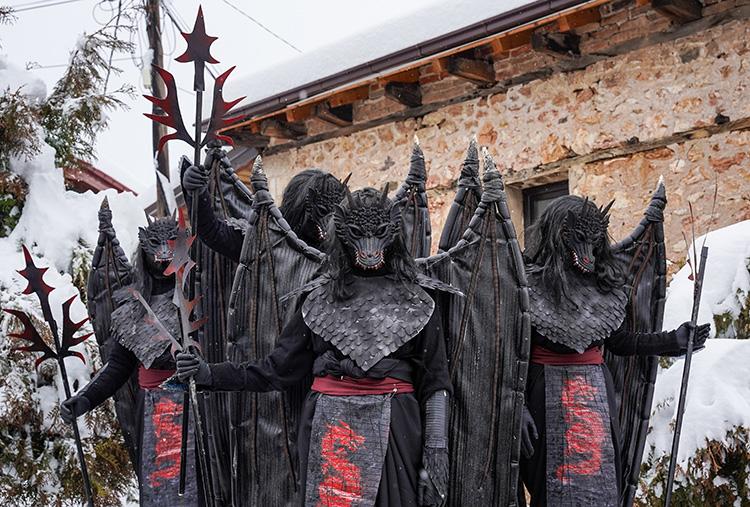
Colorful Vevčani Carnival in Macedonia (Anadolu Agency)
The celebrations begin with cultural events prior to the official parade.
January 11: The festival opens with a traditional concert organized by the Vevčani Cultural and Art Association "Drimkol". This phase serves as a preparatory showcase of local artistic achievements.
January 12: Entertainment concerts featuring local and Balkan artists are held to broaden public engagement and heighten the carnival’s festive atmosphere.
The ritual dimension of the carnival begins on the afternoon of January 13. Participants, wearing their handmade masks, take to the streets of Vevčani. During this time, participants are granted the right to “turn the world upside down.” The central mask groups, “The Bride and Groom,” accompanied by musicians, visit households throughout the village, collecting donations. Through their costumes and performances, participants satirically critique local and global events of the past year—such as political decisions or social crises.
The final day of the carnival is dedicated to activities rich in symbolic meaning. On January 14, the local population and masked groups gather in the center of Vevčani and perform a large communal dance—the Vasiličar Dance—accompanied by traditional music.
Subsequently, all masks and costumes are burned in the village square. This ritual symbolizes the destruction by fire of all evils, dark thoughts, and negative forces of the past year, marking a clean start to the new year.
At the heart of the carnival are three main traditional mask groups: “The Bride and Groom,” “Idiot August,” and “The Musicians.” The group wearing “The Bride and Groom” masks is responsible for visiting households and collecting donations. The character of “Idiot August” is typically portrayed by young people and communicates with spectators through gestures, movements, and shouts【2】. Other participants form various mask groups that offer social critique and irony by satirizing social and political events. During the masked parade, participants are granted complete freedom, described as the right to “turn the world upside down”【3】.

Image from the Vevčani Carnival Celebrations (Anadolu Agency)
The Vevčani Carnival has gained international recognition since the Vevčani Municipality became a member of the World Carnival Cities Association. In the early 1980s, French ethnologist and photojournalist Jean-Marie Stenlen visited Vevčani, significantly contributing to the carnival’s international visibility【4】. In 1984, Stenlen presented a report on the Vevčani Carnival at the Centre Pompidou in Paris and other cultural centers across Europe, documenting its masks and rituals. Additionally, photographs of original Vevčani carnival masks were published in a 1986 encyclopedia of European carnivals released in Paris【5】.
Today, the Vevčani Carnival is regarded as one of the oldest carnivals in North Macedonia. Held annually on January 13–14, the event spans two days and features masked processions, concerts, and rituals. The carnival continues to serve as a core element of Vevčani’s cultural identity, preserving its traditional structure while incorporating contemporary themes.
Anadolu Ajansı. "Kuzey Makedonya'da Vevçani Karnavalı başladı." Accessed January 13, 2026. https://www.aa.com.tr/tr/yasam/kuzey-makedonyada-vevcani-karnavali-basladi/3449210
Anadolu Ajansı. "Makedonya'da 'renkli' Vevçani Karnavalı." Accessed January 13, 2026. https://www.aa.com.tr/tr/dunya/makedonyada-renkli-vevcani-karnavali/727013
Anadolu Ajansı. "Makedonya'da Vevçani Karnavalı başladı." Accessed January 13, 2026. https://www.aa.com.tr/tr/pg/foto-galeri/makedonyada-vevcani-karnavali-basladi-/4/188496
European Heritage Days. "Vevchani Carnival. Tradition Old 1,400 Year." European Heritage Days.com. Accessed January 13, 2026. https://www.europeanheritagedays.com/European-Heritage-Makers-Week/e5553/Vevchani-Carnival-Tradition-old-1400-year
North Macedonia Timeless. "Vevçani Karnavalı." Macedonia-Timeless.com. Accessed January 13, 2026. https://macedonia-timeless.com/tur/yaplacakeyler/duyulararaclylamakedonyayahissetmek/sespgelenekveorganizasyonlarp/kltreletkinlikler/vevanikarnaval
Vevčani Izvori. "Вевчански Карневал [Vevčani Carnival]." Vevcani.mk. Accessed January 13, 2026. https://vevcani.mk/%D0%BD%D0%B0%D1%81%D1%82%D0%B0%D0%BD%D0%B8/vevcanski-karneval/
YouTube. "Makedonya'da renkli Vevçani Karnavalı." Anadolu Ajansı. Date Published: January 14, 2017. Accessed January 13, 2026. https://www.youtube.com/watch?v=R3dV6g94bp4
[1]
Вевчански Извори (Vevčani Izvori), "Вевчански Карневал [Vevčani Carnival]," Vevcani.mk, https://vevcani.mk/%D0%BD%D0%B0%D1%81%D1%82%D0%B0%D0%BD%D0%B8/vevcanski-karneval/
[2]
Вевчански Извори (Vevčani Izvori), "Вевчански Карневал [Vevčani Carnival]," Vevcani.mk, https://vevcani.mk/%D0%BD%D0%B0%D1%81%D1%82%D0%B0%D0%BD%D0%B8/vevcanski-karneval/
[3]
North Macedonia Timeless, "Vevçani Karnavalı," Macedonia-Timeless.com, https://macedonia-timeless.com/tur/yaplacakeyler/duyulararaclylamakedonyayahissetmek/sespgelenekveorganizasyonlarp/kltreletkinlikler/vevanikarnaval
[4]
Вевчански Извори (Vevčani Izvori), "Вевчански Карневал [Vevčani Carnival]," Vevcani.mk, https://vevcani.mk/%D0%BD%D0%B0%D1%81%D1%82%D0%B0%D0%BD%D0%B8/vevcanski-karneval/
[5]
Вевчански Извори (Vevčani Izvori), "Вевчански Карневал [Vevčani Carnival]," Vevcani.mk, https://vevcani.mk/%D0%BD%D0%B0%D1%81%D1%82%D0%B0%D0%BD%D0%B8/vevcanski-karneval/

Official Name(s) | Vevčani Carnival | ||||||||
|---|---|---|---|---|---|---|---|---|---|
Location | Vevčani Municipality North Macedonia | ||||||||
Date Range | January 11–14 (Main events: January 13–14) | ||||||||
Origin(s) | Pagan rituals and pre-Christian traditions | ||||||||
Key Characteristics | Groom and Bride, Ahmak August (Stupid August), Musicians | ||||||||
Key Rituals | House visits, Charity collection, Vasilitsa dance, Burning of masks | ||||||||
Theme(s) | Socio-political satire Freedom to turn the world upside down Social criticism | ||||||||
International Membership | Federation of European Carnival Cities (FECC) | ||||||||
Cultural Status | North Macedonia's oldest and most original cultural heritage | ||||||||
Historical Background
Rituals and Practices
Preparation and Initiation Phase (January 11–12)
Official Opening and Masked Parade (January 13)
Closure and Purification Rituals (January 14)
Masks and Representations
International Recognition
The Vevčani Carnival Today