


This article was automatically translated from the original Turkish version.
+1 More
Village rooms are traditional spaces in rural settlements of Anatolia, organized for communal use by the villagers or neighborhood residents. They serve functions such as hosting travelers, enabling villagers to gather for conversation, and facilitating various social and cultural gatherings. In addition to their role in accommodation and hospitality, village rooms function as public meeting places where information and communication are exchanged, social solidarity is organized, and local culture is sustained.
Village rooms are understood in conjunction with rural practices of hospitality and collective gathering. Men traditionally gather in village rooms. These spaces are not merely places of lodging but also serve as informal educational environments where daily life knowledge and social norms are transmitted. During periods when communication tools were limited, village rooms also played a role in intra-village communication and the formation of shared agendas.
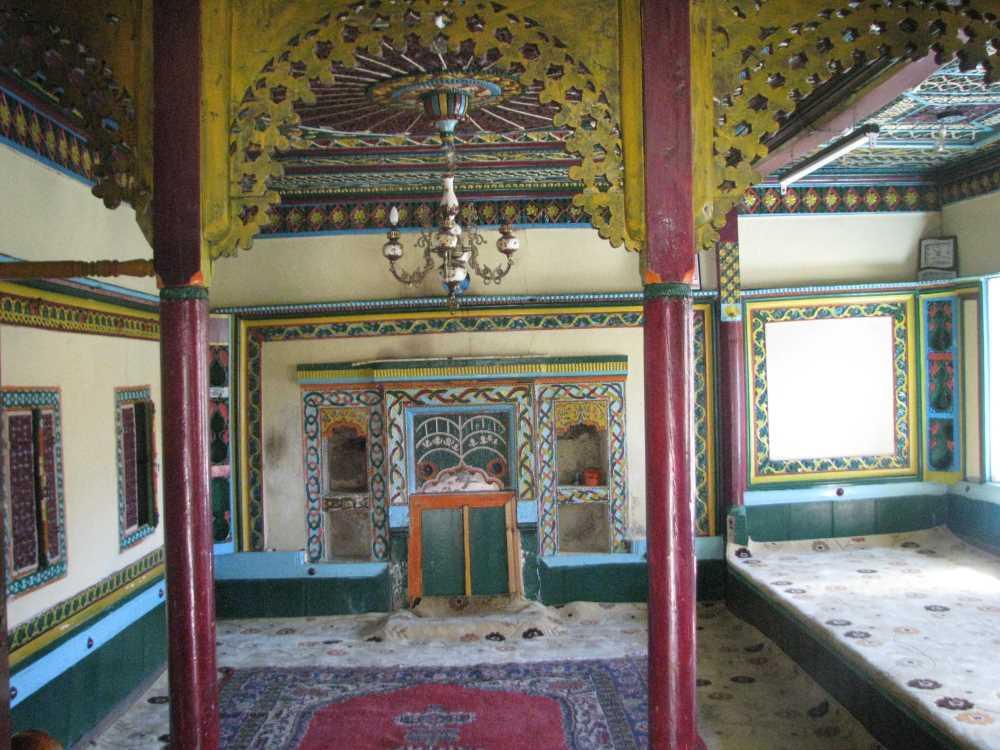
Wood-carved Village Room of Sarıçiçek Village, Gümüşhane (Culture Portal)
Studies based on regional examples reveal the prevalence of auxiliary units arranged around the main room space. The village room in Selçik town is structured as a two-story building. The ground floor contains a stable, while the upper floor features two rooms opening onto an external sofa area. The main room space is defined by a nearly square plan and is evaluated together with its interior elements. In Başköy village rooms, on the other hand, a single-story layout and wooden ceilings are characteristic.
Stone materials and rubble construction techniques are prominent in village rooms. Wooden ceilings and wooden elements are also integral components of the construction system.
Research on village rooms indicates that decoration is not uniformly applied across all examples. Some instances feature wood ornamentation executed through carving and engraving techniques; others prominently display painted woodwork and plaster decorations.
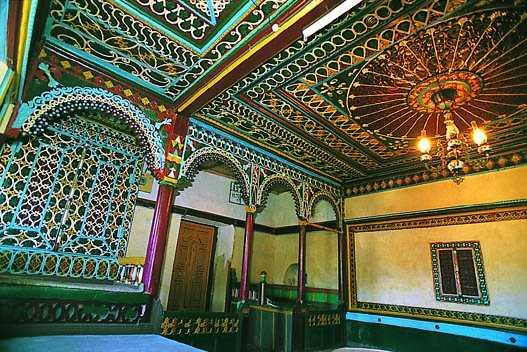
Village Room of Sarıçiçek Village, Gümüşhane (Culture Portal)
Village rooms are directly associated with the accommodation and hospitality of travelers. They meet the needs of guests and provide a space for villagers to gather for diverse social and cultural purposes. Folkloric practices such as seating arrangements, hospitality rituals, and topics of conversation are actively maintained here. In this sense, they are social spaces where everyday life practices unfold. They are also significant for the transmission of knowledge and cultural continuity.
It is understood that while some village rooms continue to be used today, others have lost their original functions, fallen out of use, and now face the risk of disappearance.

Cedar Seating and Social Life in the Village Room of Sarıçiçek, Gümüşhane (Anadolu Agency)
Abdurrezzak, Ali Osman. “Yaygın Eğitim Bağlamında Sosyo-Kültürel İşlevleri Açısından Köy Odaları: Kastamonu Örneği.” *Avrasya Uluslararası Araştırmalar Dergisi* 3, no. 7 (2015): 33-47. Accessed January 13, 2026. https://dergipark.org.tr/tr/pub/avrasyad/article/509164
Aksakal, Erdi. “Türk Kültüründe Eril Mekân Örneği; Köy Odaları.” *folklor/edebiyat* 25, no. 98 (2019): 291–308. Accessed January 13, 2026. https://dergipark.org.tr/tr/pub/fe/article/560192.
Anadolu Ajansı. "Ahşap işlemeli 150 yıllık köy odalarında buluşma geleneği sürdürülüyor." Accessed January 13, 2026. https://www.aa.com.tr/tr/kultur/ahsap-islemeli-150-yillik-koy-odalarinda-bulusma-gelenegi-surduruluyor/3089649
Bulut, Mustafa. “Sivas İlbeyli Köy Odaları.” *Müzik ve Tanrıbilim Araştırmaları Dergisi* 4, no. 1 (2017): 13–31. Accessed January 13, 2026. https://dergipark.org.tr/tr/pub/mtad/article/335192.
Gündoğan Baldık, Esra. “Sivas - Ulaş - Acıyurt Köy Odaları.” *Journal of Palmette*, no. 5 (2024): 54–72. Accessed January 13, 2026. https://dergipark.org.tr/tr/pub/palmet/article/1442907.
Gürsoy, Elif. “Süslemeli Bir Köy Odası: Selçikler Kasabası Hacıların Odası.” *Millî Folklor* 17, no. 134 (2022): 172–181. Accessed January 13, 2026. https://dergipark.org.tr/tr/pub/millifolklor/issue/71379/648312.
Naldan, Funda. “Erzincan-Çayırlı İlçesi Başköy Köy Odaları.” *Millî Folklor* 16, no. 126 (2020): 249-263. Accessed January 13, 2026. https://dergipark.org.tr/tr/pub/millifolklor/issue/55811/767265.
Türkiye Kültür Portalı. "Sarıçiçek Köy Odaları - Gümüşhane." Accessed January 13, 2026. https://www.kulturportali.gov.tr/turkiye/gumushane/gezilecekyer/saricicek-evleri
Özkan, Adem. “Geçmişten Günümüze Konya İli Akören İlçesinde Bulunan Köy Odaları.” *Karamanoğlu Mehmetbey Üniversitesi Sosyal ve Ekonomik Araştırmalar Dergisi* 14, no. 22 (2012): 1–4. Accessed January 13, 2026. https://dergipark.org.tr/tr/pub/kmusekad/issue/10214/125523.

Historical and Cultural Context
Architectural Features
Planning and Spatial Organization
Construction Techniques and Materials
Decoration and Ornamentation
Functional Use
Village Rooms Today and Conservation Approaches