


This article was automatically translated from the original Turkish version.
+1 More
Visual consistency refers to the maintenance of perceptual or semantic unity among elements presented in a visual representation, image, or multimedia content. This concept is associated with the tendencies of the human visual system to process scenes based on principles of similarity, continuity, and wholeness. Visual consistency facilitates interpretation by reducing cognitive load and can influence accuracy in tasks such as comparison and error detection.
Visual consistency is the harmonious alignment of shapes, colors, typefaces, alignment, and other visual elements used within a visual composition, design, or page layout. This principle ensures that the viewer or user perceives the overall structure as a coherent and interconnected whole. For example, if the corners of cards on six pages of a website are consistently rounded, but square corners are used on only one page, this disrupts visual consistency. Consistency is maintained by using elements in a uniform style, similar sizes, and consistent positions. This enables the viewer to more easily associate and interpret different sections of the page or design. Achieving visual consistency creates aesthetic unity and accelerates the process of reading and understanding information; conversely, breaking consistency may lead to distraction and impaired perception.

Visual Consistency Comparison (Generated by Artificial Intelligence)
Visual consistency comparison: In the left image, all templates are enclosed with circular shapes, ensuring consistency. In the right image, templates are enclosed with both square and circular shapes, resulting in a disruption of visual consistency.
Visual Consistency Comparison (Generated by Artificial Intelligence)
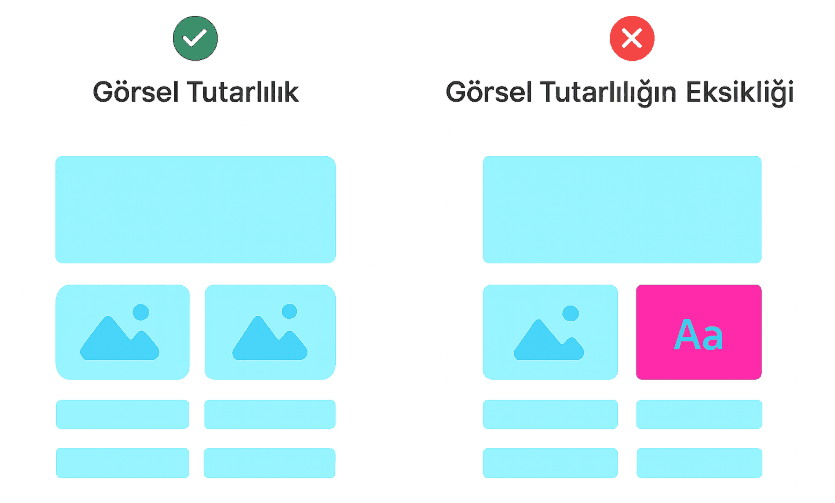
Visual consistency comparison: In the left image, all templates use the same color tone, ensuring consistency. In the right image, the use of multiple different colors disrupts visual consistency.

Visual Consistency Comparison (Generated by Artificial Intelligence)
Visual consistency comparison: In the left image, element placement maintains consistency. In the right image, the use of different templates and irregular positioning disrupts visual consistency.
Ontology engineering is the field concerned with creating and managing information models that define concepts and their relationships. In this domain, visual consistency is achieved by clearly, accurately, and coherently representing concepts in diagrams.
When visual tools such as concept diagrams or node-link graphs are used, consistency checks help identify conflicting definitions, incorrect connections, or missing relationships within the dataset.
Example: In a concept diagram, defining the classes “Vehicle” and “Watercraft” as both entirely separate and mutually inclusive categories is contradictory. Visual consistency checking reveals this error.
Video analysis is the process of extracting meaningful information from moving images. In this context, saliency detection, which combines visual and auditory data, helps identify objects or regions that are most likely to capture the viewer’s attention.
Here, visual consistency refers to the semantic alignment between visual elements in the image and the corresponding audio signal.
Example: When the visual image of a person speaking is synchronized with their voice, the analysis algorithm correctly focuses on that individual. If the audio originates from a different person, consistency is broken and the analysis becomes inaccurate.
Image enhancement encompasses processes applied to photographs or video frames to make them appear sharper, more balanced, and more natural. In this process, visual consistency involves adjusting contrast, brightness, and color balance to appear natural to the human eye.
Example: Maintaining similar lighting and color tones across all regions of a photograph ensures consistency. Excessive brightness in some areas and excessive darkness in others disrupts visual consistency.
Chen, Xiaojiao, Xiaoteng Tang, Ying Zhao, Tengyu Huang, Ran Qian, Jiayi Zhang, Wei Chen, and Xiaosong Wang. “Evaluating Visual Consistency of Icon Usage in Across-Devices.” *International Journal of Human–Computer Interaction* 40, no. 9 (2023): 2415–2431. Accessed August 14, 2025. https://www.tandfonline.com/doi/full/10.1080/10447318.2022.2162275.
Gao, Wen, Mengke Song, Wenfeng Song, Li Guo, and Muwei Jian. 2023. “A Comprehensive Survey on Video Saliency Detection With Auditory Information: The Audio-Visual Consistency Perceptual Is the Key.” *IEEE Transactions on Circuits and Systems for Video Technology* 33, no. 2: 457–472. Accessed August 14, 2025. https://ieeexplore.ieee.org/document/9874810.
Sato, Y., G. Stapleton, M. Jamnik, Z. Shams, and A. Blake. “Human Visual Consistency-Checking in the Real World Ontologies.” *IEEE Transactions on Visual Languages and Human-Centric Computing*, 2023: 249–251. Accessed August 14, 2025. https://ieeexplore.ieee.org/document/10305660.

Visual Consistency
Key Elements
Purpose
Application Areas
Ontology Engineering
Video Analysis
Image Enhancement