


This article was automatically translated from the original Turkish version.
+2 More
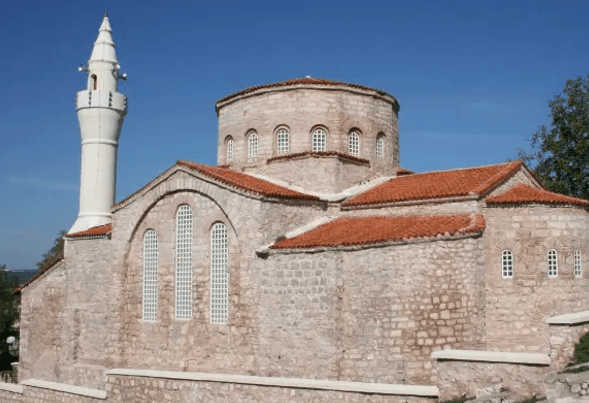
Vize Small Hagia Sophia Mosque (Gazi Süleyman Paşa Camii)
Original Function | Church | ||||||||
|---|---|---|---|---|---|---|---|---|---|
Current Function | Mosque | ||||||||
Location | Vize Kırklareli Kale Neighborhood | ||||||||
Construction Date(s) | 6th century (church) 15th century (conversion to mosque) | ||||||||
Plan Type | Basilica + Greek cross plan | ||||||||
Prominent Features | Corinthian-capital columns, three apses, sixteen-sided dome drum, narthex entrance | ||||||||
Restorations | 1979–1984, 1995, 1997, 2007 | ||||||||
Building Material(s) | Brick Marble Stone | ||||||||
Architectural Style | Byzantine, Early Ottoman | ||||||||
Located between the inner and outer walls in the Kale Neighborhood of Vize District, Kırklareli Province, the Vize Küçük Ayasofya Camii is an original structure that bears witness to both Byzantine and Ottoman architectural traditions. It is also known as the Gazi Süleyman Paşa Camii. Originally constructed in the 6th century as a church during the reign of Byzantine Emperor Justinian I, the building was converted into a mosque in the second half of the 15th century and adopted the name Gazi Süleyman Paşa Camii. Today, the structure remains open for worship and stands as a multi-layered cultural heritage site that sheds light on the religious and architectural history of the region.

Gazi Süleyman Paşa Cami (Kültür Envanteri)
The building has a nearly square rectangular plan with three apses. The central dome rests on a sixteen-sided drum. The interior space is divided into three sections by four large piers with diameters of 1.30 to 1.40 meters that support the dome and the columns positioned between them. The capitals of the columns are carved in the Corinthian order, enhancing the aesthetic value of the structure. Although the mosaic decorations have been lost over time, existing documents and architectural remnants suggest similarities with the mosaics found in the Hagia Sophia and Hagia Irene churches in Istanbul.
On the western facade, there was once a narthex featuring three marble portals in the Byzantine style. The exterior walls, constructed using a combination of stone and brick, reflect the composite architectural techniques characteristic of late Byzantine periods. The dome’s roofing system consists of cross and barrel vaults. In addition to the minbar, which no longer exists, the mihrab is a later addition made of concrete.

Interior (Kültür Envanteri)

Interior (Kültür Envanteri)
Although no definitive inscription or document establishes the exact construction date, architectural analysis dates the structure to the 6th century. Following the Middle Byzantine period, it is believed that the church assumed its current architectural form during the 13th and 14th centuries. The building’s ground plan conforms to the basilica type, while its dome system and cruciform layout reflect characteristics of the Greek cross plan. This dual planning represents an original approach seen in the later phases of Byzantine church architecture.
From the exterior, the building presents a cross-shaped appearance, with a cemetery located on its western facade. Given that Vize was one of the last major centers of the Byzantine Empire in Thrace, it is likely that this structure played an important religious and administrative role. Some regional sources suggest the building may have functioned as a psychoposlon, or soul-guiding center, but this claim has not yet been confirmed.

Gazi Süleyman Paşa Cami (Kültür Envanteri)

Gazi Süleyman Paşa Cami (Kültür Envanteri)
Following the definitive incorporation of the region into Ottoman rule after 1453, the Küçük Ayasofya Church was converted into a mosque. However, historical sources provide no clear information regarding which Süleyman Paşa was responsible for the conversion or to whom the name was dedicated. The common Ottoman practice of converting conquered churches into mosques is evident in this structure. This transformation served both to establish the region’s new religious identity and to meet the worship needs of the local Muslim population.
Over time, the building became partially buried beneath ground level, leading to moisture-related damage. During World War I, interventions by Russian and Bulgarian forces in the region resulted in the mosque being temporarily reverted to a church, causing significant damage to its architectural elements. Many artistic artifacts were lost during this period.
The first systematic conservation effort was carried out by the General Directorate of Foundations between 1979 and 1984. The mosque underwent further restoration in 1995 and, in 1997, received partial cleaning and maintenance in collaboration with the Department of Archaeology and Art History at Trakya University and the Kırklareli Museum. Finally, in 2007, the General Directorate of Foundations undertook a comprehensive restoration, returning the structure to its original form and achieving its current appearance.
The Vize Küçük Ayasofya Camii (Gazi Süleyman Paşa) is one of the most important cultural heritage structures in the region, distinguished by its hybrid architecture reflecting both Byzantine and Ottoman periods, its dual plan arrangement, and its unique use of materials. Evaluated in relation to the Hagia Sophia and Hagia Irene churches in Istanbul, this building is not only a local landmark but also a regional example that reflects the broader characteristics of Byzantine church architecture. Its continued use for worship today further distinguishes it as a living cultural entity.
Altunsoy, Nazlı. “Küçük Ayasofya Kilisesi (Gazi Süleyman Paşa Camii).” *Türkiye Turizm Ansiklopedisi.* Accessed May 22, 2025.https://www.academia.edu/109207993/K%C3%BC%C3%A7%C3%BCk_Ayasofya_Kilisesi_Gazi_S%C3%BCleyman_Pa%C5%9Fa_Camii
Culture Inventory. "Gazi Süleyman Paşa Camii (Vize)." Accessed May 22, 2025.https://kulturenvanteri.com/yer/gazi-suleyman-pasa-camii-vize/#17.1/41.576294/27.767403.
T.C. Ministry of Culture and Tourism. "Vize Küçük Ayasofya (Gazi Süleyman Paşa Camii)." *Kültür Portalı*. Accessed May 22, 2025.https://www.kulturportali.gov.tr/turkiye/kirklareli/gezilecekyer/vize-kucuk-ayasofya-gazi-suleyman-pasa-camii.

Vize Small Hagia Sophia Mosque (Gazi Süleyman Paşa Camii)
Original Function | Church | ||||||||
|---|---|---|---|---|---|---|---|---|---|
Current Function | Mosque | ||||||||
Location | Vize Kırklareli Kale Neighborhood | ||||||||
Construction Date(s) | 6th century (church) 15th century (conversion to mosque) | ||||||||
Plan Type | Basilica + Greek cross plan | ||||||||
Prominent Features | Corinthian-capital columns, three apses, sixteen-sided dome drum, narthex entrance | ||||||||
Restorations | 1979–1984, 1995, 1997, 2007 | ||||||||
Building Material(s) | Brick Marble Stone | ||||||||
Architectural Style | Byzantine, Early Ottoman | ||||||||
No Discussion Added Yet
Start discussion for "Vize Small Hagia Sophia Mosque (Gazi Süleyman Paşa Camii)" article
Architectural Features
Historical Development
Ottoman Period and Conversion into a Mosque
Recent Restoration and Conservation Efforts
Architectural Value and Significance